


Baculovirus merozoite surface protein 1 C-terminal recombinant antigens are highly protective in a natural primate model for human Plasmodium vivax malaria
- PMID: 9529073
- PMCID: PMC108080
- DOI: 10.1128/IAI.66.4.1500-1506.1998
Baculovirus merozoite surface protein 1 C-terminal recombinant antigens are highly protective in a natural primate model for human Plasmodium vivax malaria
Abstract
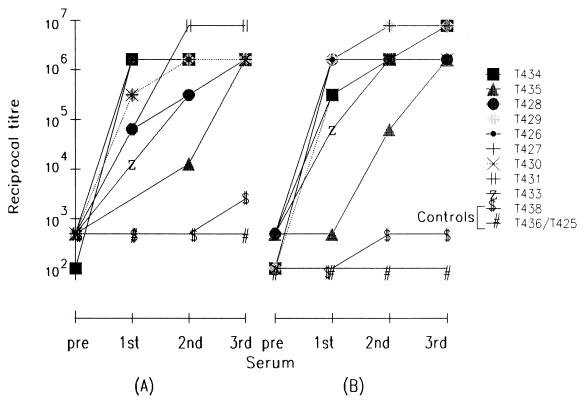
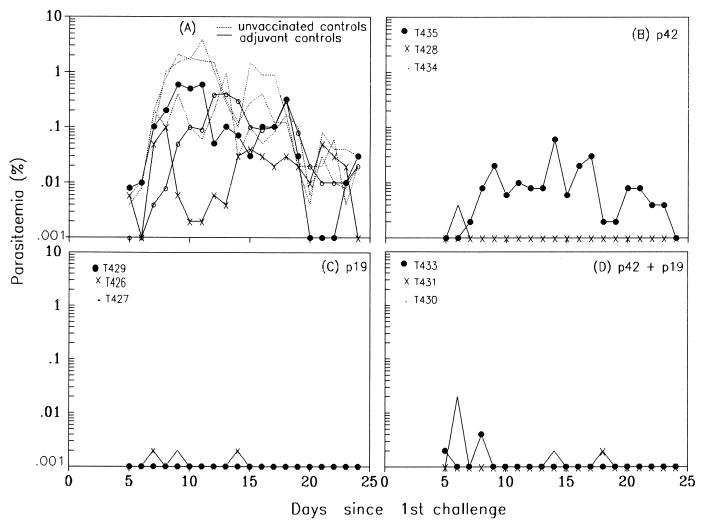
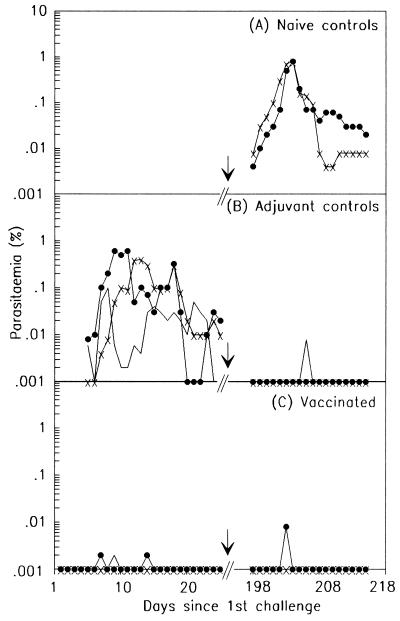
A successful anti-blood stage malaria vaccine trial based on a leading vaccine candidate, the major merozoite surface antigen-1 (MSP1), is reported here. The trial was based on Plasmodium cynomolgi, which is a primate malaria parasite which is highly analogous to the human parasite Plasmodium vivax, in its natural host, the toque monkey, Macaca sinica. Two recombinant baculovirus-expressed P. cynomolgi MSP1 proteins, which are analogous to the 42- and 19-kDa C-terminal fragments of P. falciparum MSP1, were tested by immunizing three groups of three animals each with either p42, p19, or both together. The vaccines were delivered subcutaneously in three doses at 4-week intervals with complete and incomplete Freund's adjuvants. Very high antibody titers were obtained against both vaccinating antigens as measured by enzyme-linked immunosorbent assay (10[6] and above) and against whole parasites as measured by indirect immunofluorescence assay (>10[5]), achieving, in most animals, about a 10-fold increase from the first to the last immunization. A blood stage challenge with P. cynomolgi parasites led, in three adjuvant-treated and three naive control animals, to blood infections which were patent for at least 44 days, reaching peak densities of 0.6 and 3.8%, respectively. In contrast, all except one of the nine animals in the three vaccinated groups were highly protected, showing either no parasitemia at all or transient parasitemias which were patent for only 1 or 2 days. When the three p19-vaccinated monkeys were rechallenged 6 months later, the protective efficacy was unchanged. The success of this trial, and striking analogies of this natural host-parasite system with human P. vivax malaria, suggests that it could serve as a surrogate system for the development of a human P. vivax malaria vaccine based on similar recombinant analogs of the P. vivax MSP1 antigen.
Figures
References
-
- Anonymous. Annual administrative report of the anti-malaria campaign. Colombo Sri Lanka: Ministry of Health; 1992.
-
- Barnwell, J. W., et al. Unpublished data.
-
- Boyd M F. Criteria of immunity and susceptibility in naturally acquired and induced vivax malaria infections. Am J Trop Med Hyg. 1942;22:217–227.
-
- Chang S P, Case S E, Gosnell W L, Hashimoto A, Kramer K J, Tam L Q, Hashiro C Q, Nikaido C M, Gibson H L, Lee-Ng C T, Barr P J, Yokota B T, Hui G S N. A recombinant baculovirus 42-kilodalton C-terminal fragment of Plasmodium falciparum merozoite surface protein 1 protects Aotus monkeys against malaria. Infect Immun. 1996;64:253–261. - PMC - PubMed
-
- Coatney G R, Collins W E, Warren M, Contacos P G. The primate malarias. Washington, D.C: U.S. Government Printing Office; 1971.
Publication types
MeSH terms
Substances
LinkOut - more resources
Full Text Sources
Other Literature Sources
Research Materials
