. 1998 Apr;66(4):1561-9.
doi: 10.1128/IAI.66.4.1561-1569.1998.

Helper T-cell epitopes encoded by the Babesia bigemina rap-1 gene family in the constant and variant domains are conserved among parasite strains

Affiliations

Helper T-cell epitopes encoded by the Babesia bigemina rap-1 gene family in the constant and variant domains are conserved among parasite strains

W C Brown et al. Infect Immun. 1998 Apr.

Abstract

Among important candidates for babesial vaccines are apical complex proteins, including rhoptry-associated protein 1 (RAP-1) from Babesia bovis and B. bigemina, which have been shown to induce partial immunity. Four variant B. bigemina rap-1 transcripts identified in a clone of the Mexico strain have highly conserved sequence in the central region but vary in sequence at the amino and carboxy termini (NT and CT) of the predicted proteins, resulting in different combinations of NT and CT domains in the individual gene products. Cattle were immunized with native protein consisting of the RAP-alpha1 variant, which contains NT-1 and CT-1 domains, and T-cell responses were characterized. We previously reported the identification of two T helper (Th) cell epitopes in B. bigemina RAP-1alpha1 protein (I. Hötzel, W. C. Brown, T. F. McElwain, S. D. Rodriguez, and G. H. Palmer, Mol. Biochem. Parasitol. 81:89-99, 1996). One epitope mapped to the constant domain of RAP-1 (amino acids [aa] 144 to 187), and one mapped to the CT-1 variable domain (aa 386 to 480). Th1-like clones responding to these epitopes proliferated differentially to different strains of B. bigemina, raising the possibilities that the T-cell epitopes may vary antigenically and that CT-1 may be differentially expressed with respect to the other RAP-1 CT domains in the different strains. In this report, we definitively map the T-cell epitope identified in the constant domain of RAP-1 to aa 159 to 187 (FVVSLLKKNVVRDPESNDVENFASQYFYM) and show that the predicted amino acid sequence is completely conserved among seven strains. The T-cell epitope in the CT-1 domain was mapped to aa 436 to 465 (VNSEKVDADDAGNAETQQLPDAENEVRADD), which is also completely conserved among eight strains of B. bigemina. We further show that the RAP-1alpha1-immunized cattle were protected against homologous B. bigemina challenge, thus suggesting an association between protective immunity and the helper T-cell response against the two epitopes. The immunogenic and highly conserved nature of these T-cell epitopes and their ability to stimulate functionally relevant Th cells that express gamma interferon support their inclusion in a vaccine.


Figures
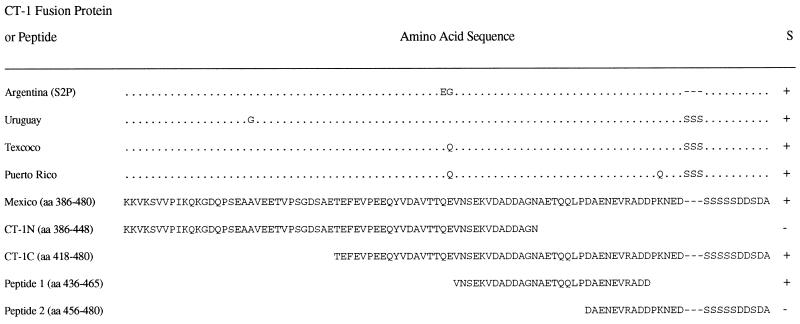
FIG. 1
FIG. 1
RAP-1 fusion proteins and peptides used in this study. CT-1 was cloned by PCR from DNA isolated from the different parasite strains indicated, and sequence analysis was performed (16). The sequences are compared with RAP-1 CT-1 (Mexico); identical amino acids are indicated by dots, while different amino acids are indicated by letters. Deletions are indicated by dashes. CT-1N and CT-1C were derived from the JG-29 cloned Mexico strain by PCR and sequenced. All CT-1 peptides were expressed in pMAL as MBP fusion proteins. Peptides 1 and 2 were synthesized. All fusion proteins and peptides were tested for stimulation (S) of CT-1-specific Th cell clones derived from cattle immunized with RAP-1α1 (containing CT-1), and the results are summarized. +, and −, positive and negative proliferative responses of CT-1-specific Th cell clones.
FIG. 2
FIG. 2
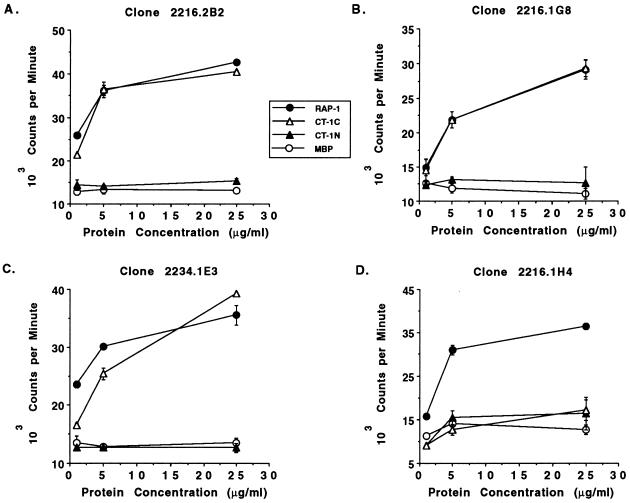
B. bigemina RAP-1 CT-1-specific T cells respond to aa 418 to 480. Three CT-1-specific Th cell clones (A to C) and one RAP-1-specific Th cell clone specific for an epitope within aa 144 to 187 (D) were cultured in a 3-day proliferation assay with autologous APC, 2 U of recombinant human IL-2 per ml, and 1, 5, or 25 μg of recombinant MBP fusion proteins per ml, consisting of the whole RAP-1 protein (closed circles), the N terminal fragment of CT-1 (CT-1N) consisting of aa 386 to 448 (closed triangles), the C-terminal fragment of CT-1 (CT-1C) consisting of aa 418 to 480 (open triangles), or control MBP protein (open circles). Cells were radiolabeled for 6 h with [3H]thymidine, harvested, and counted. The results are presented as the mean ± range of variation around the mean of duplicate cultures. Background proliferative responses of cells in medium plus IL-2 for the clones were as follows: 2216.2B2, 15,305 ± 639 cpm; 2216.1G8, 12,652 ± 2,376 cpm; 2234.1E3, 12,635 ± 775 cpm; and 2216.1H4, 16,353 ± 3,758 cpm.
FIG. 3
FIG. 3
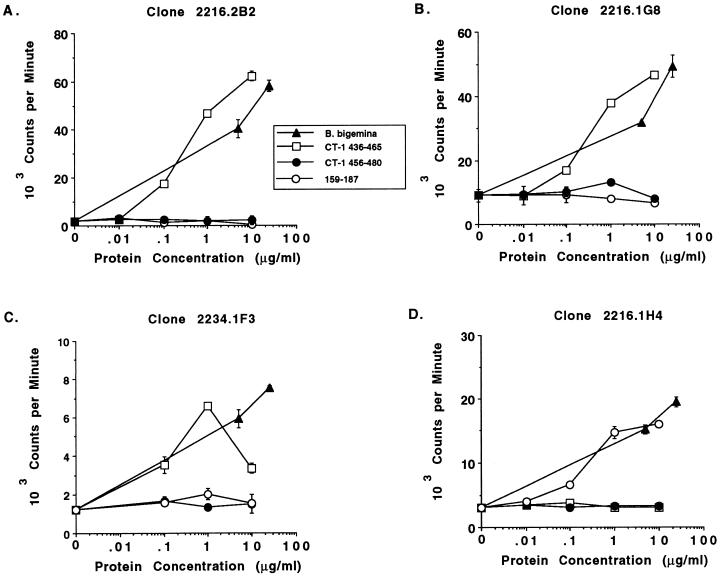
Proliferative responses of RAP-1-specific Th cell clones to peptides within CT-1 or constant domains. Three CT-1-specific Th cell clones (A to C) and one Th cell clone specific for an epitope within aa 144 to 187 (D) were cultured in a 3-day proliferation assay with autologous APC and 0.1, 1.0, and 10.0 μg of B. bigemina RAP-1α1 peptide antigen per ml, consisting of aa 436 to 465 (open squares), aa 456 to 480 (closed circles), and aa 159 to 187 (open circles), or 5 and 25 μg of B. bigemina (Mexico) merozoite CM antigen per ml (closed triangles). Clones 2234.1F3 (C) and 2216.1H4 (D) were assayed in the presence of 1 U of recombinant human IL-2 per ml. Cells were radiolabeled for 6 h with [3H]thymidine, harvested, and counted. The results are presented as the mean ± range of variation around the mean of duplicate cultures.
FIG. 4
FIG. 4
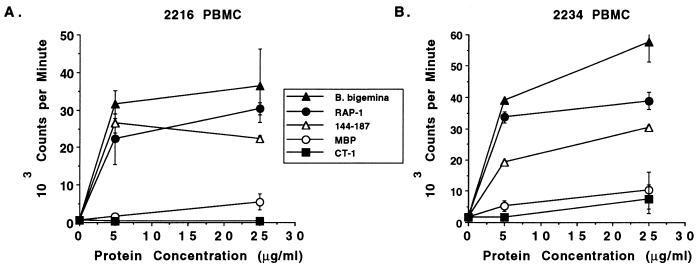
Proliferative responses of PBMC from RAP-1α1-immunized cattle to recombinant proteins containing Th cell epitopes. PBMC obtained prior to B. bigemina challenge were cultured for 6 days with 5 and 25 μg of antigen per ml consisting of B. bigemina (Mexico) merozoite CM antigen (closed triangles) or recombinant MBP fusion proteins consisting of RAP-1 protein (closed circles), aa 144 to 187 (open triangles), CT-1 (aa 386 to 480; closed squares), and MBP (open circles). Cells were radiolabeled for 4 h with [125I]iododeoxyuridine, harvested, and counted. The results are presented as the means ± 1 standard deviation of triplicate cultures.

References

    1. Brown W C, Estes D M, Rodriguez S D, Ruef B J, Tuo W, McElwain T F, Palmer G H. Proceedings from the Society for Tropical Veterinary Medicine, 4th Biennial Meeting, Montpellier, France. 1997. Babesia bigemina rhoptry-associated protein 1 (RAP-1) induces a type 1 cytokine response and both IgG1 and IgG2 antibody subclasses; p. 30.
    1. Brown W C, Logan K S, Wagner G G, Tetzlaff C L. Cell-mediated immune responses to Babesia bovis merozoite antigens in cattle following infection with tick-derived or cultured parasites. Infect Immun. 1991;59:2418–2426. - PMC - PubMed
    1. Brown W C, McElwain T F, Ruef B J, Suarez C E, Shkap V, Chitko-McKown C G, Tuo W, Rice-Ficht A C, Palmer G H. Babesia bovis rhoptry-associated protein 1 is immunodominant for T helper cells of immune cattle and contains T-cell epitopes conserved among geographically distant B. bovis strains. Infect Immun. 1996;64:3341–3350. - PMC - PubMed
    1. Brown W C, Rice-Ficht A C. Use of helper T cells to identify potentially protective antigens of Babesia bovis. Parasitol Today. 1994;10:145–149. - PubMed
    1. Brown W C, Woods V M, Dobbelaere D A E, Logan K S. Heterogeneity in cytokine profiles of Babesia bovis-specific bovine CD4+ T cell clones activated in vitro. Infect Immun. 1993;61:3273–3281. - PMC - PubMed

Publication types

Substances