. 1998 Apr;66(4):1622-31.
doi: 10.1128/IAI.66.4.1622-1631.1998.

Copy number of pilus gene clusters in Haemophilus influenzae and variation in the hifE pilin gene

Affiliations

Copy number of pilus gene clusters in Haemophilus influenzae and variation in the hifE pilin gene

T D Read et al. Infect Immun. 1998 Apr.

Abstract

Brazilian purpuric fever (BPF)-associated Haemophilus influenzae biogroup aegyptius strain F3031 contains two identical copies of a five gene cluster (hifA to hifE) encoding pili similar to well-characterized Hif fimbriae of H. influenzae type b. HifE, the putative pilus tip adhesin of F3031, shares only 40% amino acid sequence similarity with the same molecule from type b strains, whereas the other four proteins have 75 to 95% identity. To determine whether pilus cluster duplication and the hifE(F3031) allele were special features of BPF-associated bacteria, we analyzed a collection of H. influenzae strains by PCR with hifA- and hifE-specific oligonucleotides, by Southern hybridization with a hifC gene probe, and by nucleotide sequencing. The presence of two pilus clusters was limited to some H. influenzae biogroup aegyptius strains. The hifE(F3031) allele was limited to H. influenzae biogroup aegyptius. Two strains contained one copy of hifE(F3031) and one copy of a variant hifE allele. We determined the nucleotide sequences of four hifE genes from H. influenzae biogroup aegyptius and H. influenzae capsule serotypes a and c. The predicted proteins produced by these genes demonstrated only 35 to 70% identity to the three published HifE proteins from nontypeable H. influenzae, serotype b, and BPF strains. The C-terminal third of the molecules implicated in chaperone binding was the most highly conserved region. Three conserved domains in the otherwise highly variable N-terminal putative receptor-binding region of HifE were similar to conserved portions in the N terminus of Neisseria pilus adhesin PilC. We concluded that two pilus clusters and hifE(F3031) were not specific for BPF-causing H. influenzae, and we also identified portions of HifE possibly involved in binding mammalian cell receptors.


Figures
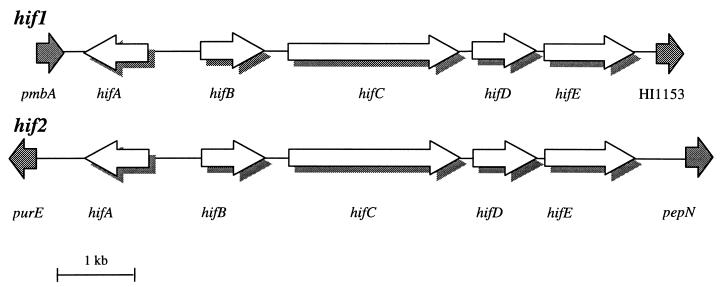
FIG. 1
FIG. 1
Schematic diagram of hif1 and hif2 clusters of BPF-associated strain F3031 (24). The five pilus genes of each cluster are indicated by open arrows, while the flanking H. influenzae genes are indicated by gray arrows. hif1 and hif2 are flanked by direct repeats homologous to Rd genome coordinates (6) 1220363 to 1220394 and 1682304 to 1682362, respectively.
FIG. 2
FIG. 2
Southern hybridization of the set of H. influenzae strains with hifC-specific probe (see Materials and Methods for details). Chromosomal DNA was digested with BglII. The positions of DNA molecular size markers (in kilobases) are shown on the left. Strains with two fragments hybridizing to the hifC probe were F3031, F6422 (double band), F4931, F4933, F2066, F3118, and ATCC 43794 (all H. influenzae biogroup aegyptius strains). H. influenzae strains with one hybridizing BglII fragment are biogroup aegyptius strains F3331 and ATCC 43800, NTHI strains F8835 and GA2188, serotype a strains GA2078 and GA4774, serotype b strain 1007, and serotype c strain ATCC 9007. The biogroup aegyptius strain F6422 and serotype f strains GA084, GA4090 and GA4913 had extra hybridizing DNA fragments, but because they appeared after extended exposure of the film, they were not deemed significant.
FIG. 3
FIG. 3
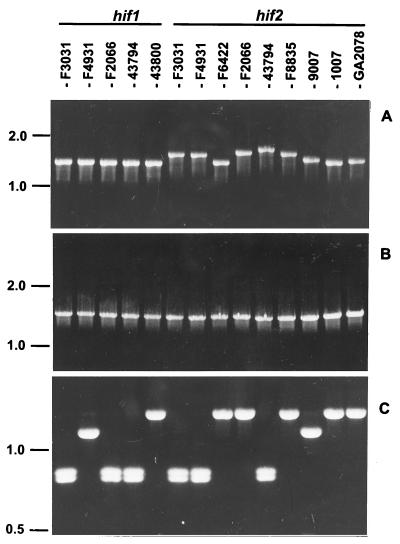
RFLP of hifE genes. (A) Fourteen PCR amplicons generated with oligonucleotide primers HE1 and HI1153 (hifE1) or HE1 and PEP (hifE2). (B) These DNA fragments were excised from the gel and used as templates for nested PCR with HE1 and HE2. The uniformly sized hifE amplicons were digested with four restriction enzymes. (C) ClaI digestion of the amplicons. The sizes of DNA markers (in kilobases) are shown on the left.
FIG. 4
FIG. 4
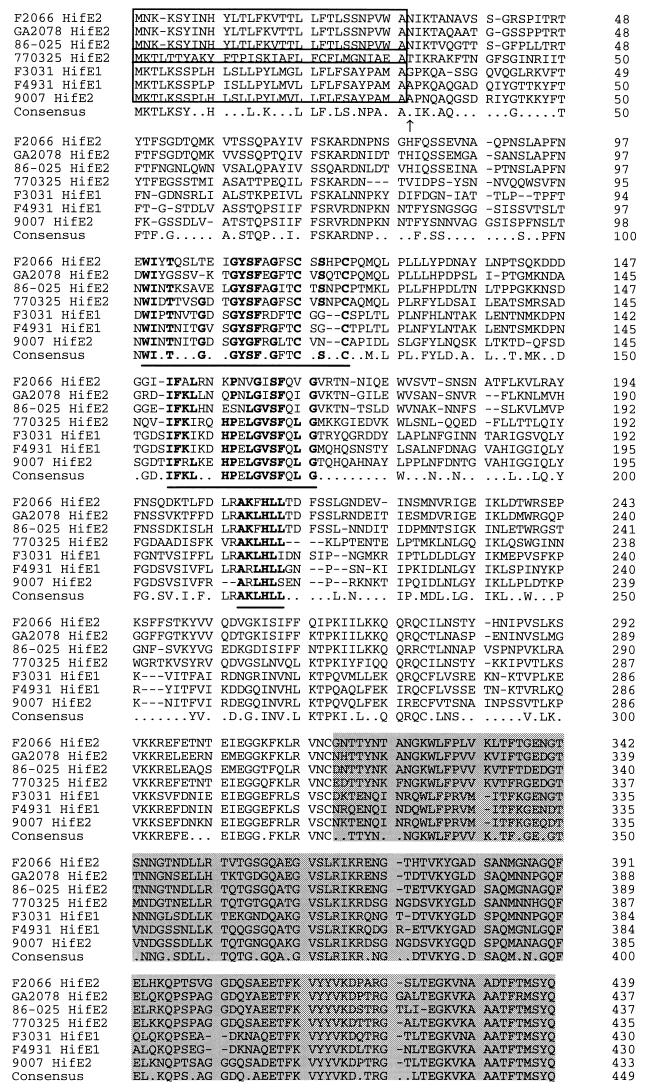
Alignment of H. influenzae HifE amino acid sequences. The amino acid sequences of Hib strain 770235 and BPF-associated strain F3031 were published by van Ham et al. (39) and Read et al. (24), respectively. The sequence of NTHI strain 86-025 was obtained from GenBank (accession no. U19730). Other sequences were reported in this study. Residues conserved between the seven proteins are shown in the last line each block (consensus). Dashes indicated gaps introduced by the alignment program. The highly conserved C-terminal region of the HifE proteins following the last cytosine residue is shaded. Predicted signal peptidase cleavage sites are illustrated with an arrow (↑). The three groups of variant signal peptides are boxed separately. Three conserved domains in the N terminus of the proteins with similarities to the Neisseria PilC sequence are underlined. Residues in these domains similar to the PilC consensus are shown in bold type.
FIG. 5
FIG. 5
Comparison of HifE domains with Neisseria PilC proteins. The alignment of PilC proteins is taken from the study by Rahman et al. (23). A portion of the N terminus of each of six PilC proteins from residues 124 to 270 is aligned against the three HifE conserved regions underlined in Fig. 4. PilC residues in bold are conserved within all six proteins and share similarity to the HifE domain. In two cases phenylalanine residues (f) are typed in lower case where they match tyrosine residues in PilC. N. meningitidis (NM) FAM120 PilC1, FAM120 PilC2, and A1493 PilC (24, 29) have been assigned EMBL accession numbers Y13020, Y13021, and Z54202, respectively. N. gonorrhoeae (NG) MS11 PilC1, MS11 PilC2 and GC-640 PilC (13, 24, 28) have been assigned EMBL accession numbers Z50180, Z49120, and Z54202, respectively.

References

    1. Brenner D J, Mayer L W, Carlone G M, Harrison L H, Bibb W F, de Cunto Brandileone M C, Sottnek F O, Irino K, Reeves M W, Swenson J M, Birkness K A, Weyant R S, Berkley S F, Woods T C, Steigerwalt A G, Grimont P A D, McKinney R M, Fleming D W, Gheesling L L, Cooksey R C, Arko R J, Broome C V the Brazilian Purpuric Fever Study Group. Biochemical, genetic, and epidemiologic characterization of Haemophilus influenzae biogroup aegyptius (Haemophilus aegyptius) strains associated with Brazilian purpuric fever. J Clin Microbiol. 1988;26:1524–1534. - PMC - PubMed
    1. Coleman T, Grass S, Munson R., Jr Molecular cloning, expression, and sequence of the pilin gene from nontypeable Haemophilus influenzae M37. Infect Immun. 1991;59:1716–1722. - PMC - PubMed
    1. Fakih M G, Murphy T F, Pattoli M A, Berenson C S. Specific binding of Haemophilus influenzae to minor gangliosides of human respiratory epithelial cells. Infect Immun. 1997;65:1695–1700. - PMC - PubMed
    1. Farley M M, Stephens D S, Kaplan S L, Mason E O., Jr Pilus- and non-pilus-mediated interactions of Haemophilus influenzae type b with human erythrocytes and human nasopharyngeal mucosa. J Infect Dis. 1990;161:274–280. - PubMed
    1. Farley M M, Whitney A M, Spellman P, Quinn F D, Weyant R S, Mayer L, Stephens D S. Analysis of the attachment and invasion of human epithelial cells by Haemophilus influenzae biogroup aegyptius. J Infect Dis. 1992;165:S111–S114. - PubMed

Publication types

Associated data

LinkOut - more resources