. 1998 Apr 6;187(7):1133-8.
doi: 10.1084/jem.187.7.1133.

Activated complement component 3 (C3) is required for ultraviolet induction of immunosuppression and antigenic tolerance

Affiliations

Activated complement component 3 (C3) is required for ultraviolet induction of immunosuppression and antigenic tolerance

C Hammerberg et al. J Exp Med. .

Abstract

Complement component 3 (C3), a critical regulator of innate immunity, may also play a role in the regulation of cognate immunity, such as contact sensitivity responses. Because ultraviolet (UV) radiation also activates C3 in the skin, we determined whether the immunosuppressed state that results when a contact sensitizer is applied through UVB-exposed skin requires the presence and activation of C3. This question was addressed through the use of C3-deficient mice, blockade of C3 cleavage to C3b, and accelerated degradation of iC3b by soluble complement receptor 1 (sCR1). Both C3-modulated systems totally reversed the failure to induce a contact sensitivity response to dinitrofluorobenzene (DNFB) upon primary sensitization at the UV-exposed site, as well as immunologic tolerance to a second DNFB immunization through normal skin. Treatment with sCR1 reduced the infiltration of CD11b+ leukocytes into the epidermis and dermis of UV-irradiated skin but did not reverse the UV-induced depletion of epidermal class II MHC+CD11blo Langerhans cells. These data, taken together with previous results showing abrogation of locally induced UV immunosuppression by in vivo anti-CD11b treatment, suggest a novel mechanism by which ligation of the leukocyte beta2 integrin, CD11b, by iC3b molecules formed from C3 activation in UV-exposed skin, modifies cutaneous CD11b+ cells such that skin antigen-presenting cells are unable to sensitize in a primary immune response, but actively induce antigenic tolerance.


Figures
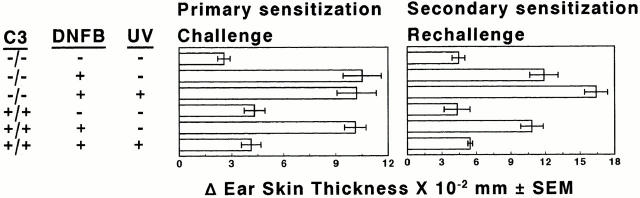
Figure 1
Figure 1
Failure of a single low UVB dose (140 mJ/cm2) to induce an immunosuppressed state to a contact sensitizer applied through the UV-irradiated skin of C3-deficient mice. The contact sensitivity responses of C3-deficient mice (−/−) and their +/+ controls (129 × C57BL/6)F1 to DNFB in the absence of UV exposure are shown in the second and fifth bars from the top, respectively. The effect of a single UVB dose given 48 h before application of DNFB to the UV-exposed site on the response to DNFB by C3-deficient mice and their controls is given in the third and sixth bars from the top, respectively. The left panel shows the ear swelling response to primary sensitization through dorsal skin and challenge. The right panel indicates the response to a second sensitization through normal back skin and rechallenge. Data are expressed as the mean ± SEM difference in ear thickness between pre- and postchallenge measurements. Four mice were used in each group.
Figure 2
Figure 2
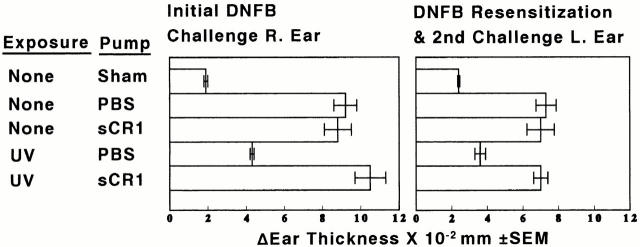
Reversal by sCR1 of induction of tolerance to a contact sensitizer immunized through skin of C3H/HeN mice exposed to a single UVB dose (72 mJ/cm2). The contact sensitivity response to DNFB of mice receiving no UV with and without sCR1 treatment is given in the third and second bars from the top, respectively. The response of mice receiving UV with no sCR1 is shown in the fourth bar from the top, and with sCR1 in the fifth bar from the top. The left panel shows the ear swelling response to primary sensitization through dorsal skin and challenge. The right panel indicates the response to secondary sensitization through normal back skin and rechallenge. Data are expressed as described in Fig. 1. Four mice were used in each group.
Figure 3
Figure 3
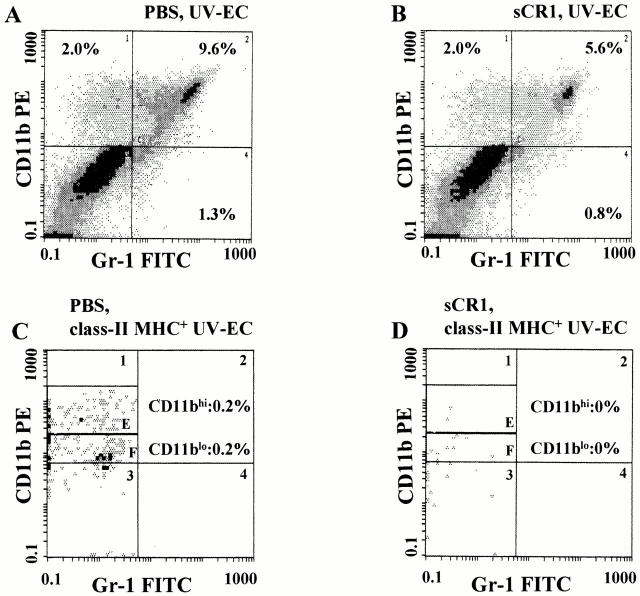
sCR1 treatment of UV-irradiated C3H/HeN mice partially blocks infiltration of CD11b+ leukocytes but does not prevent UV-induced depletion of class II MHC+CD11bloGr-1 LC. Three-color flow cytometric analysis was used to determine the expression of CD11b and Gr-1 by epidermal cells obtained from the skin of C3H/HeN mice (A and B), 48 h after UV exposure, that had been treated with either PBS (A) or sCR1 (B). Cells were first selected based upon their viability (EMA exclusion), then analyzed for CD11b expression (x-axis represents PE intensity) and Gr-1 expression (y-axis represents FITC intensity). Cells stained with the matching antibody isotype were confined to quadrant 3. Percentage of stained cells after subtracting the isotype background are given for each quadrant. Four-color flow cytometric analysis was used to identify class II MHC+CD11bloGr-1 LC from UV-exposed epidermis of C3H/HeN mice with (D) or without (C) sCR1 treatment. Determination of the expression of CD11b (y-axis represents PE intensity) and Gr-1 (x-axis represents FITC intensity) on class II MHC+ epidermal cells electronically selected by their reactivity to biotin-conjugated anti-Iak and avidin-Cascade blue was determined by flow cytometric analysis. For the preparation of epidermal cell suspensions six to eight mice were used in each group.

References

    1. Feldbush, T.L., M.V. Hobbs, C.D. Severson, Z.K. Ballas, and J.M. Weiler. 1984. Role of complement in the immune response. Federation Proc. 43:2548–2552. - PubMed
    1. Erdei A, Fust G, Gergely J. The role of C3 in the immune response. Immunol Today. 1991;12:332–337. - PubMed
    1. Lio D, Sireci G, Gervasi F, Dieli F, Salerno A. Induction of contact sensitivity by cell-associated immunocomplexes requires activation of the early complement components. Int J Exp Path. 1992;73:741–750. - PMC - PubMed
    1. Dieli F, Sireci G, Lio D, Salerno A. Role of the fourth complement component (C4) in the regulation of contact sensitivity. Cell Immunol. 1989;123:236–243. - PubMed
    1. Tsuji RF, Kikuchi M, Askenase PW. Possible involvement of C5/C5a in the efferent and elicitation phases of contact sensitivity. J Immunol. 1996;156:4644–4650. - PubMed

Publication types