. 1998 Apr;116(4):1413-20.
doi: 10.1104/pp.116.4.1413.

Characterization of cadmium binding, uptake, and translocation in intact seedlings of bread and durum wheat cultivars

Affiliations

Characterization of cadmium binding, uptake, and translocation in intact seedlings of bread and durum wheat cultivars

JJ Hart et al. Plant Physiol. 1998 Apr.

Abstract

High Cd content in durum wheat (Triticum turgidum L. var durum) grain grown in the United States and Canada presents potential health and economic problems for consumers and growers. In an effort to understand the biological processes that result in excess Cd accumulation, root Cd uptake and xylem translocation to shoots in seedlings of bread wheat (Triticum aestivum L.) and durum wheat cultivars were studied. Whole-plant Cd accumulation was somewhat greater in the bread wheat cultivar, but this was probably because of increased apoplastic Cd binding. Concentration-dependent 109Cd2+-influx kinetics in both cultivars were characterized by smooth, nonsaturating curves that could be dissected into linear and saturable components. The saturable component likely represented carrier-mediated Cd influx across root-cell plasma membranes (Michaelis constant, 20-40 nm; maximum initial velocity, 26-29 nmol g-1 fresh weight h-1), whereas linear Cd uptake represented cell wall binding of 109Cd. Cd translocation to shoots was greater in the bread wheat cultivar than in the durum cultivar because a larger proportion of root-absorbed Cd moved to shoots. Our results indicate that excess Cd accumulation in durum wheat grain is not correlated with seedling-root influx rates or root-to-shoot translocation, but may be related to phloem-mediated Cd transport to the grain.


Figures
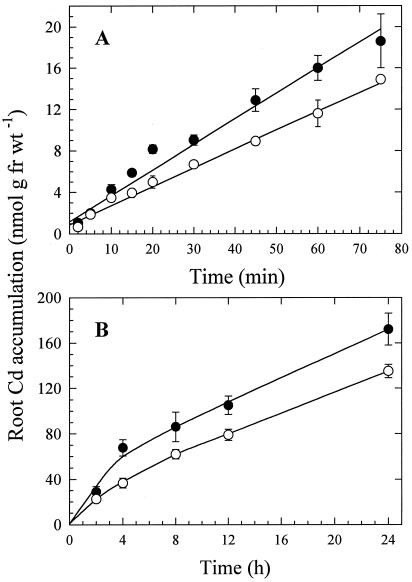
Figure 1
Figure 1
Time course of 109Cd accumulation in intact bread (•) and durum (○) wheat seedlings. Roots were incubated in solutions containing 215 (A) or 170 nm (B) Cd for the durations shown. All uptake solutions also contained 5 mm Mes-Tris, pH 6.0, 0.2 mm CaSO4, 12.5 μm H3BO3, and 0.15 nm ZnSO4. Roots were desorbed for 15 min before 109Cd activity was determined. Data points and error bars represent means (n = 4) and se, respectively. Error bars do not extend outside some data points. fr wt, Fresh weight.
Figure 2
Figure 2
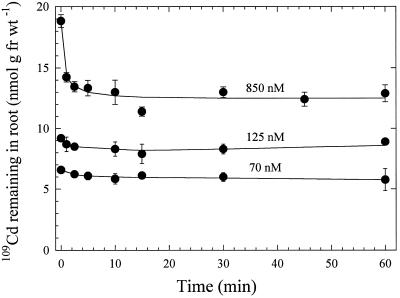
Time-dependent release of 109Cd from intact bread wheat roots into 100 μm CdSO4 desorption solution at 2°C after 20 min of exposure to Cd at the concentrations shown. Roots harvested at 0 min were briefly rinsed in deionized water before harvest. Data points and error bars represent means (n = 4) and se, respectively. Error bars do not extend outside some data points. fr wt, Fresh weight.
Figure 3
Figure 3
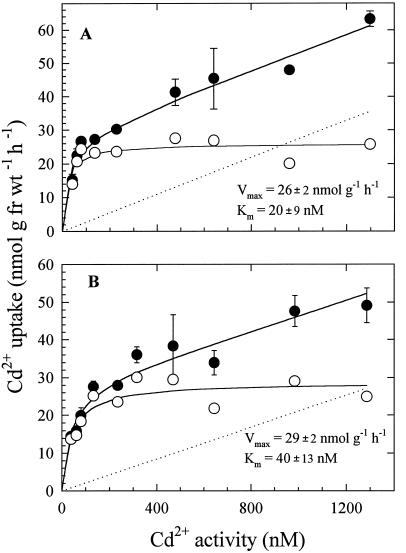
Concentration-dependent Cd2+ uptake in roots of intact bread (A) and durum (B) wheat seedlings. Linear (dotted line) and saturable (○) components were derived from experimental data (•) by subtracting the equation for the regression line plotted through high concentration points. Vmax and Km values of saturable components were calculated by fitting a hyperbolic curve function to the saturable points. Data symbols and error bars represent means (n = 4) and se, respectively. Error bars do not extend outside some symbols. fr wt, Fresh weight.
Figure 4
Figure 4
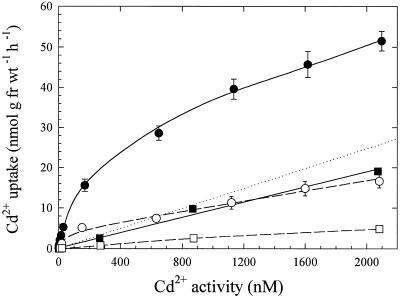
Concentration-dependent Cd2+ uptake in roots of intact and methanol:chloroform-treated bread wheat seedlings at 23°C (• and ▪, respectively) and 2°C (○ and □, respectively). Uptake solution was the same as in Figure 1. Dotted line represents linear component from Figure 3A. Data points and error bars represent means (n = 4) and se, respectively. Error bars do not extend outside some data points. fr wt, Fresh weight.
Figure 5
Figure 5
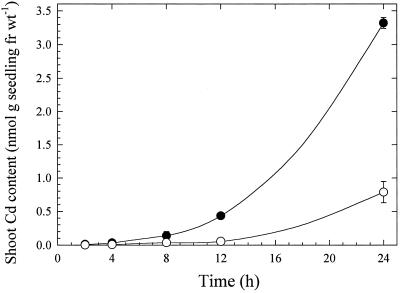
Cd translocation to shoots of bread (•) and durum (○) wheat seedlings. Roots were immersed in a solution that included 170 nm Cd. Data points and error bars represent means (n = 4) and se, respectively. Error bars do not extend outside some data points. fr wt, Fresh weight.

References

    1. Cataldo DA, Garland TR, Wildung RE. Cadmium uptake kinetics in intact soybean plants. Plant Physiol. 1983;73:844–848. - PMC - PubMed
    1. Chaudhry FM, Loneragan JF. Zinc absorption by wheat seedlings and the nature of its inhibition by alkaline earth cations. J Exp Bot. 1972;23:552–560.
    1. Codex Alimentarius Commission (1993) Risk assessment procedures used by the Codex Alimentarius Commission, and its subsidiary and advisory bodies. In Joint FAO/WHO Food Standards Programme, Rome, Twentieth Session, June 28–July 7, 1993, International Conference Centre, Geneva, Switzerland, pp 1–21
    1. Costa G, Morel JL. Cadmium uptake by Lupinus albus (L.): cadmium excretion, a possible mechanism of cadmium tolerance. J Plant Nutr. 1993;16:1921–1929.
    1. Cutler JM, Rains DW. Characterization of cadmium uptake by plant tissue. Plant Physiol. 1974;54:67–71. - PMC - PubMed

LinkOut - more resources