. 1998 Feb;42(2):200-7.
doi: 10.1136/gut.42.2.200.

Rapid modulation of electrolyte transport in Caco-2 cell monolayers by enteropathogenic Escherichia coli (EPEC) infection

Affiliations

Rapid modulation of electrolyte transport in Caco-2 cell monolayers by enteropathogenic Escherichia coli (EPEC) infection

G K Collington et al. Gut. 1998 Feb.

Abstract

Background and aims: The pathophysiology of enteropathogenic Escherichia coli (EPEC) diarrhoea remains uncertain. EPEC adhere to enterocytes and transduce signals which produce a characteristic "attaching and effacing" (A/E) lesion in the brush border membrane. The present in vitro study was designed to determine whether signal transduction by EPEC also influences electrolyte transport.

Methods: Caco-2 cell monolayers were rapidly infected with wild type EPEC strain E2348/69, or the signal transduction-defective mutant 14.2.1(1), and mounted in Ussing chambers.

Results: Strain E2348/69 stimulated a rapid but transient increase in short circuit current (Isc) which coincided with A/E lesion formation; this Isc response was absent on infection with strain 14.2.1(1). While the initial rise in Isc induced by E2348/69 was partially (approximately 35%) dependent on chloride, the remainder possibly represents an influx of sodium and amino acid(s) across the apical membrane.

Conclusions: The study directly shows that, after initial adhesion, EPEC induce major alterations in host cell electrolyte transport. The observed Isc responses indicate a rapid modulation of electrolyte transport in Caco-2 cells by EPEC, including stimulation of chloride secretion, for which signal transduction to host cells is a prerequisite.


Figures
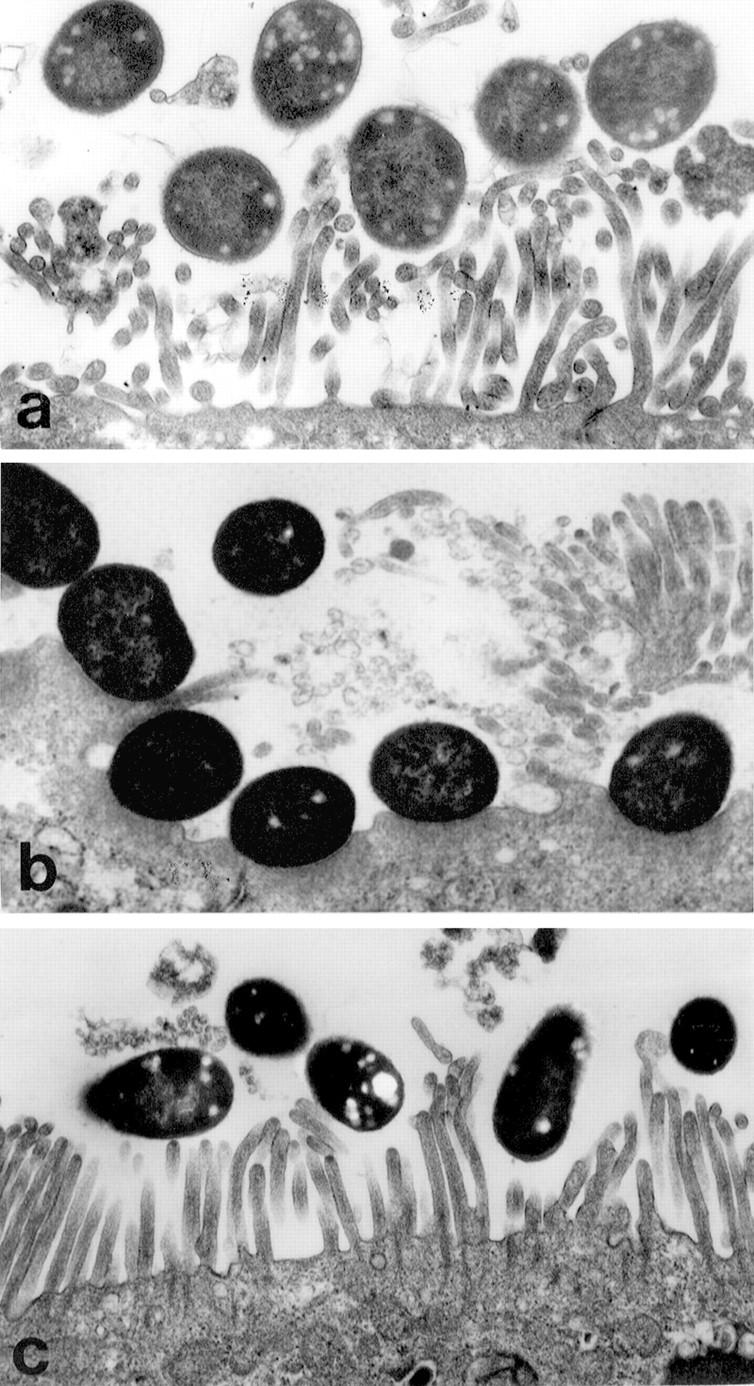
Figure 1
Figure 1
Transmission electron micrographs of EPEC adhesion to Caco-2 monolayers. On initial infection, both wild type strain E2348/69 (a) and cfm strain 14.2.1(1) adhered to intact brush border microvilli. After 15 minutes, E23438/69 were intimately attached to the apical membrane devoid of microvilli (b); however, even after 60 minutes, 14.2.1(1) did not intimately adhere to host cells (c). Original magnification: × 17 500.
Figure 2
Figure 2
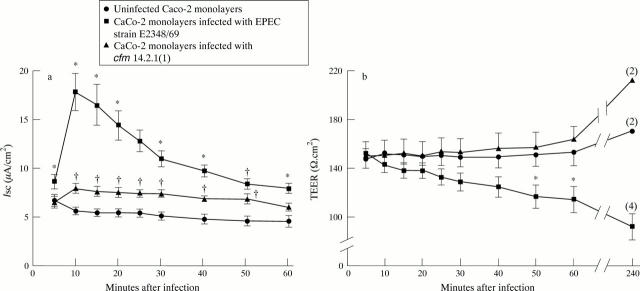
(a) Short circuit current (Isc; µA/cm2) and (b) transepithelial electrical resistance (TEER; Ω.cm2) in uninfected Caco-2 monolayers, and those infected with EPEC strain E2348/69 or cfm 14.2.1(1). Each point represents the mean (SEM) from nine monolayers, unless otherwise indicated in parentheses. *p<0.05 v uninfected or 14.2.1(1) infected monolayers; p<0.05 v uninfected monolayers only.
Figure 3
Figure 3
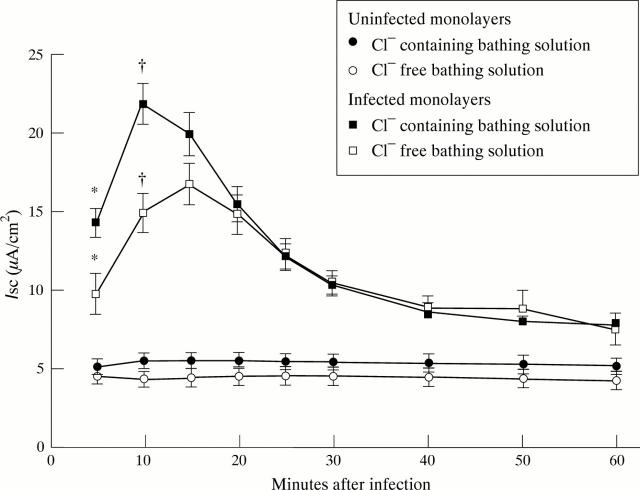
Cl dependence of short circuit current (Isc; µA/cm2) in uninfected Caco-2 monolayers and those infected with EPEC strain E2348/69. The Isc of uninfected monolayers did not differ significantly between Cl -inclusive and Cl -free bathing solutions; each point represents the mean (SEM) of seven monolayers. The rapid increase in Isc induced by E2348/69 in Cl -inclusive bathing solution was significantly reduced in Cl -free solution; each point represents mean Isc (SEM) from nine monolayers. *p<0.05 v uninfected or 14.2.1(1) infected monolayers; p<0.05 v uninfected monolayers.
Figure 4
Figure 4
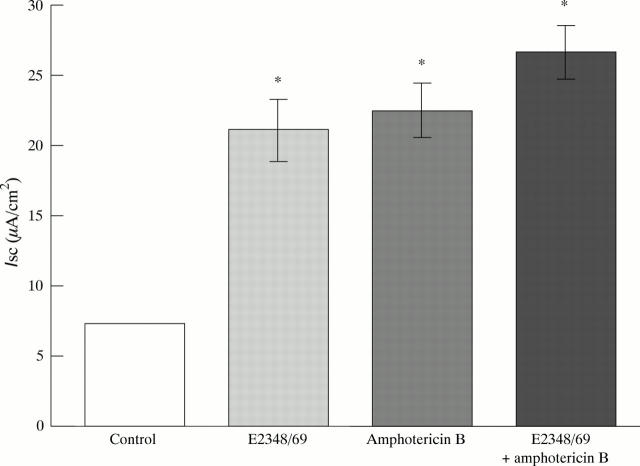
Effect of amphotericin B (10 µg/ml apical application) on short circuit current (Isc; µA/cm2) in uninfected Caco-2 monolayers and those infected with EPEC strain E2348/69. Values presented were determined 15 minutes after initial infection. Although E2348/69 infection or amphotericin B treatment induced increases in Isc, these effects were not cumulative. Each bar represents the mean (SEM) from three monolayers. *p<0.05 v control (uninfected and untreated) monolayers.
Figure 5
Figure 5
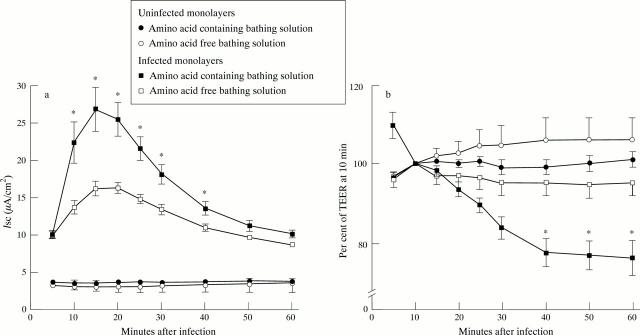
Amino acid dependence of (a) short circuit current (Isc; µA/cm2) and (b) change in transepithelial electrical resistance (TEER; expressed as % of TEER at 10 minutes) in uninfected Caco-2 monolayers and those infected with EPEC strain E2348/69. The Isc of uninfected monolayers did not differ significantly between amino acid-inclusive and amino acid-free bathing solutions; each point represents the mean (SEM) from eight monolayers. The rapid and sustained increase in Isc induced by E2348/69 in amino acid-inclusive bathing solution was significantly reduced in amino acid-free solution; each point represents the mean (SEM) from five monolayers. Loss of TEER associated with E2348/69 infection did not occur under amino acid-free conditions. *p<0.05 v infected monolayers in amino acid-free bathing solution.

References

    1. Proc R Soc Med. 1970 Dec;63(12):1297-301 - PubMed
    1. Infect Immun. 1990 Jun;58(6):1565-71 - PubMed
    1. Gastroenterology. 1982 Aug;83(2):441-54 - PubMed
    1. Infect Immun. 1982 Nov;38(2):798-801 - PubMed
    1. Am J Physiol. 1984 Sep;247(3 Pt 1):C260-7 - PubMed

Publication types