. 1998 Apr;180(7):1632-41.
doi: 10.1128/JB.180.7.1632-1641.1998.

The CIRCE element and its putative repressor control cell cycle expression of the Caulobacter crescentus groESL operon

Affiliations

The CIRCE element and its putative repressor control cell cycle expression of the Caulobacter crescentus groESL operon

R L Baldini et al. J Bacteriol. 1998 Apr.

Abstract

The groESL operon is under complex regulation in Caulobacter crescentus. In addition to strong induction after exposure to heat shock, under physiological growth conditions, its expression is subject to cell cycle control. Transcription and translation of the groE genes occur primarily in predivisional cells, with very low levels of expression in stalked cells. The regulatory region of groESL contains both a sigma32-like promoter and a CIRCE element. Overexpression of C. crescentus sigma32 gives rise to higher levels of GroEL and increased levels of the groESL transcript coming from the sigma32-like promoter. Site-directed mutagenesis in CIRCE has indicated a negative role for this cis-acting element in the expression of groESL only at normal growth temperatures, with a minor effect on heat shock induction. Furthermore, groESL-lacZ transcription fusions carrying mutations in CIRCE are no longer cell cycle regulated. Analysis of an hrcA null strain, carrying a disruption in the gene encoding the putative repressor that binds to the CIRCE element, shows constitutive synthesis of GroEL throughout the Caulobacter cell cycle. These results indicate a negative role for the hrcA gene product and the CIRCE element in the temporal control of the groESL operon.


Figures
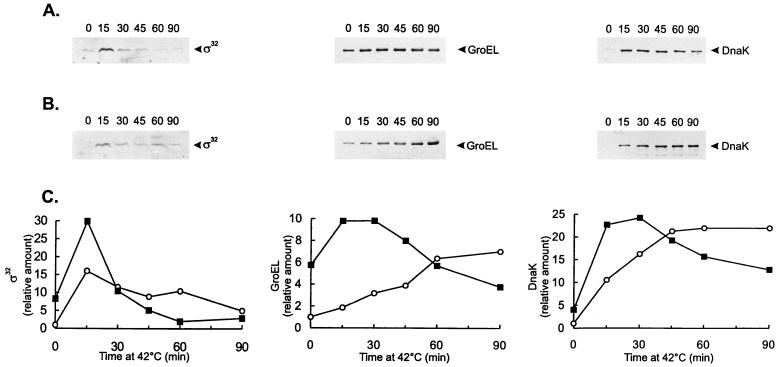
FIG. 1
FIG. 1
(A and B) Western blot analyses of GroEL and DnaK in C. crescentus strains containing different levels of ς32. NA1000 cells carrying (A) or not carrying (B) plasmid pAR33 (high-copy-number plasmid containing the C. crescentus rpoH gene) were grown to mid-log phase at 30°C or shifted to 42°C for the indicated times (minutes). Protein extracts were prepared and separated by SDS-polyacrylamide gel electrophoresis. The proteins were transferred to nitrocellulose membranes and probed with antibody to C. crescentus GroEL or C. crescentus DnaK and antibody against E. coli ς32, as described in Materials and Methods. Bound antigen was visualized by chemiluminescence and recorded on X-ray film. Equal amounts of protein were applied to each lane. (C) The relative levels of ς32, GroEL, and DnaK, determined by densitometry scanning of the films, for strains NA1000 (○) and NA1000 carrying pAR33 (▪) are shown.
FIG. 2
FIG. 2
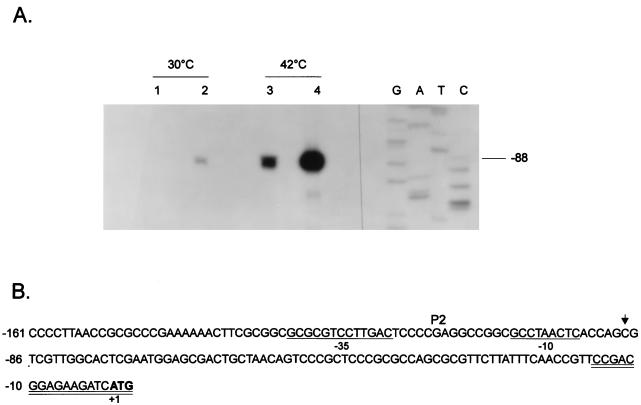
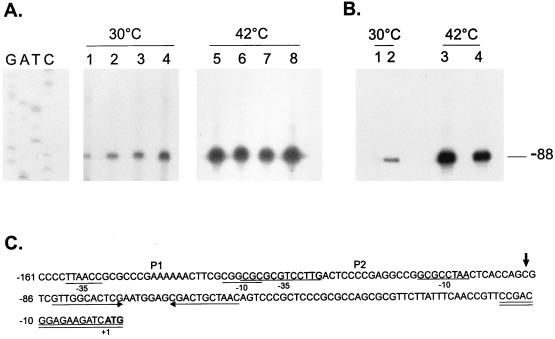
Increased groESL mRNA levels in a ς32-overexpressing C. crescentus strain. (A) An 18-nucleotide primer complementary to nucleotides −15 to +3 of the 5′ region of the groESL operon was 5′ end labelled and hybridized to 50 μg of total RNA isolated from NA1000 cells carrying (lanes 2 and 4) or not carrying (lanes 1 and 3) the plasmid pAR33 (high-copy-number plasmid containing C. crescentus rpoH gene) grown at 30°C or exposed to 42°C for 15 min. The hybrids were then extended by using reverse transcriptase, and the extension products were resolved by denaturing gel electrophoresis and autoradiography. (B) Sequence of the 5′ region of the groESL operon. The transcription start site is shown by an arrow over the nucleotide sequence. The putative −10 and −35 regions of the P2 promoter are underlined. The ATG of the initiator methionine is shown in bold type. The oligonucleotide used in primer extension experiments is complementary to the sequence underlined twice.
FIG. 3
FIG. 3
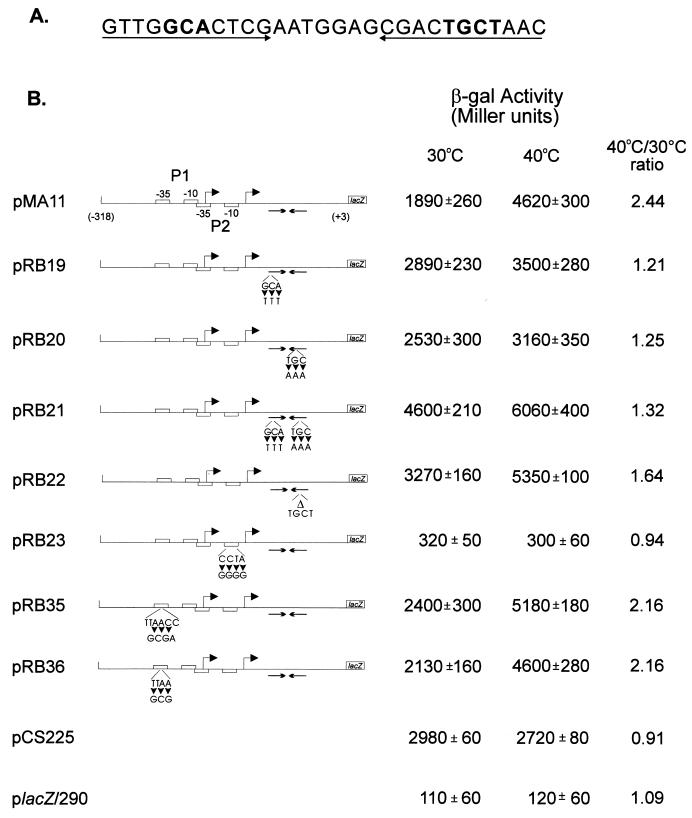
Changes in transcriptional activity due to mutations in the groESL regulatory region. (A) Nucleotide sequence of the inverted repeat (CIRCE element) located downstream of heat shock promoter P2. Nucleotides shown in bold type have been mutated. (B) Schematic representations of the fragments cloned into the transcription reporter vector placZ/290 and the corresponding β-galactosidase (β-gal) activity of each construct. Site-directed mutations were carried out by the method of Kunkel et al. (16), with M13mp19 containing the groESL regulatory region, as described in Materials and Methods. The arrowheads indicate base changes, and the triangle indicates a four-base deletion. All mutant constructs and the control plasmids were assayed for β-galactosidase activity (18) in mid-log-phase, plasmid-bearing C. crescentus NA1000 cultures either grown at 30°C or after 1 h of incubation at 40°C. pCS225 is a transcription fusion containing the promoter region of the xylX gene, required for growth on xylose, fused to the lacZ gene in placZ/290 (17). The values of β-galactosidase activity and the corresponding standard deviations represent the averages of six independent assays.
FIG. 4
FIG. 4
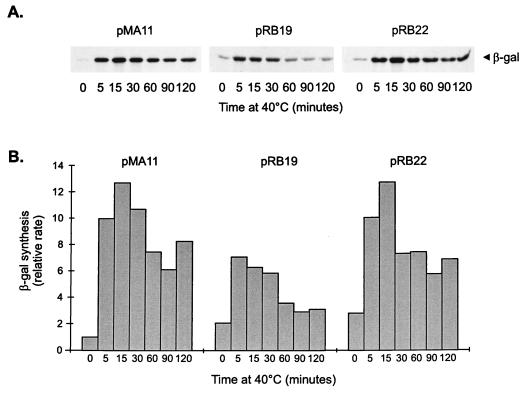
Time course of heat shock induction of β-galactosidase (β-gal) synthesis in different groESL-lacZ transcription fusions. (A) C. crescentus NA1000 cells harboring transcription fusion pMA11, pRB19, or pRB22 were subjected to heat shock at 40°C, and aliquots of cells were pulse-labelled with [35S]methionine for 2 min at the indicated times. Cells were then harvested by centrifugation, and protein extracts were immunoprecipitated with anti-β-galactosidase antibody to determine the rate of β-galactosidase synthesis before and during heat shock. (B) Relative rates of β-galactosidase synthesis determined by densitometry scanning of the autoradiograms.
FIG. 5
FIG. 5
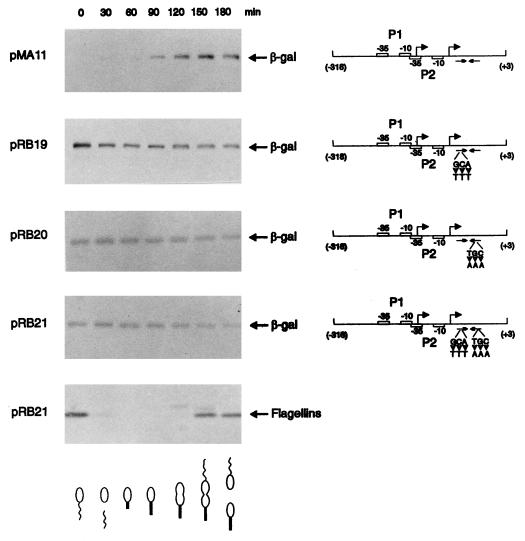
Transcription fusions containing mutations in the CIRCE element lose cell cycle control. Synchronized cultures of C. crescentus NA1000 harboring different transcription fusions were pulse-labelled with [35S]methionine at the indicated times during the cell cycle. Extracts of these cells were then immunoprecipitated with anti-β-galactosidase antibody, as described in Materials and Methods, to analyze the rate of β-galactosidase synthesis as a function of the cell cycle. A schematic representation of each transcription fusion is shown on the right. pMA11 is the wild-type construct; pRB19 and pRB20 carry mutations in the left arm and the right arm of the IR, respectively; pRB21 has mutations in both arms of the IR. As an internal control for cell synchrony, flagellin synthesis was determined throughout the cycle with the pRB21 construct. The drawings at the bottom of the figure are schematic representations of the C. crescentus cell cycle corresponding to the time indicated in each lane.
FIG. 6
FIG. 6
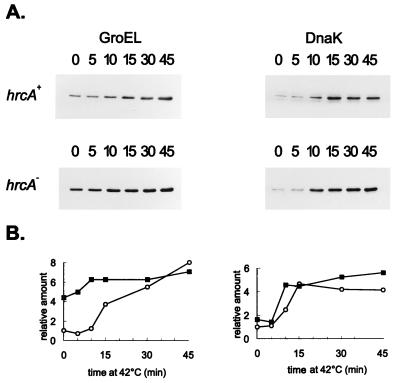
Effect of HrcA on the level of GroEL. Cells of C. crescentus NA1000 (hrcA+) or LS2293, which presents a disruption of the hrcA gene, were grown to mid-log phase at 30°C or shifted to 42°C for the times (minutes) indicated. Protein extracts were prepared and separated by SDS-polyacrylamide gel electrophoresis. After transfer of the proteins to nitrocellulose membranes, the blots were probed with antibody to GroEL or to DnaK, as described in Materials and Methods. Equal amounts of protein were applied to all lanes, and hrcA+ and hrcA samples were loaded on the same gel and processed together. The relative levels of GroEL and DnaK, determined by densitometry scanning of the films, are shown below the blots; hrcA+ (○) and hrcA (▪).
FIG. 7
FIG. 7
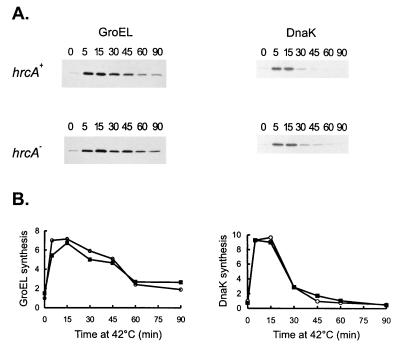
Effects of HrcA on GroEL and DnaK syntheses during heat shock. Cells of C. crescentus NA1000 (hrcA+) or LS2293 (hrcA) were subjected to heat shock at 40°C, and aliquots of cells were pulse-labelled with [35S]methionine for 2 min at the indicated times (in minutes). Cells were then harvested by centrifugation, and protein extracts were immunoprecipitated with anti-GroEL or anti-DnaK antibodies. The relative rates of GroEL and DnaK syntheses were determined by densitometry scanning of the autoradiograms. Symbols: ○, hrcA+; ▪, hrcA.
FIG. 8
FIG. 8
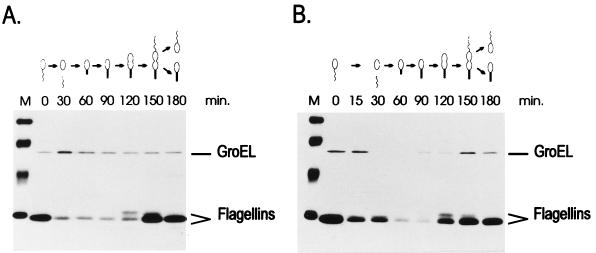
GroEL synthesis is constitutive in the hrcA null strain. Synchronized cultures of C. crescentus NA1000 (B) or LS2293 containing a disruption of the hrcA gene (A) were pulse-labelled with [35S]methionine at the indicated times during the cell cycle. Extracts of these cells were then immunoprecipitated with antisera against C. crescentus GroEL and antisera against C. crescentus flagellins, as described in Materials and Methods, to analyze GroEL and flagellin (as a control) synthesis as a function of the cell cycle. The drawings at the top of the figure are schematic representations of the C. crescentus cell cycle corresponding to the time indicated in each lane. M lanes contain 14C-labelled molecular mass markers (Amersham) in descending order: 97,400 Da, 66,000 Da, 46,000 Da, and 30,000 Da.
FIG. 9
FIG. 9
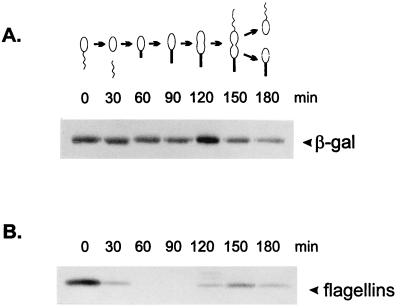
Transcription directed by groESL regulatory region is constitutive in the hrcA null strain. Synchronized cultures of C. crescentus hrcA null strain (LS2293) harboring the wild-type groESL-lacZ transcription fusion pMA11 were pulse-labelled with [35S]methionine at the indicated times during the cell cycle. Extracts of these cells were then immunoprecipitated with anti-β-galactosidase antibody, as described in Materials and Methods, to determine the rate of β-galactosidase (β-gal) synthesis as a function of the cell cycle. As a control of cell synchrony, the rate of flagellin synthesis was determined throughout the cycle.
FIG. 10
FIG. 10
Primer extension mapping of the transcription start sites in hrcA and CIRCE mutants. (A) An 18-nucleotide primer complementary to nucleotides −15 to +3 was 5′ end labelled and hybridized to 50 μg of total RNA isolated from NA1000 cells harboring transcription fusion pMA11 (lanes 1 and 5), pRB19 (lanes 2 and 6), pRB20 (lanes 3 and 7), or pRB21 (lanes 4 and 8) grown at 30°C or exposed to 42°C for 30 min. The hybrids were then extended by using reverse transcriptase, and the extension products were resolved by denaturing gel electrophoresis and autoradiography. (B) The same procedure as described above for panel A was performed except that the RNA used was isolated from NA1000 (lanes 1 and 3) or LS2293 cells (lanes 2 and 4) grown at 30°C or after a 15-min exposure to 42°C. The sequencing ladder shown in panel A was generated by using the same 18-residue oligonucleotide as the primer and the plasmid pUC19 containing the groESL regulatory region as the template. (C) Sequence of the 5′ region of the groESL operon. The transcription start site is shown by an arrow over the nucleotide sequence. The putative −10 and −35 regions of the P1 and P2 promoters are underlined. The CIRCE element is depicted by arrows under the nucleotide sequence. The oligonucleotide used in primer extension experiments is complementary to the sequence underlined twice. The ATG of the initiator methionine is shown in bold type.

References

    1. Antoine R, Locht C. Isolation and molecular characterization of a novel broad-host-range plasmid from Bordetella bronchiseptica with sequence similarities to plasmids from gram-positive organisms. Mol Microbiol. 1992;6:1785–1799. - PubMed
    1. Avedissian M, Gomes S L. Expression of the groESL operon is cell cycle controlled in Caulobacter crescentus. Mol Microbiol. 1996;19:79–89. - PubMed
    1. Avedissian M, Lessing D, Gober J W, Shapiro L, Gomes S L. Regulation of the Caulobacter crescentus dnaKJ operon. J Bacteriol. 1995;177:3479–3484. - PMC - PubMed
    1. Burnett B P, Horwich A L, Low K B. A carboxy-terminal deletion impairs the assembly of GroEL and confers a pleiotropic phenotype in Escherichia coli K-12. J Bacteriol. 1994;176:6980–6985. - PMC - PubMed
    1. Contreras I, Shapiro L, Henry S. Membrane phospholipid composition of Caulobacter crescentus. J Bacteriol. 1987;135:1130–1136. - PMC - PubMed

Publication types