. 1998 Apr;180(7):1723-8.
doi: 10.1128/JB.180.7.1723-1728.1998.

The TolQRA proteins are required for membrane insertion of the major capsid protein of the filamentous phage f1 during infection

Affiliations

The TolQRA proteins are required for membrane insertion of the major capsid protein of the filamentous phage f1 during infection

E M Click et al. J Bacteriol. 1998 Apr.

Abstract

Infection of Escherichia coli by the filamentous bacteriophage f1 is initiated by interaction of the end of the phage particle containing the gene III protein with the tip of the F conjugative pilus. This is followed by the translocation of the phage DNA into the cytoplasm and the insertion of the major phage capsid protein, pVIII, into the cytoplasmic membrane. DNA transfer requires the chromosomally encoded TolA, TolQ, and TolR cytoplasmic membrane proteins. By using radiolabeled phages, it can be shown that no pVIII is inserted into the cytoplasmic membrane when the bacteria contain null mutations in tolQ, -R and -A. The rate of infection can be varied by using bacteria expressing various mutant TolA proteins. Analysis of the infection process in these strains demonstrates a direct correlation between the rate of infection and the incorporation of infecting bacteriophage pVIII into the cytoplasmic membrane.


Figures
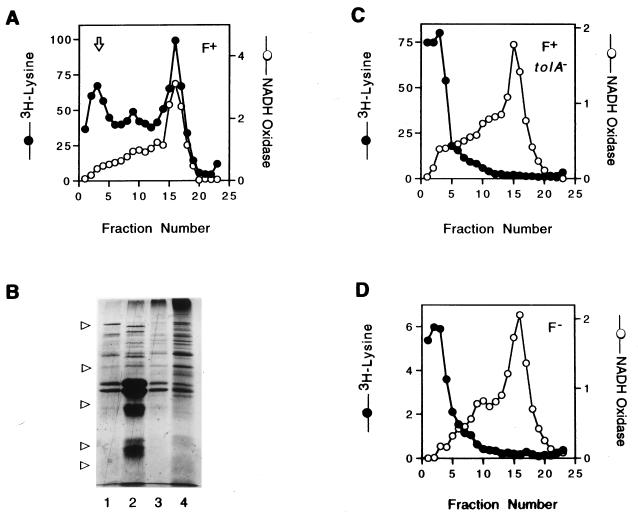
FIG. 1
FIG. 1
Phage coat protein pVIII from infecting phages is not found in the inner membranes of either F or tolA mutant bacteria. (A, C, and D) Cultures of K17DE3 bacteria that were F+ (A), tolA/F+ (C), or F (D) were infected with [3H]lysine-labeled phages (Table 1, experiment 1). The washed bacteria were broken in a French press, and the membrane fractions were separated by sucrose flotation gradient as described in Materials and Methods. The fractions, collected from the bottom of the gradient, were assayed for NADH oxidase activity, and radioactivity, which is expressed as counts per minute (in thousands), was determined. The arrow in panel A indicates the flotation position of both intact and broken phages. (B) Coomassie blue-stained SDS polyacrylamide gel of pooled fractions 1 to 5 (lane 1), 7 to 10 (lane 2), 11 to 13 (lane 3), and 14 to 18 (lane 4) from panel A. The arrows on the left indicate migration of protein standards with molecular masses (from the top) of 97, 45, 31, 21.5, and 14.4 kDa.
FIG. 2
FIG. 2
Subtilisin treatment of sheared bacteria infected with [35S]methionine-[35S]cysteine-labeled phages. Cultures of K17DE3/F+ and K17DE3tolA/F+ bacteria infected with [35S]methionine-[35S]cysteine-labeled phages were washed, sheared, divided in half, and then incubated in the presence (○) or absence (•) of subtilisin (Table 1, experiment 4) as described in Materials and Methods. Radiolabeled membranes (approximately 2 × 10⁵ cpm of K17DE3/F+ bacteria and 8 × 10³ cpm of K17DE3tolA/F+ bacteria) were analyzed as described in the legend to Fig. 1. Radioactivity, measured by counting 20 to 40% of each fraction for 10 min, is expressed as a percentage of the total in the gradient.
FIG. 3
FIG. 3
Infection of strains expressing TolA deletion mutant proteins. Cultures of K17DE3tolA/F+ bacteria containing plasmids expressing either TolAΔIIn (•), TolAΔIIc (□), TolAΔII (○), or no TolA (⧫) were infected for 15 min with 35S-labeled phages, and the membrane fractions of the washed cultures (approximately 3 × 10⁵ cpm) were analyzed as described in the legend to Fig. 1. Radioactivity is expressed as a percentage of the total in the gradient. The inset is an expanded scale comparing radioactivity in fractions 10 to 21 for bacteria with TolAΔII (○) and for bacteria with no TolA (♦). The washed cultures contained 6.4, 6.0, 5.2, and 5.2% of the input radioactivity, respectively.
FIG. 4
FIG. 4
Infection of tolQ and tolR mutant bacteria. Cultures of tol+ strain GM1 (•), tolR::Cm mutant TPS300 (◊), tolQ missense mutant TPS66 (▵), and tolQ amber mutant TPS13 expressing TolR from plasmid pPGK101 (□) were infected with [3H]lysine-labeled phages and analyzed as described in the legend to Fig. 1. Radioactivity is expressed as a percentage of the total in the gradient (approximately 1.5 × 10⁵ cpm per strain).

References

    1. Armstrong J, Perham R N, Walker J E. Domain structure of bacteriophage fd adsorption protein. FEBS Lett. 1981;135:167–172. - PubMed
    1. Armstrong J, Hewitt J A, Perham R N. Chemical modification of the coat protein in bacteriophage-fd and orientation of the virion during assembly and disassembly. EMBO J. 1983;2:1641–1646. - PMC - PubMed
    1. Boeke J D, Model P, Zinder N D. Effects of bacteriophage f1 gene III protein on the host cell membrane. Mol Gen Genet. 1982;186:185–188. - PubMed
    1. Click E M, Webster R E. Filamentous phage infection: required interactions with the TolA protein. J Bacteriol. 1997;179:6464–6471. - PMC - PubMed
    1. Davies J K, Reeves P. Genetics of resistance to colicins in Escherichia coli K-12: cross-resistance among colicins of group A. J Bacteriol. 1975;123:102–117. - PMC - PubMed

Publication types

LinkOut - more resources