


doi: 10.1128/JB.180.7.1973-1977.1998.
Characterization of the Aspergillus nidulans nmrA gene involved in nitrogen metabolite repression
Affiliations
- PMID: 9537404
- PMCID: PMC107119
- DOI: 10.1128/JB.180.7.1973-1977.1998
Item in Clipboard
Characterization of the Aspergillus nidulans nmrA gene involved in nitrogen metabolite repression
J Bacteriol.
1998 Apr.
Abstract
The gene nmrA of Aspergillus nidulans has been isolated and found to be a homolog of the Neurospora crassa gene nmr-1, involved in nitrogen metabolite repression. Deletion of nmrA results in partial derepression of activities subject to nitrogen repression similar to phenotypes observed for certain mutations in the positively acting areA gene.
Figures
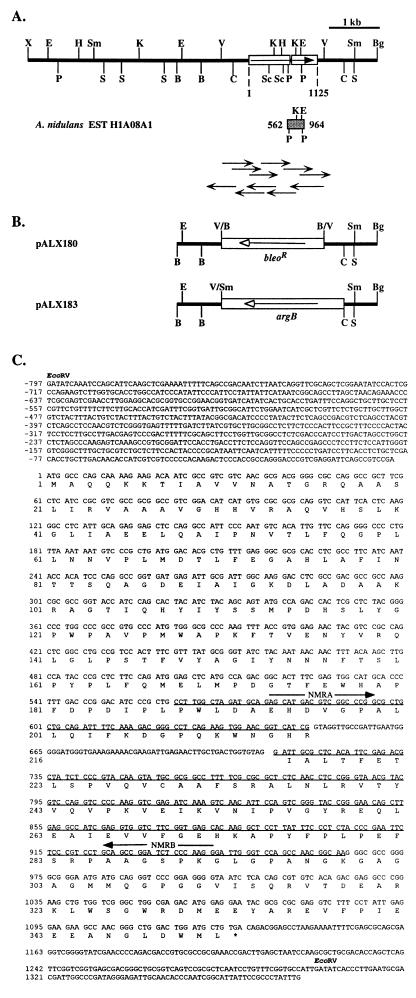
(A) Restriction map of the 7-kb XbaI-BglII fragment containing the gene nmrA. The two exons of the coding region (open rectangles) and the direction of transcription (arrow) are shown. The flanking coordinates of the open reading frame relative to the translational start are shown below the map. The location and coordinates of the EST (hatched rectangle) are shown. The gene nmrA was sequenced with a combination of dye primer and dye terminator reactions on an ABI 377 sequencer by the strategy shown, with the direction and size of the arrows indicating the strand and length of sequence. Restriction sites are BamHI (B), BglII (Bg), ClaI (C), EcoRI (E), EcoRV (V), HindIII (H), KpnI (K), PstI (P), SacI (Sc), SalI (S), SmaI (Sm), and XbaI (X). (B) Deletion constructs. pALX180, in which the EcoRV fragment spanning the entire coding region of nmrA as well as approximately 800 and 200 bp of 5′ and 3′ sequences, respectively, was replaced with an end-filled BamHI fragment containing the bleomycin resistance gene from pAmPh520 (3), and pALX183, in which the ClaI-EcoRV fragment spanning the entire coding region of nmrA as well as approximately 800 bp from both 5′ and 3′ sequences was replaced with a ClaI-SmaI fragment containing the A. nidulans gene argB (38). The flanking sequences (solid line) and selectable markers (open rectangles) and their direction of transcription (arrow) are shown. (C) Nucleotide and conceptual protein sequence of nmrA. The region encompassed by the EST (underlined) and the oligonucleotide primers NMRA and NMRB (arrow) used for the PCR-generated nmrA probe are shown. The two EcoRV restriction sites are marked for reference to the map in panel A. Nucleotides are numbered with reference to the +1 at the start of the coding region.
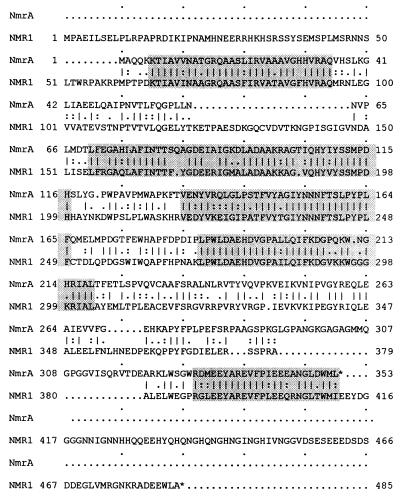
Alignment of the A. nidulans NmrA and N. crassa NMR1 conceptual protein sequences. The alignment was generated with GAP from the Wisconsin package (version 8; Genetics Computer Group, Madison, Wis.) with the Dayhoff protein comparison weight matrix, a GAP weight of 3, and a length weight of 0.1. Identities between the two sequences are marked with vertical lines, and similarities are marked by colons. The five regions of highest identity are shaded. The two sequences show 60.8% identity and 75.5% similarity over their entire region.
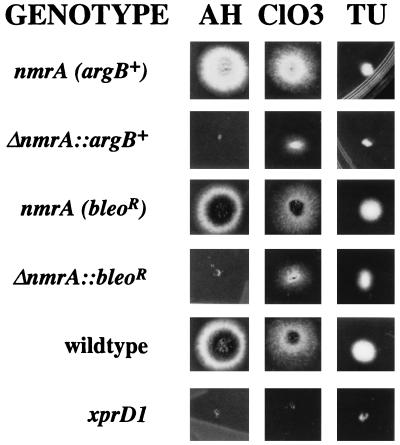
Growth properties of nmrA deletion strains. Growth was scored for 2 to 3 days at 37°C on 1% glucose medium (9) containing 5 mM ammonium tartrate together with 200 mM potassium chlorate (ClO3), 5 mM ammonium tartrate together with 5 mM d ,l -β-aspartylhydroxamate (AH), and 2.5 mM ammonium tartrate with 10 mM thiourea (TU) with appropriate auxotrophic supplements. The ΔnmrA::argB+ strain was generated by transformation of a strain whose genotype was yA1 pabaA1 argB1 amdA7 with a gel-purified insert of pALX183 selecting for arginine prototrophy (Fig. 1B). The nmrA+ (argB+) control strain was an ArgB+ transformant from the same transformation that did not result in the deletion of nmrA. The ΔnmrA::bleoR strain was obtained by transformation of a strain whose genotype was biA1 amdS::lacZ niiA4 with a gel-purified insert of pALX180 (Fig. 1B) selecting for resistance to bleomycin. The nmrA+ (bleoR) control strain was a bleomycin-resistant transformant from the same transformation that did not result in the deletion of nmrA. The genotypes of the strains designated wild type and xprD1 were biA1 and biA1 amdS::lacZ xprD1 niiA4, respectively. Genotypes and phenotypes were reported by Clutterbuck (5). The xprD1 mutation results from an inversion truncating the areA gene (2, 25).
References
-
- Arst H N. Integrator gene in Aspergillus nidulans. Nature. 1976;262:231–234. - PubMed
-
- Arst H N. A near terminal pericentric inversion leads to nitrogen metabolite derepression in Aspergillus nidulans. Mol Gen Genet. 1982;188:490–493. - PubMed
-
- Austin B, Hall R M, Tyler B M. Optimized vectors and selection for transformation of Neurospora crassa and Aspergillus nidulans to bleomycin and phleomycin resistance. Gene. 1990;93:157–162. - PubMed
-
- Clutterbuck A J. Aspergillus nidulans genetics. In: King R C, editor. Handbook of genetics. Vol. 1. New York, N.Y: Plenum Publishing Corp.; 1974. pp. 447–510.
Publication types
MeSH terms
Substances
Associated data
- Actions
LinkOut - more resources
Full Text Sources
Molecular Biology Databases
