


Gene number in an invertebrate chordate, Ciona intestinalis
- PMID: 9539755
- PMCID: PMC22507
- DOI: 10.1073/pnas.95.8.4437
Gene number in an invertebrate chordate, Ciona intestinalis
Abstract
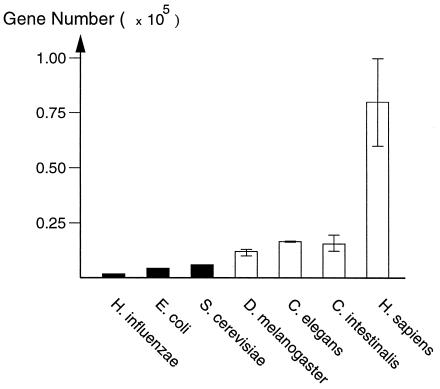
Gene number can be considered a pragmatic measure of biological complexity, but reliable data is scarce. Estimates for vertebrates are 50-100,000 genes per haploid genome, whereas invertebrate estimates fall below 25,000. We wished to test the hypothesis that the origin of vertebrates coincided with extensive gene creation. A prediction is that gene number will differ sharply between invertebrate and vertebrate members of the chordate phylum. A gene number estimation method requiring limited sequence sampling of genomic DNA was developed and validated by using data for Caenorhabditis elegans. Using the method, we estimated that the invertebrate chordate Ciona intestinalis has 15,500 protein-coding genes (+/-3,700). This number is significantly lower than gene numbers of vertebrate chordates, but similar to those of invertebrates in distantly related phyla. The data indicate that evolution of vertebrates was accompanied by a dramatic increase in protein-coding capacity of the genome.
Figures
References
-
- Ohno S. Evolution by Gene Duplication. Heidelberg: Springer; 1970.
-
- Holland, P. W. H., Garcia-Fernàndez, J., Williams, N. A. & Sidow, A. (1994) Development (Cambridge, U.K.), Suppl., 125–133. - PubMed
-
- Bird A P. Trends Genet. 1995;11:94–100. - PubMed
-
- Waterston R, Martin C, Craxton M, Huynh C, Coulson A, Hillier L, Durbin R, Green P, Shownkeen R, Halloran N, et al. Nat Genet. 1992;1:114–123. - PubMed
-
- Cavalier-Smith T. The Evolution of Genome Size. Chichester: Wiley; 1985.
Publication types
MeSH terms
Substances
Associated data
- Actions
- Actions
- Actions
- Actions
- Actions
- Actions
- Actions
- Actions
- Actions
- Actions
- Actions
- Actions
- Actions
- Actions
- Actions
- Actions
- Actions
- Actions
- Actions
- Actions
- Actions
- Actions
- Actions
- Actions
- Actions
- Actions
- Actions
- Actions
- Actions
- Actions
Grants and funding
LinkOut - more resources
Full Text Sources
Other Literature Sources
