. 1998 Apr 14;95(8):4469-74.
doi: 10.1073/pnas.95.8.4469.

Functional copies of a human gene can be directly isolated by transformation-associated recombination cloning with a small 3' end target sequence

Affiliations

Functional copies of a human gene can be directly isolated by transformation-associated recombination cloning with a small 3' end target sequence

N Kouprina et al. Proc Natl Acad Sci U S A. .

Abstract

Unique, small sequences (sequence tag sites) have been identified at the 3' ends of most human genes that serve as landmarks in genome mapping. We investigated whether a single copy gene could be isolated directly from total human DNA by transformation-associated recombination (TAR) cloning in yeast using a short, 3' unique target. A TAR cloning vector was constructed that, when linearized, contained a small amount (381 bp) of 3' hypoxanthine phosphoribosyltransferase (HPRT) sequence at one end and an 189-bp Alu repeat at the other end. Transformation with this vector along with human DNA led to selective isolations of the entire HPRT gene as yeast artificial chromosomes (YACs) that extended from the 3' end sequence to various Alu positions as much as 600 kb upstream. These YACs were retrofitted with a NeoR and a bacterial artificial chromosome (BAC) sequence to transfer the YACs to bacteria and subsequently the BACs to mouse cells by using a Neo selection. Most of the HPRT isolates were functional, demonstrating that TAR cloning retains the functional integrity of the isolated material. Thus, this modified version of TAR cloning, which we refer to as radial TAR cloning, can be used to isolate large segments of the human genome accurately and directly with only a small amount of sequence information.


Figures
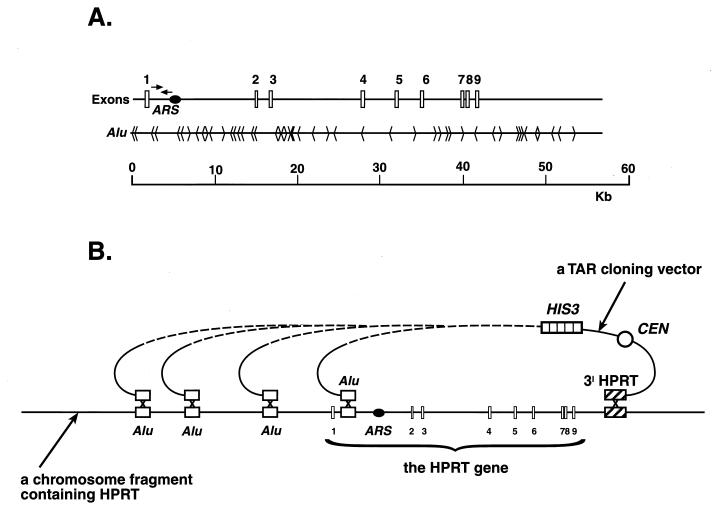
Figure 1
Figure 1
Isolation of the human HPRT gene by radial TAR cloning. (A) The structure of the human HPRT gene (5). The gene contains nine exons. The position and orientation of 49 Alu sequences within the locus are shown in the context of the known ARS in intron 1. Arrows indicate the positions of primers used for initial identification of clones containing the HPRT gene. (B) A scheme of isolation of HPRT as a series of circular YACs using a TAR cloning vector containing a 3′ HPRT sequence and an Alu repeat. Yeast spheroplasts are transformed with genomic human DNA along with a TAR cloning vector containing the 3′ sequence (dotted box) and the Alu (see Materials and Methods) at the ends of the linearized plasmid. Recombination between the sequences in the vector and genomic DNA containing HPRT leads to the establishment of circular YACs that extend from the 3′ sequence to various Alu positions. Because the vector lacks an ARS, the only YACs that will be stably maintained are those that include human DNA fragments containing a yeast ARS-like sequence. In the present scheme, only YACs that include a fragment extending upstream from intron 1 can be propagated because that is the position of the first ARS-like sequence in the HPRT region extending from the 3′ hook (15). CEN corresponds to the yeast chromosome VI centromere, and HIS3 is a selectable marker.
Figure 2
Figure 2
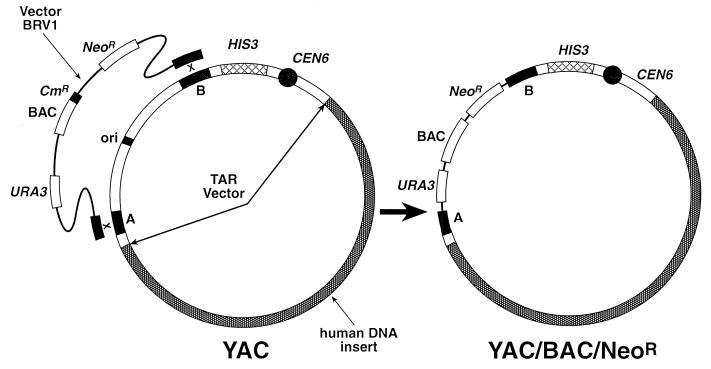
Retrofitting of a circular YAC into a BAC containing the NeoR mammalian selectable marker. The retrofitting vector BRV1 contains two targeting sequences, A and B, flanking the ColE1 origin of replication in a TAR cloning vector used for a gene isolation. Recombination between the BamHI-linearized BRV1 vector and a YAC during yeast transformation leads to replacement of the ColE1 origin of replication in the TAR cloning vector by a cassette containing the F factor origin of replication (BAC), the chloramphenicol acetyltransferase (CmR) gene, the NeoR gene, and the URA3 yeast selectable marker.

References

    1. Larionov V, Kouprina N, Solomon G, Barrett J C, Resnick M A. Proc Natl Acad Sci USA. 1997;94:7384–7387. - PMC - PubMed
    1. Ketner G, Spencer F, Tugendreich S, Connelly C, Hieter P. Proc Natl Acad Sci USA. 1994;91:6186–6190. - PMC - PubMed
    1. Stinchomb D T, Thomas M, Kelly I, Selker E, Davis R W. Proc Natl Acad Sci USA. 1980;77:4559–4563. - PMC - PubMed
    1. Larionov V, Kouprina N, Graves J, Chen X-N, Korenberg J R, Resnick M A. Proc Natl Acad Sci USA. 1996;93:491–496. - PMC - PubMed
    1. Edwards A, Voss H, Rice P, Civitello A, Stegemann J, Schwager C, Zimmermann J, Erfle H, Caskey C T, Ansorge W. Genomics. 1990;6:593–608. - PubMed

Publication types

Substances

LinkOut - more resources