


Latent varicella-zoster virus is located predominantly in neurons in human trigeminal ganglia
- PMID: 9539794
- PMCID: PMC22546
- DOI: 10.1073/pnas.95.8.4658
Latent varicella-zoster virus is located predominantly in neurons in human trigeminal ganglia
Abstract
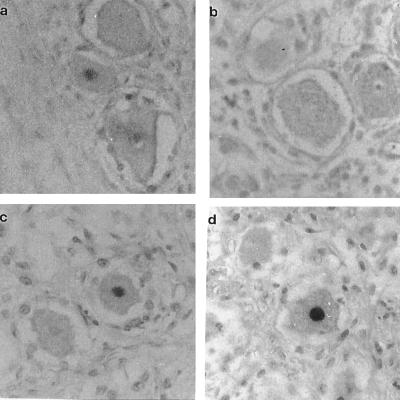
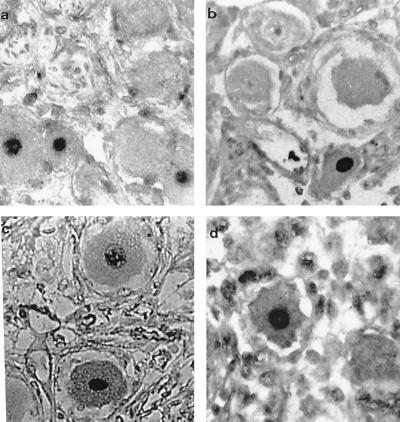
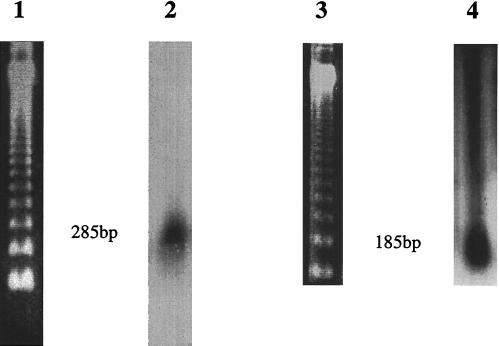
Varicella-zoster virus (VZV) is a human herpesvirus that causes varicella (chicken pox) as a primary infection and, after a variable period of latency in trigeminal and dorsal root ganglia, reactivates to cause herpes zoster (shingles). Both of these conditions may be followed by a variety of neurological complications, especially in immunocompromised individuals such as those with human immunodeficiency virus (HIV) infection. There have been a number of conflicting reports regarding the cellular location of latent VZV within human ganglia. To address this controversy we examined fixed wax-embedded trigeminal ganglia from 30 individuals obtained at autopsy, including 11 with HIV infection, 2 neonates, and 17 immunocompetent individuals, for the presence of latent VZV. Polymerase chain reaction (PCR), in situ hybridization, and PCR in situ amplification techniques with oligonucleotide probes and primer sequences to VZV genes 18, 21, 29, and 63 were used. VZV DNA in ganglia was detected in 15 individuals by using PCR alone, and in 12 individuals (6 normal non-HIV and 6 positive HIV individuals, but not neonatal ganglia) by using PCR in situ amplification. When in situ hybridization alone was used, 5 HIV-positive individuals and only 1 non-HIV individual showed VZV nucleic acid signals in ganglia. In all of the VZV-positive ganglia examined, VZV nucleic acid was detected in neuronal nuclei. Only occasional nonneuronal cells contained VZV DNA. We conclude from these studies that the neuron is the predominant site of latent VZV in human trigeminal ganglia.
Figures
References
-
- Meier J L, Straus S E. J Infect Dis. 1992;166:S13–S23. - PubMed
-
- Kennedy P G E. Infections of the Nervous System. London: Butterworth; 1987. pp. 117–208.
-
- Amlie-Lefond C, Kleinschmidt-DeMasters B K, Mahalingam R, Davis L E, Gilden D H. Ann Neurol. 1995;37:784–790. - PubMed
-
- Weller T H. J Infect Dis. 1992;166:S1–S6. - PubMed
-
- Steiner I, Kennedy P G E. Mol Neurobiol. 1993;7:137–159. - PubMed
Publication types
MeSH terms
Substances
Grants and funding
LinkOut - more resources
Full Text Sources
Other Literature Sources
