. 1998 Apr;64(4):1466-71.
doi: 10.1128/AEM.64.4.1466-1471.1998.

Gene cloning, transcriptional analysis, purification, and characterization of phenolic acid decarboxylase from Bacillus subtilis

Affiliations

Gene cloning, transcriptional analysis, purification, and characterization of phenolic acid decarboxylase from Bacillus subtilis

J F Cavin et al. Appl Environ Microbiol. 1998 Apr.

Abstract

Bacillus subtilis displays a substrate-inducible decarboxylating activity with the following three phenolic acids: ferulic, p-coumaric, and caffeic acids. Based on DNA sequence homologies between the Bacillus pumilus ferulate decarboxylase gene (fdc) (A. Zago, G. Degrassi, and C. V. Bruschi, Appl. Environ. Microbiol. 61:4484-4486, 1995) and the Lactobacillus plantarum p-coumarate decarboxylase gene (pdc) (J.-F. Cavin, L. Barthelmebs, and C. Diviès, Appl. Environ. Microbiol. 63:1939-1944, 1997), a DNA probe of about 300 nucleotides for the L. plantarum pdc gene was used to screen a B. subtilis genomic library in order to clone the corresponding gene in this bacterium. One clone was detected with this heterologous probe, and this clone exhibited phenolic acid decarboxylase (PAD) activity. The corresponding 5-kb insertion was partially sequenced and was found to contain a 528-bp open reading frame coding for a 161-amino-acid protein exhibiting 71 and 84% identity with the pdc- and fdc-encoded enzymes, respectively. The PAD gene (pad) is transcriptionally regulated by p-coumaric, ferulic, or caffeic acid; these three acids are the three substrates of PAD. The pad gene was overexpressed constitutively in Escherichia coli, and the stable purified enzyme was characterized. The difference in substrate specificity between this PAD and other PADs seems to be related to a few differences in the amino acid sequence. Therefore, this novel enzyme should facilitate identification of regions involved in catalysis and substrate specificity.


Figures
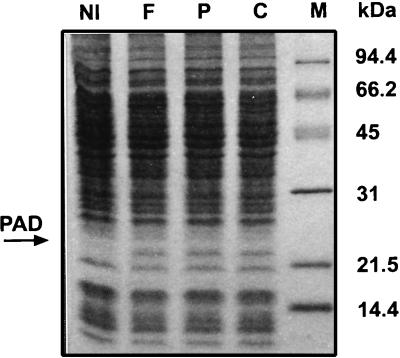
FIG. 1
FIG. 1
SDS-PAGE of crude cell extracts from a B. subtilis uninduced culture (lane NI) and from cultures induced with ferulic acid (lane F), p-coumaric acid (lane P), and caffeic acid (lane C). Lane M contained molecular mass standards.
FIG. 2
FIG. 2
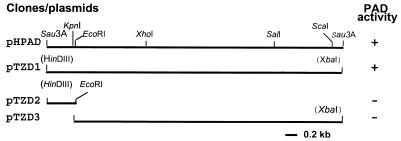
Physical and restriction map of the 5-kb insertion from pHPAD. Fragments that were subcloned in pTZ19R are shown, and the corresponding PAD activities are indicated on the right. Restriction sites in parentheses belong to the multicloning site of the vectors.
FIG. 3
FIG. 3
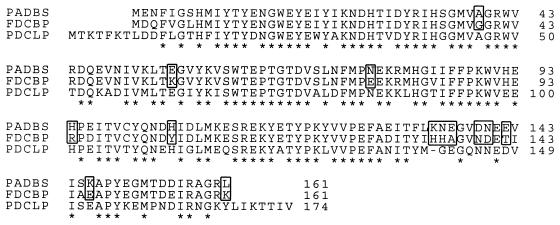
Comparison of the deduced amino acid sequence encoded by the pad gene of B. subtilis (PADBS) with the sequences of B. pumilus FDC (FDCBP) (accession no. X84815) and L. plantarum PDC (PDCLP) (accession no. U63827). The sequences were aligned by using the Clustal program. Asterisks indicate identical amino acids. The numbers on the right are the amino acid positions in the protein sequences. PAD residues that are neither identical nor similar to FDC residues are enclosed in boxes.
FIG. 4
FIG. 4
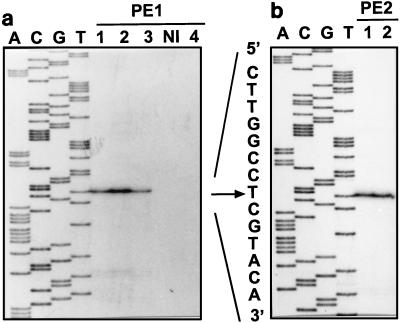
Mapping of the 5′ end of B. subtilis pad mRNA (arrow) by primer extension analysis. (a) Primer BSD2 (PE1) was used with total RNA from uninduced cells (lane NI) and cells induced by adding 1.2 mM ferulic acid (lane 1), p-coumaric acid (lane 2), caffeic acid (lane 3), and cinnamic acid (lane 4). (b) Primer BSD4 (PE2) was used with RNA from cells induced with ferulic acid (lane 1) and p-coumaric acid (lane 2). The products of the reverse transcriptase reactions were coelectrophoresed with DNA sequencing reaction mixtures (lanes A, C, G, and T) initiated with the same primers on pad template DNA.
FIG. 5
FIG. 5
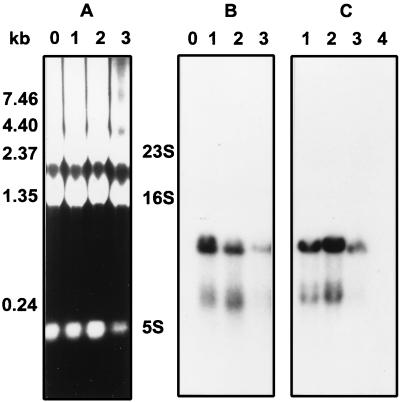
(A) Denaturing agarose gel electrophoresis of total RNA (10 μg per lane) from B. subtilis uninduced cells (lane 0) and induced cells harvested 10 min (lane 1), 30 min (lane 2), and 60 min (lane 3) after 1.2 mM ferulic acid was added. (B) Corresponding Northern blot analysis. (C) Northern blot analysis of total RNA purified from cells induced for 10 min with ferulic acid (lane 1), p-coumaric acid (lane 2), caffeic acid (lane 3), and cinnamic acid (lane 4). The Northern blot analysis was performed with a [α-32P]dATP-radiolabeled probe that was PCR synthesized by using plasmid pHPAD as a template.
FIG. 6
FIG. 6
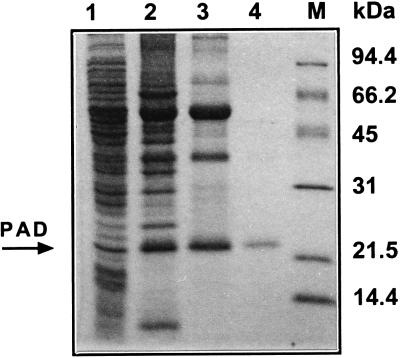
SDS-PAGE of protein extracts obtained during purification of PAD from recombinant E. coli(pHPAD). Lane 1, crude extract; lane 2, (NH4)2PO4-saturated fraction; lane 3, Q-Sepharose fraction; lane 4, second Methyl HIC step fraction (2.5 μg of purified enzyme); lane M, molecular mass standards.
FIG. 7
FIG. 7
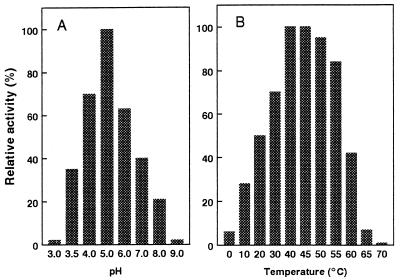
Temperature optimum (A) and pH optimum (B) of purified PAD.

References

    1. Akin D E. Biological structure of lignocellulose and its degradation in the rumen. Anim Feed Sci Technol. 1988;21:215–310.
    1. Arantes O, Lereclus D. Construction of cloning vectors for Bacillus thuringiensis. Gene. 1991;108:115–119. - PubMed
    1. Bertani G. Studies on lysogenesis. I. The mode of phage liberation by lysogenic Escherichia coli. J Bacteriol. 1951;60:293–300. - PMC - PubMed
    1. Cavin J F, Barthelmebs L, Guzzo J, Van Beeumen J, Bart S, Travers J F, Diviès C. Purification and characterization of an inducible p-coumaric acid decarboxylase from Lactobacillus plantarum. FEMS Microbiol Lett. 1997;147:291–295. - PMC - PubMed
    1. Cavin J-F, Barthelmebs L, Diviès C. Molecular characterization of an inducible p-coumaric acid decarboxylase from Lactobacillus plantarum: gene cloning, transcriptional analysis, overexpression in Escherichia coli, purification, and characterization. Appl Environ Microbiol. 1997;63:1939–1944. - PMC - PubMed

Publication types

MeSH terms

Associated data

LinkOut - more resources