. 1998 May 15;509 ( Pt 1)(Pt 1):183-94.
doi: 10.1111/j.1469-7793.1998.183bo.x.

Contribution of the Kv3.1 potassium channel to high-frequency firing in mouse auditory neurones

Affiliations

Contribution of the Kv3.1 potassium channel to high-frequency firing in mouse auditory neurones

L Y Wang et al. J Physiol. .

Abstract

1. Using a combination of patch-clamp, in situ hybridization and computer simulation techniques, we have analysed the contribution of potassium channels to the ability of a subset of mouse auditory neurones to fire at high frequencies. 2. Voltage-clamp recordings from the principal neurones of the medial nucleus of the trapezoid body (MNTB) revealed a low-threshold dendrotoxin (DTX)-sensitive current (ILT) and a high-threshold DTX-insensitive current (IHT). 3. IHT displayed rapid activation and deactivation kinetics, and was selectively blocked by a low concentration of tetraethylammonium (TEA; 1 mM). 4. The physiological and pharmacological properties of IHT very closely matched those of the Shaw family potassium channel Kv3.1 stably expressed in a CHO cell line. 5. An mRNA probe corresponding to the C-terminus of the Kv3.1 channel strongly labelled MNTB neurones, suggesting that this channel is expressed in these neurones. 6. TEA did not alter the ability of MNTB neurones to follow stimulation up to 200 Hz, but specifically reduced their ability to follow higher frequency impulses. 7. A computer simulation, using a model cell in which an outward current with the kinetics and voltage dependence of the Kv3.1 channel was incorporated, also confirmed that the Kv3.1- like current is essential for cells to respond to a sustained train of high-frequency stimuli. 8. We conclude that in mouse MNTB neurones the Kv3.1 channel contributes to the ability of these cells to lock their firing to high-frequency inputs.


Figures
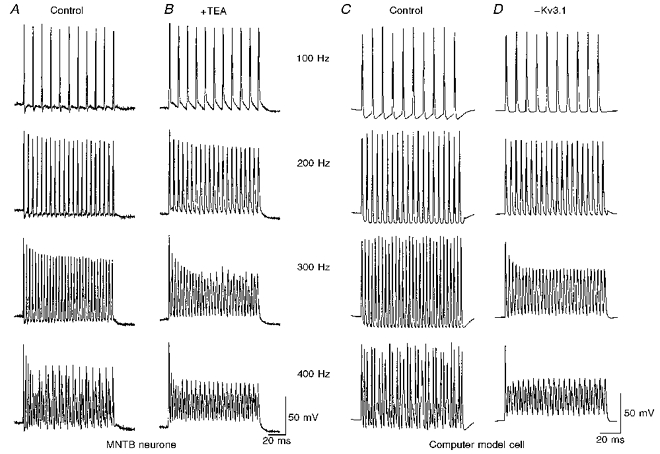
Figure 5
Figure 5. Contribution of IHT to the ability of MNTB neurones or computer-generated model cells to respond to high-frequency stimulation
A, a typical recording from an MNTB neurone showing that a train of action potentials can be evoked by directly injecting short current pulses (2 nA, 0.3 ms) at four different test frequencies (100 to 400 Hz). Some failure in action potential generation can be seen at 400 Hz. B, after application of 1 mm TEA, individual action potentials were broadened. At 300 Hz, this neurone failed to fire full-size action potentials after the first 3 or 4 impulses. At 400 Hz, the cell no longer fired normal action potentials (except the first spike of the train) and instead showed slow waves of oscillation. C, simulations of a model cell characterized by sodium, ILT- and IHT-like conductances, as well as a leakage conductance. The cell was stimulated by brief current pulses (1.4 nA, 0.25 ms) applied at frequencies from 100 to 400 Hz. D, responses of the model cells to the same stimuli after elimination of the IHT conductance.
Figure 1
Figure 1
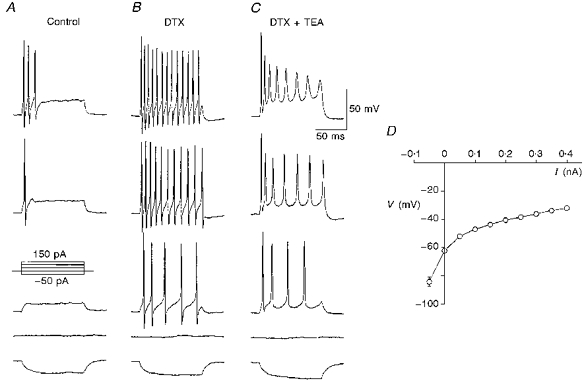
Multiple outwardly rectifying conductances underlying the firing pattern in MNTB neuronesA, the response of a MNTB neurone to a series of current injections from -50 to 150 pA with increments of 50 pA. The resting potential before current injections was about -60 mV. B, when this cell was exposed to 100 nm DTX, the number of spikes elicited increased during depolarizing current injections, even at a previously subthreshold current level (50 pA, 3rd trace of the panel). Similar observations were made in three other cells. C, co-application of TEA (1 mm) and DTX (100 nm) caused a reduction in both the number and amplitude of spikes in response to the same depolarizing current injections as in B. D, voltage-current relationship for data averaged from 11 MNTB neurones. The measurement of voltage at different current injection levels was made at 145 ms into the pulse.
Figure 2
Figure 2. Different components of the voltage-dependent potassium current and their sensitivity to potassium channel blockers
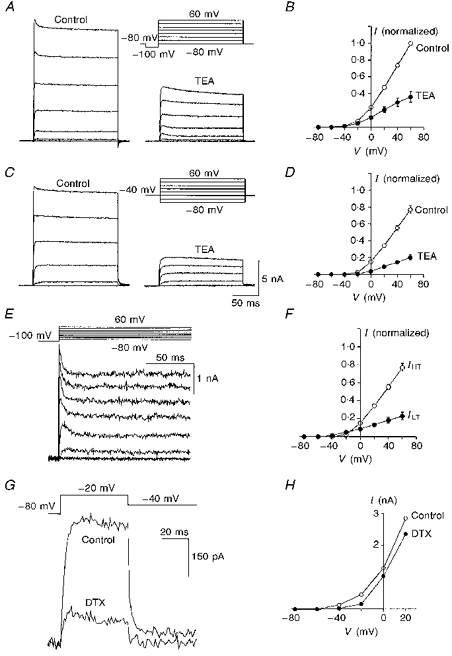
A, the total outward current (left panel) from an MNTB neurone was recorded by stepping from a holding potential of -80 mV to +60 mV in 20 mV increments. Each 200 ms step was preceded by a 30 ms prepulse to -100 mV. Addition of 1 mm TEA blocked a large portion of the current (right panel). B, the averaged current-voltage relationship in the absence and presence of TEA. C,IHT recorded using the same voltage protocol as in A after maintaining the holding potential at -40 mV for 2 min (left panel). The amount of block by TEA (right panel) was increased substantially compared with A. D, the average current-voltage relationship before and after addition of TEA from a holding potential of -40 mV. E,ILT obtained by subtracting IHT in C (left panel) from total outward currents in A (left panel). F, the relative distribution of ILTversusIHT is shown in two sets of averaged current-voltage curves. Note that the threshold for activation of ILT is 20 mV more negative than that for IHT. G,ILT was recorded directly by stepping from a holding potential of -80 mV to -20 mV. Application of DTX (100 nm) reduced the current to 25.0 ± 2.1 % (n= 3) of the control amplitude. H, current-voltage relationship from one recording before and after DTX addition. Holding potential was -80 mV. The averaged data plotted in B, D and F (n= 9) was taken from measurements made at 195 ms into the pulse. The current amplitude at any given voltage in different cells was normalized to that recorded at +60 mV under control conditions.
Figure 3
Figure 3. Positive labelling of MNTB neurones by a Kv3.1 antisense probe
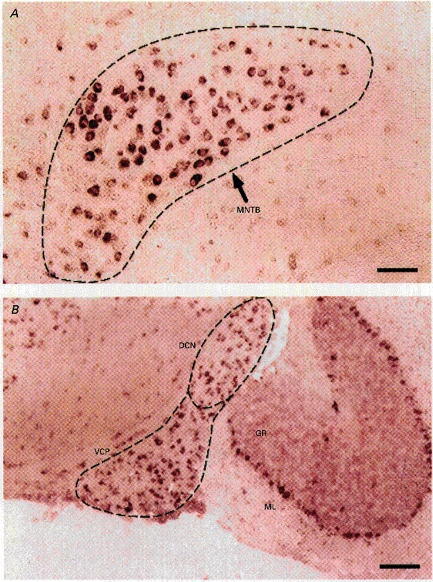
A, strong labelling of the principal neurones of the MNTB region. B, labelling of neurones in the dorsal cochlear nucleus (DCN), ventral posterior cochlear nucleus (VCP), cerebellar granule cells (GR) and Purkinje neurones. The latter are situated between the molecular layer (ML) and the GR layer. This experiment was performed on a 12-day postnatal mouse. Scale bar, 100 μm.
Figure 4
Figure 4. Physiological correlation between IHT and the Kv3.1 current
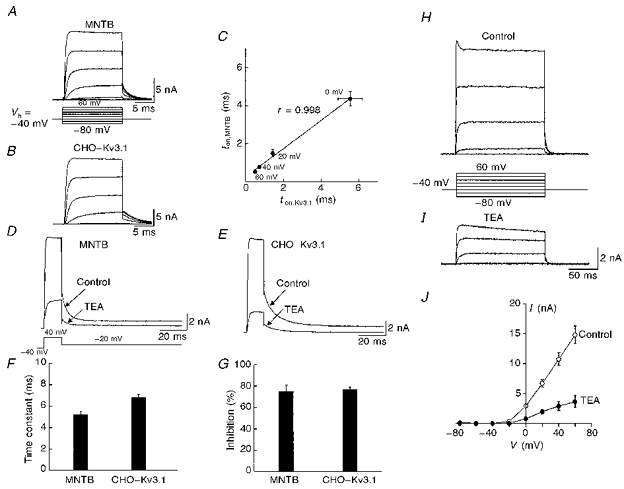
A and B, representative current traces recorded from an MNTB neurone and a CHO-Kv3.1 cell in response to a series of voltage steps from -80 to +60 mV in 20 mV increments. C, the 10-90 % rise time for maximal activation for MNTB neurones (ton,MNTB, n= 9) is plotted against that for CHO-Kv3.1 cells (ton,Kv3.1, n= 6) at different test voltages. D and E, similar kinetics of the tail currents recorded from an MNTB neurone and a CHO-Kv3.1 cell, and similar block by 1 mm TEA. These tail currents were well fitted by a single exponential function. F and G, a summary of the time constants calculated from the fitting of tail currents and the extent of block by TEA. H and I, current traces recorded from a CHO-Kv3.1 cell before and after addition of TEA (1 mm). J, the averaged current-voltage curves from seven CHO-Kv3.1 cells. The holding potential for these recordings was -40 mV.

References

    1. Barnes-Davies M, Forsythe ID. Pre- and postsynaptic glutamate receptors at a giant excitatory synapse in rat auditory brainstem slices. Journal of Physiology. 1995;488:387–406. - PMC - PubMed
    1. Brew HM, Forsythe ID. Two voltage-dependent K+ conductances with complementary functions in postsynaptic integration at a central auditory synapse. Journal of Neuroscience. 1995;15:8011–8022. - PMC - PubMed
    1. Brownell WE. Organization of the cat trapezoid body and the discharge characteristics of its fibres. Brain Research. 1975;94:413–433. - PubMed
    1. Chandy KG, Gutman GA. Voltage-gated K+ channels. In: North RA, editor. CRC Handbook of Receptors and Channels. Boca Raton, FL, USA: CRC; 1995. pp. 1–71.
    1. Critz SD, Wible BA, Lopez HS, Brown AM. Stable expression and regulation of a rat brain K+ channel. Journal of Neurochemistry. 1993;60:1175–1178. - PubMed

Publication types

LinkOut - more resources