Fatality outside hospital from acute coronary events in three British health districts, 1994-5. United Kingdom Heart Attack Study Collaborative Group
- PMID: 9552910
- PMCID: PMC28511
Fatality outside hospital from acute coronary events in three British health districts, 1994-5. United Kingdom Heart Attack Study Collaborative Group
Abstract
Objectives: To provide a contemporary account of the treatment and outcomes of acute coronary attacks in England and Wales and to identify strategies that might improve the outcome.
Design: Two year community and hospital based study in three British health districts.
Setting: Health districts of Brighton (population 282,000), South Glamorgan (408,000), and York (264,000).
Subjects: 3523 men and women under 75 years of age who died outside hospital from acute coronary causes, who were admitted to hospital with acute myocardial infarction, or who developed acute infarction or died unexpectedly from acute coronary causes while they were already in hospital.
Interventions: Attempted resuscitation in people having a cardiac arrest outside hospital.
Main outcome measures: Total case fatality, case fatality outside and inside hospital, and the effect of resuscitation on case fatality outside hospital.
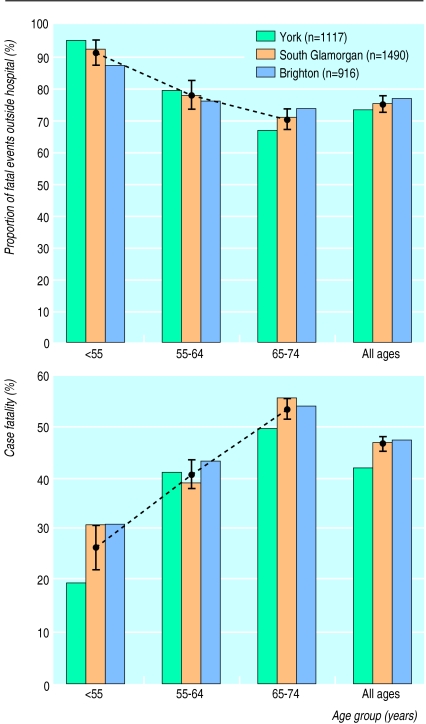
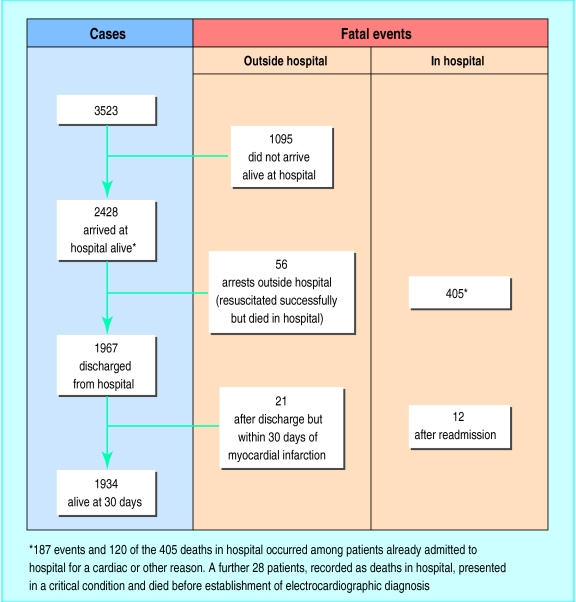
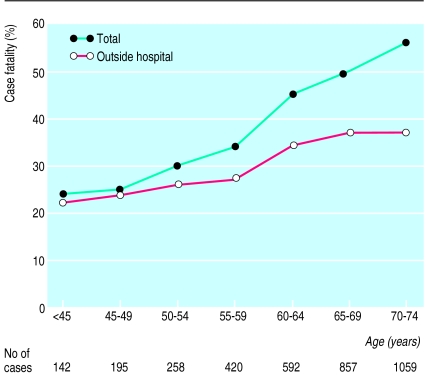
Results: 1589 patients died within 30 days of the acute event. Case fatality was 45% (95% confidence interval 43% to 47%), rising from 27% (160/595) (23% to 31%) at age < 55 years to 53% (1019/1916) (51% to 55%) at 65-74 years. Overall, 74% (1172/1589) (72% to 76%) of fatal events happened outside hospital, and there was a negative age gradient (P < 0.001) such that 91% (145/160) (87% to 95%) of fatalities occurred outside hospital at age < 55 compared with 70% (710/1019) (67% to 73%) at 65-74 years. Without successful resuscitation of 55 patients outside hospital, total case fatality at 30 days would have risen from 45% to 46.7%.
Conclusion: Opportunities for reducing fatality from acute coronary attacks lie mainly outside hospital. These results and others imply that survival from cardiac arrest outside hospital might be trebled by improved ambulance and patient response. Proper application of secondary preventive measures for patients with coronary disease could have an even larger impact.
Figures
Comment in
-
Cardiac arrests outside hospital.BMJ. 1998 Apr 4;316(7137):1031-2. doi: 10.1136/bmj.316.7137.1031. BMJ. 1998. PMID: 9552897 Free PMC article. No abstract available.
-
Effects of ambulance response times are being evaluated.BMJ. 1998 Sep 5;317(7159):684. doi: 10.1136/bmj.317.7159.684. BMJ. 1998. PMID: 9728014 Free PMC article. No abstract available.
-
Deaths outside hospital from acute coronary events. Community training in resuscitation and other therapies is needed.BMJ. 1998 Sep 19;317(7161):820. BMJ. 1998. PMID: 9786689 No abstract available.
References
-
- Tunstall-Pedoe H. Coronary heart attacks in East London. Lancet. 1975;ii:833–838. - PubMed
-
- Tunstall-Pedoe H, Kuulasmaa K, Amouyel P, Arveier D, Rajakangas AM, Pajak A. Myocardial infarction and coronary deaths in the World Health Organization MONICA registration project: registration procedures, event rates and case fatality rates in 30 populations from 21 countries in 4 continents. Circulation. 1994;90:583–612. - PubMed
-
- British Heart Foundation. Coronary heart disease statistics. London: BHF, 1997.
Publication types
MeSH terms
LinkOut - more resources
Full Text Sources
Medical