Resolution of peanut allergy: case-control study
- PMID: 9554896
- PMCID: PMC28527
- DOI: 10.1136/bmj.316.7140.1271
Resolution of peanut allergy: case-control study
Abstract
Objectives: To determine whether there are any differences between children who remain mildly or moderately allergic to peanut and children with similar histories but a negative reaction on challenge with peanut.
Design: Case-controls matched for age and sex.
Setting: Children's day wards in two teaching hospitals.
Intervention: Open food challenge with peanut.
Subjects: 15 children with resolved peanut allergy (resolvers) and 15 with persistent allergy (persisters).
Main outcome measure: Reaction on challenge with peanut, serum total and peanut specific IgE concentrations.
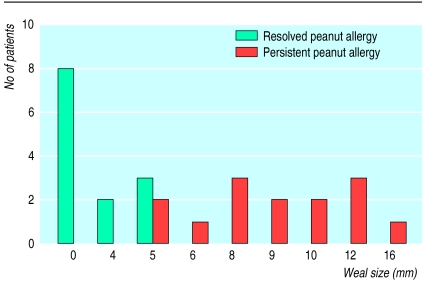
Results: The groups had a similar median age at first reaction to peanut (11 months, range 5-38) and similar symptoms. Allergy to other foods was less common in resolvers (2/15) than persisters (9/15) (P=0.02). On skin prick testing with peanut all 13 resolvers tested but only 3/14 persisters had a weal of <6 mm (P<0.0001). Total and peanut specific IgE concentrations did not differ much between the groups.
Conclusion: Appropriately trained clinicians must be prepared to challenge preschool children with peanut as some will be tolerant despite a history of reactions to peanut and a positive skin prick test with peanut. Preschool children whose apparent peanut allergy is refuted by food challenge show allergy to other foods less often than those in whom peanut allergy persists. The size of weal on skin prick testing to peanut predicts reactivity but not severity on peanut challenge.
Figures
Comment in
-
Resolution of peanut allergy. Patients have not been proved to grow out of peanut allergy.BMJ. 1998 Nov 7;317(7168):1317; author reply 1317-8. doi: 10.1136/bmj.317.7168.1317. BMJ. 1998. PMID: 9804731 Free PMC article. No abstract available.
References
-
- Bock SA, Atkins FM. The natural history of peanut allergy. J Allergy Clin Immunol. 1989;83:900–904. - PubMed
-
- Host A, Halken S. A prospective study of cow milk allergy in Danish infants during the first 3 years of life. Clinical course in relation to clinical and immunological type of hypersensitivity reaction. Allergy. 1990;45:587–596. - PubMed
-
- Sampson HA, McCaskill C. Food hypersensitivity in atopic dermatitis: evaluation of 113 patients. J Pediatr. 1985;107:669–675. - PubMed
MeSH terms
Substances
LinkOut - more resources
Full Text Sources
Other Literature Sources
Medical