


Foot-and-mouth disease virus virulent for cattle utilizes the integrin alpha(v)beta3 as its receptor
- PMID: 9557639
- PMCID: PMC109579
- DOI: 10.1128/JVI.72.5.3587-3594.1998
Foot-and-mouth disease virus virulent for cattle utilizes the integrin alpha(v)beta3 as its receptor
Abstract
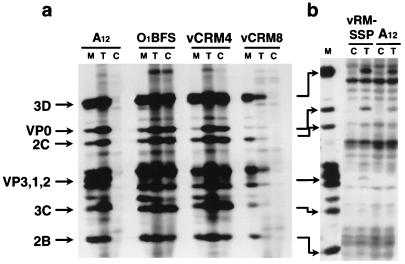
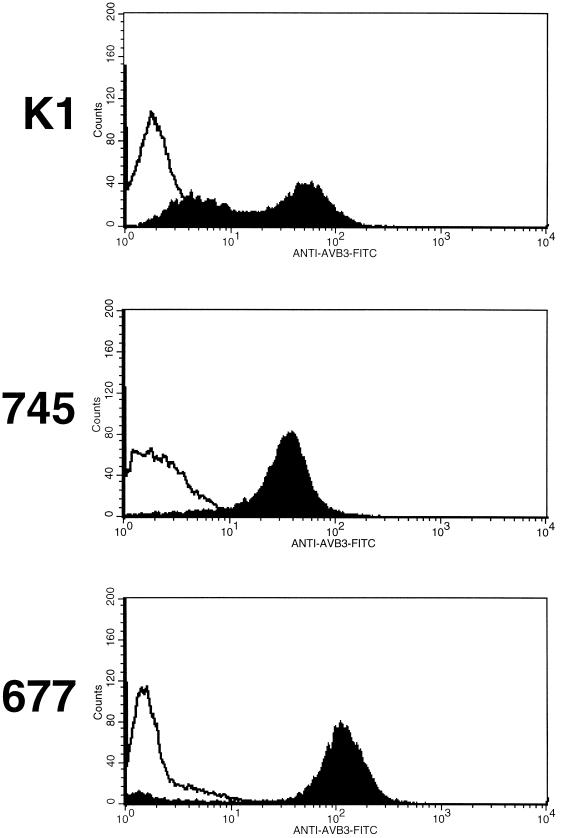
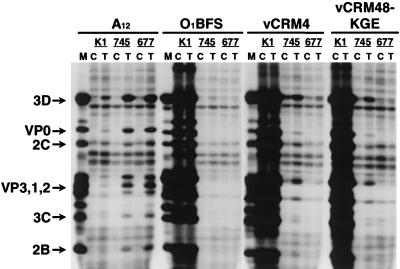
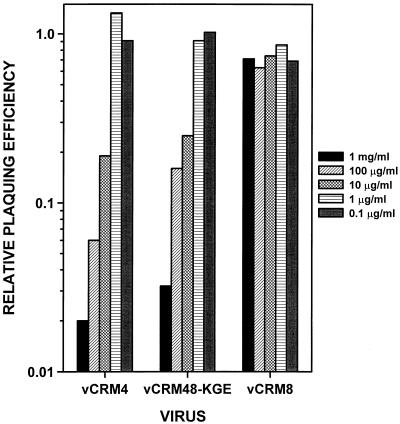
Adsorption and plaque formation of foot-and-mouth disease virus (FMDV) serotype A12 are inhibited by antibodies to the integrin alpha(v)beta3 (A. Berinstein et al., J. Virol. 69:2664-2666, 1995). A human cell line, K562, which does not normally express alpha(v)beta3 cannot replicate this serotype unless cells are transfected with cDNAs encoding this integrin (K562-alpha(v)beta3 cells). In contrast, we found that a tissue culture-propagated FMDV, type O1BFS, was able to replicate in nontransfected K562 cells, and replication was not inhibited by antibodies to the endogenously expressed integrin alpha5beta1. A recent report indicating that cell surface heparan sulfate (HS) was required for efficient infection of type O1 (T. Jackson et al., J. Virol. 70:5282-5287, 1996) led us to examine the role of HS and alpha(v)beta3 in FMDV infection. We transfected normal CHO cells, which express HS but not alpha(v)beta3, and two HS-deficient CHO cell lines with cDNAs encoding human alpha(v)beta3, producing a panel of cells that expressed one or both receptors. In these cells, type A12 replication was dependent on expression of alpha(v)beta3, whereas type O1BFS replicated to high titer in normal CHO cells but could not replicate in HS-deficient cells even when they expressed alpha(v)beta3. We have also analyzed two genetically engineered variants of type O1Campos, vCRM4, which has greatly reduced virulence in cattle and can bind to heparin-Sepharose columns, and vCRM8, which is highly virulent in cattle and cannot bind to heparin-Sepharose. vCRM4 replicated in wild-type K562 cells and normal, nontransfected CHO (HS+ alpha(v)beta3-) cells, whereas vCRM8 replicated only in K562 and CHO cells transfected with alpha(v)beta3 cDNAs. A similar result was also obtained in assays using a vCRM4 virus with an engineered RGD-->KGE mutation. These results indicate that virulent FMDV utilizes the alpha(v)beta3 integrin as a primary receptor for infection and that adaptation of type O1 virus to cell culture results in the ability of the virus to utilize HS as a receptor and a concomitant loss of virulence.
Figures

References
-
- Acharya R, Fry E, Stuart D, Fox G, Rowlands D, Brown F. The three-dimensional structure of foot-and-mouth disease virus at 2.9 Å resolution. Nature. 1989;337:709–716. - PubMed
-
- Amadori M, Berneri C, Archetti I L. Immunogenicity of foot-and-mouth disease virus grown in BHK-21 suspension cells. Correlation with cell ploidy alterations and abnormal expression of the α5β1 integrin. Vaccine. 1994;12:159–166. - PubMed
-
- Ashida M, Hamada C. Molecular cloning of the hepatitis A virus receptor from a simian cell line. J Gen Virol. 1997;78:1565–1569. - PubMed
-
- Baxt B. Effect of lysosomotropic compounds on early events in foot-and-mouth disease virus replication. Virus Res. 1987;7:257–271. - PubMed
MeSH terms
Substances
LinkOut - more resources
Full Text Sources
Other Literature Sources
