


Substitution of ras for the herpesvirus saimiri STP oncogene in lymphocyte transformation
- PMID: 9557651
- PMCID: PMC109591
- DOI: 10.1128/JVI.72.5.3698-3704.1998
Substitution of ras for the herpesvirus saimiri STP oncogene in lymphocyte transformation
Abstract
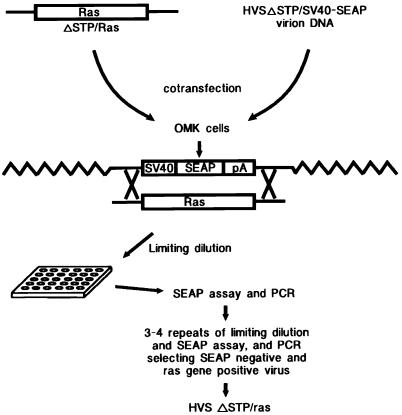
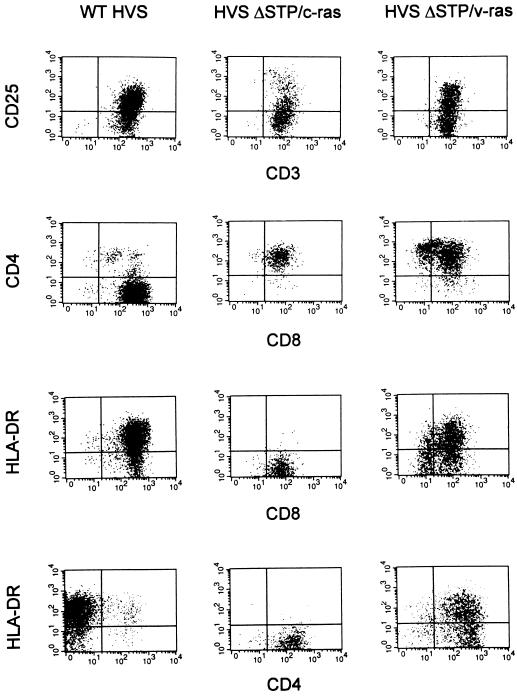
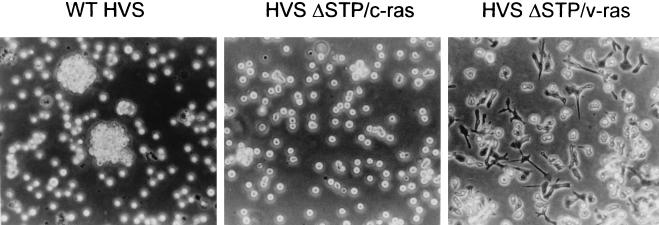
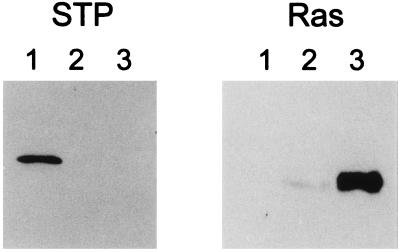
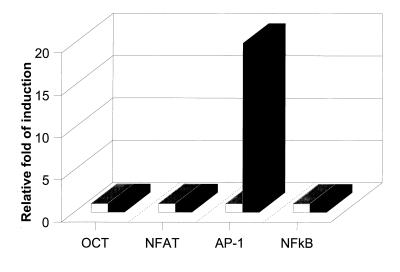
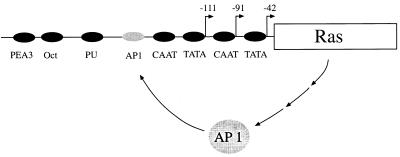
STP-C488 (STP of herpesvirus saimiri [HVS] group C strain 488 [C488]) is the only virus-encoded protein found to associate with cellular ras and activate ras signal transduction pathways. To investigate an important role for ras signal transduction in STP-dependent growth transformation, we constructed recombinant strains of HVS C488 in which the STP-C488 oncogene was replaced with cellular normal ras (c-ras) or viral oncogenic ras (v-ras). Recombinant HVS deltaSTP/v-ras immortalized primary common marmoset T lymphocytes to interleukin-2-independent growth as efficiently as wild-type HVS C488 (wt HVS), while recombinant HVS deltaSTP/c-ras did so with low efficiency. Whereas wt HVS immortalized CD4- CD8+ single-positive T lymphocytes, HVS deltaSTP/c-ras- and HVS deltaSTP/v-ras-immortalized cells were principally CD4+ CD8+ double-positive T lymphocytes. In addition, HVS deltaSTP/v-ras-immortalized T cells showed a high level of ras expression and exhibited an adherent macrophage-like morphology. These phenotypes were likely caused by the drastic activation of AP-1 transcriptional factor activity. Finally, HVS deltaSTP/v-ras and HVS deltaSTP/c-ras each induced lymphoma in one of two common marmosets, although onset of disease was more rapid with the v-ras virus. These results demonstrate that ras can substitute for the STP oncogene of HVS C488 to allow immortalized growth of primary lymphoid cells and that an activated form of ras does so more efficiently than the normal cellular form of ras.
Figures
References
Publication types
MeSH terms
Substances
Grants and funding
LinkOut - more resources
Full Text Sources
Research Materials
