. 1998 May;72(5):3907-15.
doi: 10.1128/JVI.72.5.3907-3915.1998.

The role of nucleocapsid and U5 stem/A-rich loop sequences in tRNA(3Lys) genomic placement and initiation of reverse transcription in human immunodeficiency virus type 1

Affiliations

The role of nucleocapsid and U5 stem/A-rich loop sequences in tRNA(3Lys) genomic placement and initiation of reverse transcription in human immunodeficiency virus type 1

Y Huang et al. J Virol. 1998 May.

Abstract

We have studied the effect of mutations in the human immunodeficiency virus type 1 (HIV-1) nucleocapsid (NC) sequence on tRNA(3Lys) genomic placement, i.e., the in vivo placement of primer tRNA(3Lys) on the HIV-1 primer binding site (PBS). HIV-1 produced from COS cells transfected with wild-type or mutant proviral DNA was used in this study. We have found that mutations in the amino acid sequences flanking the first Cys-His box in the NC sequence produce the maximum inhibition of genomic placement. A similar finding was obtained when the NC-facilitated annealing of primer tRNA(3Lys) to the HIV PBS in vitro was studied. However, since the genomic placement of tRNA(3Lys) occurs independently of precursor protein processing, the NC mutations studied here have probably exerted their effect through one or both of the precursor proteins, Pr55gag and/or Pr160(gag-pol). One mutation in the linker region between the two Cys-His boxes, P31L, prevented packaging of both Pr160(gag-pol) and tRNA(3Lys) and prevented the genomic placement of tRNA(3Lys). Both packaging and genomic placement were rescued by cotransfection with a plasmid coding for wild-type Pr160(gag-pol). For other linker mutations [R7R10K11 S, R32G, and S3(32-34)], packaging of Pr160(gag-pol) and tRNA(3Lys) was not affected, but genomic placement was, and placement could not be rescued by cotransfection with plasmids coding for either Pr55gag or Pr160(gag-pol). After placement, the initiation of reverse transcription within extracellular virions is characterized by a 2-base DNA extension of the placed tRNA(3Lys). This process requires precursor processing, and those NC mutations which showed the most inhibition of initiation were in either of the two NC Cys-His boxes. Destabilization of a U5 stem-A-rich loop immediately upstream of the PBS (through deletion of four consecutive A's in the loop) did not affect the in vivo genomic placement of tRNA(3Lys) but resulted in the presence in the extracellular virus of longer cDNA extensions of tRNA(3Lys), with a corresponding decrease in the presence of unextended and 2-base-extended tRNA(3Lys).


Figures
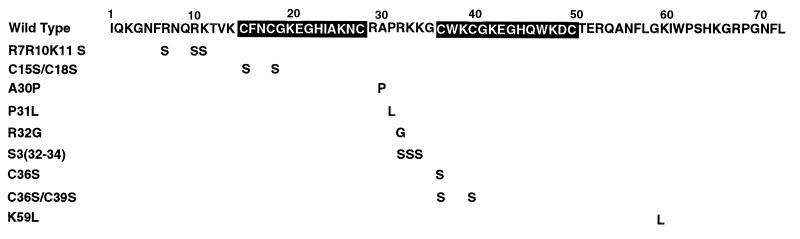
FIG. 1
FIG. 1
Schematic representations of wild-type and mutant NCp7 proteins. The two Cys-His boxes are in black, and their positions define other subdomains of this protein, such as the N and C subdomains and the 7-amino-acid linker subdomain between the two boxes.
FIG. 2
FIG. 2
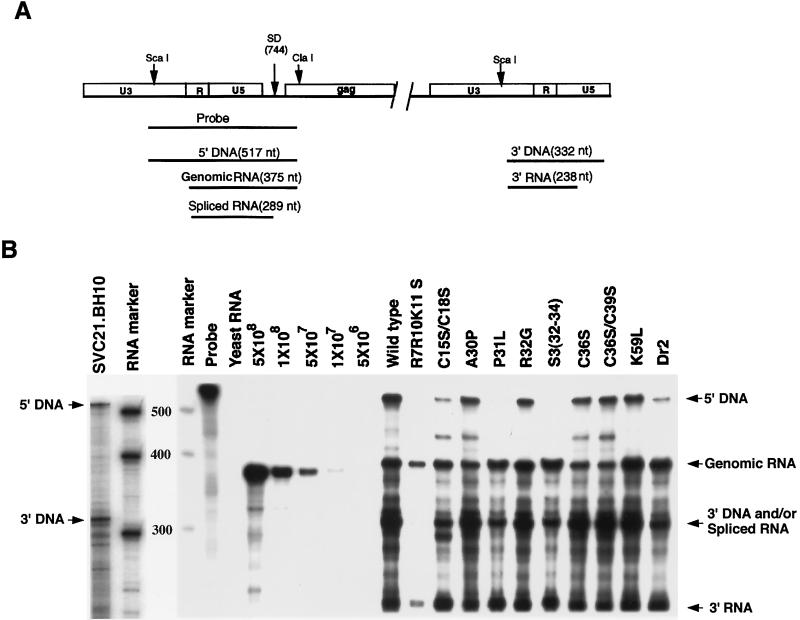
RPA used to determine the amount of full-length genomic RNA present in viral preparations. (A) Model showing how unspliced viral RNA is distinguishable from spliced viral RNA and proviral DNA by the RPA. The 32P-labelled ScaI-ClaI RNA probe is complementary to a region of the RNA genome which goes from the 3′ region of U3 to the 5′ region of the gag gene, and the fragment sizes of the probe which are protected from RNase degradation when hybridizing to the different nucleic acids are shown. nt, nucleotides. (B) 1D PAGE separation of radioactive probe fragments protected from RNase digestion by hybridizing the RNA probe with total viral RNA isolated from wild-type and mutant virions. Lane 1, HIV-1 (BH10) proviral DNA in an HpaI-linearized plasmid DNA (SVC21.BH10); lanes 2 and 4, RNA size markers (RNA Century Marker template set; Ambion); lane 3, molecular weights of the RNA size markers; lane 5, undigested RNA probe; lane 6, yeast RNA; lanes 7 to 11, standard curve with synthetic HIV-1 RNA which will protect a probe fragment similar in size (18 bases shorter) to that protected by unspliced genomic RNA (see Materials and Methods). The number of molecules used in each lane is listed.
FIG. 3
FIG. 3
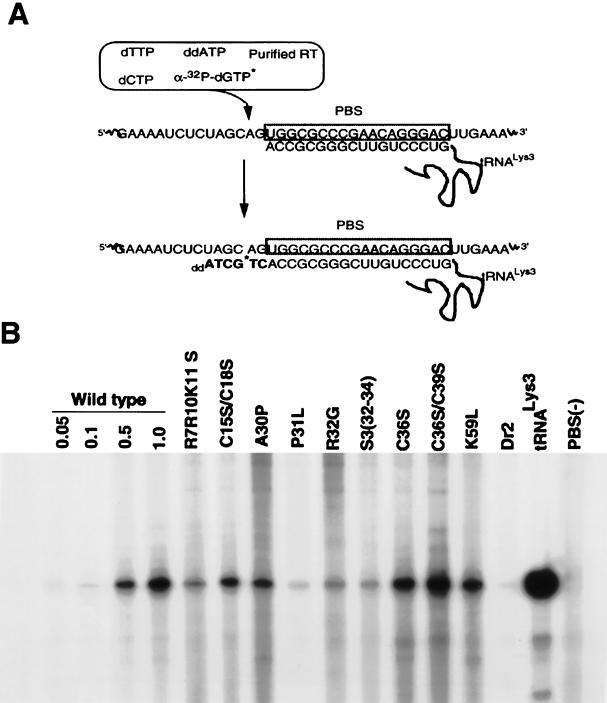
tRNA3Lys placement in wild-type and mutant virions. (A) Placement was measured by the ability of tRNA3Lys to be extended 6 bases in an in vitro reverse transcription reaction with HIV-1 RT and total viral RNA as the source of primer-template. In the presence of dCTP, dTTP, [α-32P]dGTP, and ddATP instead of dATP, extension terminated after 6 bases. (B) Resolution by 1D PAGE of 6-base extension products of tRNA3Lys in an in vitro reverse transcription reaction with total RNA from wild-type and mutant viruses as the source of primer-template, as described for panel A. Each viral RNA sample (including wild-type lane 1.0) contained 0.5 × 10⁸ molecules of unspliced genomic RNA (determined by RPA). The first three wild-type lanes contained 0.05, 0.1, and 0.5 times this amount of genomic RNA. After the wild-type lanes, the next nine lanes represent NC mutant virions. Dr2 is an RT mutant virus. The tRNA3Lys lane represents a 6-base extension of purified tRNA3Lys annealed in vitro with synthetic genomic RNA; PBS(−) represents total viral RNA extracted from a mutant virus missing the PBS.
FIG. 4
FIG. 4
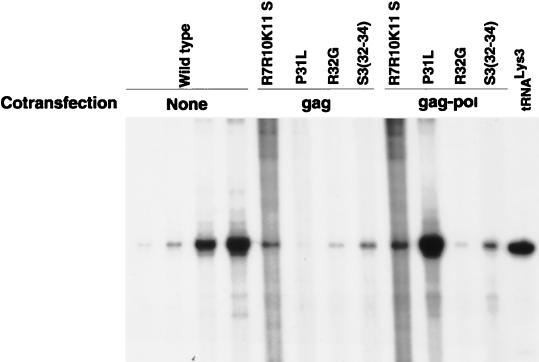
Attempts to rescue genomic placement of tRNA3Lys in mutant NC virions with wild-type Pr55gag or wild-type Pr160gag-pol. COS cells were cotransfected with mutant proviral DNA and with a plasmid coding for either Pr55gag (pSVGAG-RRE-R) or Pr160gag-pol (pSVFS5TprotD25G). Total RNA was isolated from the virions produced, and placement was measured by the ability of the RNA to produce a 6-base extension of tRNA3Lys as described for Fig. 3. Each viral RNA sample (including wild-type lane 4) contained 0.5 × 10⁸ molecules of unspliced genomic RNA (determined by RPA). The first three wild-type lanes contained 0.05, 0.1, and 0.5 times this amount of genomic RNA.
FIG. 5
FIG. 5
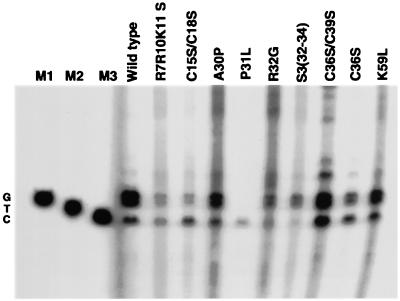
Analysis of tRNA3Lys placement and extension by RT in wild-type and mutant viruses. Similar to the case for the experiments represented in Fig. 3 and 4, total viral RNA isolated from wild-type and mutant viruses was used as the source of primer-template in the in vitro reverse transcription reaction. However, only [α-32P]dCTP and [α-32P]dGTP were used. Using Fig. 3A as a guide, unextended tRNA3Lys will be extended 1 base by dCTP, while 2-base-extended tRNA3Lys will be extended 3 and 4 bases by dGTP and dCTP, respectively. Lanes M1 to M3, size markers generated in the in vitro reverse transcription reaction with tRNA3Lys annealed to synthetic genomic RNA as the primer-template. Reaction mixtures generating M1, M2, and M3 each contained [α-32P]dCTP and the following dNTPs: M1 (1-base extension), none; M2 (2-base extension), ddTTP; M3 (3-base extension), dTTP and ddGTP.
FIG. 6
FIG. 6
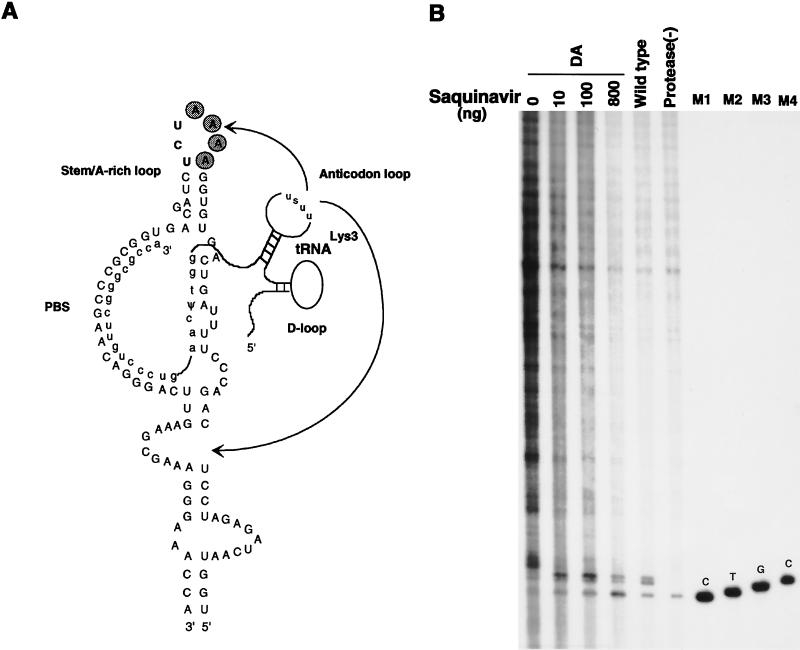
Effect of deletion of the four A’s in the A-rich loop on tRNA3Lys genomic placement and extension of tRNA3Lys by RT. (A) Proposed regions of base pairing between tRNA3Lys and the HIV-1 genome. This figure is modified from reference . In addition to the interaction between the 3′-terminal 18 nucleotides of tRNA3Lys and the PBS, other proposed interactions include ones between the tRNA3Lys anticodon loop and A-rich regions in the genome both upstream (–22) and downstream (26) of the PBS (arrows), as well as a proposed interaction of the TΨC loop in the primer tRNA with a U5 region upstream of the PBS, which was initially proposed for avian retroviruses (1, 2). (B) Effect of A-rich loop deletion on tRNA3Lys placement and extension by RT. In vitro reverse transcription reactions were run as described in the Fig. 5 legend. Wild-type and protease(−) lanes represent total RNA isolated from wild-type and protease-negative virions, showing that only unextended tRNA3Lys is detected in protease-negative virions. The four DA lanes represent reactions with total RNA isolated from virus in which the four A’s of the A-rich loop have been deleted. The transfected cells, exposed to DNA for 15 h, were washed with fresh medium and were grown in increasing concentrations of the viral protease inhibitor Saquinovir for an additional 48 h before isolation of the virus. Lanes M1, M2, and M3, size markers generated from tRNA3Lys annealed to synthetic genomic RNA, as described in the legend to Fig. 5. Lane M4, size marker (4-base tRNA3Lys extension) generated by first extending tRNA3Lys 1 base with RT in the presence of [α-32P]dCTP and then adding dTTP, dGTP, and an excess of ddCTP before additional incubation.

References

    1. Aiyar A, Cobrinik D, Ge Z, Kung H J, Leis J. Interaction between retroviral U5 RNA and the TΨC loop of the tRNATrp primer is required for efficient initiation of reverse transcription. J Virol. 1992;66:2464–2472. - PMC - PubMed
    1. Aiyar A, Ge Z, Leis J. A specific orientation of RNA secondary structures is required for initiation of reverse transcription. J Virol. 1994;68:611–618. - PMC - PubMed
    1. Arts E J, Ghosh M, Jacques P S, Ehresmann B, LeGrice S F J. Restoration of tRNALys3-primed (−) strand DNA synthesis to an HIV-1 reverse transcriptase mutant with extended tRNAs. J Biol Chem. 1996;271:9054–9061. - PubMed
    1. Arts E J, Stetor S R, Li X, Rausch J W, Howard K J, Ehresmann B, North T W, Wohrl B M, Goody R S, Wainberg M A, LeGrice S F J. Initiation of (−) strand DNA synthesis from the tRNALys3 on lentiviral RNAs: implications of specific HIV-1 RNA-tRNALys3 interactions inhibiting primer utilization by retroviral reverse transcriptases. Proc Natl Acad Sci USA. 1996;93:10063–10068. - PMC - PubMed
    1. Barat C, Lullien V, Schatz O, Keith G, Darlix J L. HIV-1 reverse transcriptase specifically interacts with the anticodon domain of its cognate primer tRNA. EMBO J. 1989;8:3279–3285. - PMC - PubMed

Publication types

MeSH terms

LinkOut - more resources