


Specificity in cholesterol regulation of gene expression by coevolution of sterol regulatory DNA element and its binding protein
- PMID: 9560206
- PMCID: PMC20191
- DOI: 10.1073/pnas.95.9.4935
Specificity in cholesterol regulation of gene expression by coevolution of sterol regulatory DNA element and its binding protein
Abstract
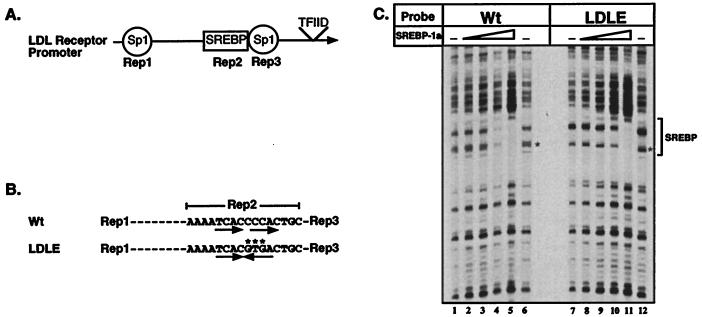
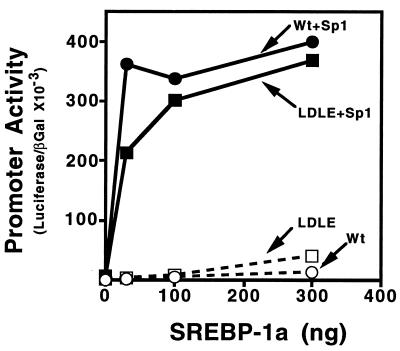
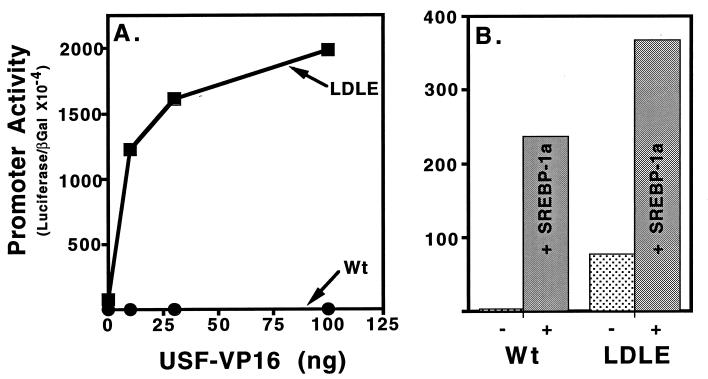
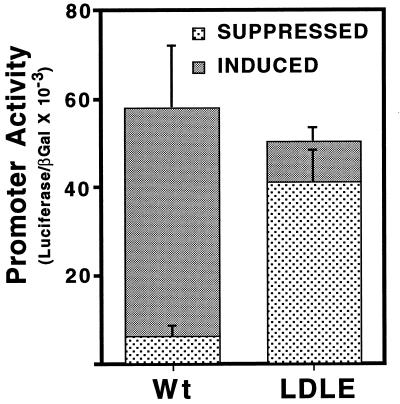
When demand for cholesterol rises in mammalian cells, the sterol regulatory element (SRE) binding proteins (SREBPs) are released from their membrane anchor through proteolysis. Then, the N-terminal region enters the nucleus and activates genes of cholesterol uptake and biosynthesis. Basic helix-loop-helix (bHLH) proteins such as SREBPs bind to a palindromic DNA sequence called the E-box (5'-CANNTG-3'). However, SREBPs are special because they also bind direct repeat elements called SREs. Importantly, sterol regulation of all promoters studied thus far is mediated by SREBP binding only to SREs. To study the reason for this we converted the direct repeat SRE from the sterol-regulated low-density lipoprotein receptor promoter into an E-box. In this report we show that SREBPs are still able to bind and activate this promoter however, sterol regulation is lost. The results are consistent with the mutant promoter being a target for promiscuous activation by constitutively expressed E-box binding bHLH proteins that are not regulated by cholesterol. Kim and coworkers [Kim, J. B., Spotts, G. D., Halvorsen, Y.-D., Shih, H.-M., Ellenberger, T., Towle, H. C. & Spiegelman, B. M. (1995) Mol. Cell. Biol. 15, 2582-2588] demonstrated that the dual DNA binding specificity of SREBPs is caused by a specific tyrosine in the conserved basic region of the DNA binding domain that corresponds to an arginine in all other bHLH proteins that recognize only E-boxes. Taken together the data suggest an evolutionary mechanism where a DNA binding protein along with its recognition site have coevolved to ensure maximal specificity and sensitivity in a crucial nutritional regulatory response.
Figures
References
-
- Goldstein J, Brown M. Nature (London) 1990;343:425–430. - PubMed
-
- Osborne T F. Crit Rev Eukaryotic Gene Expression. 1995;5:317–335. - PubMed
-
- Brown M S, Goldstein J L. Cell. 1997;89:331–340. - PubMed
-
- Smith J R, Osborne T F, Brown M S, Goldstein J L, Gil G. J Biol Chem. 1988;263:18480–18487. - PubMed
-
- Osborne T F. J Biol Chem. 1991;266:13947–13951. - PubMed
Publication types
MeSH terms
Substances
Grants and funding
LinkOut - more resources
Full Text Sources
Other Literature Sources
Medical
Molecular Biology Databases
