


A paracrine role for the epithelial progesterone receptor in mammary gland development
- PMID: 9560231
- PMCID: PMC20216
- DOI: 10.1073/pnas.95.9.5076
A paracrine role for the epithelial progesterone receptor in mammary gland development
Abstract
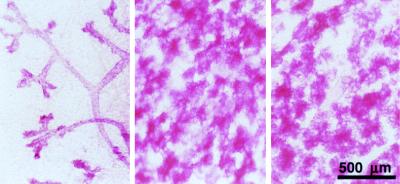
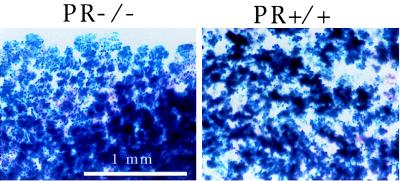
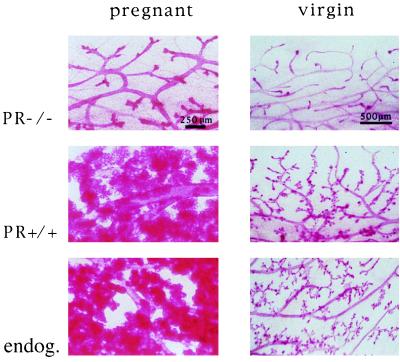
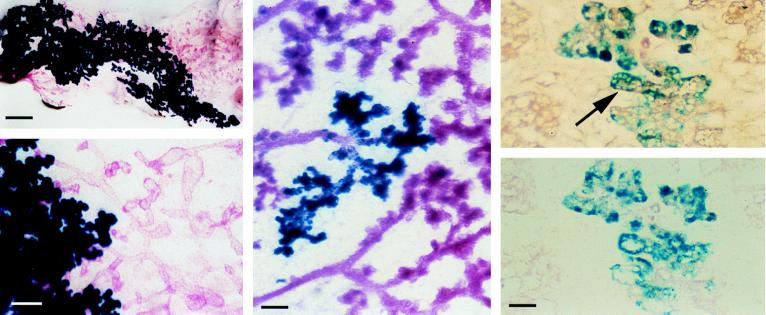
Recently generated progesterone receptor (PR)-negative (PR-/-) mice provide an excellent model for dissecting the role of progesterone in the development of the mammary gland during puberty and pregnancy. However, the full extent of the mammary gland defect in these mice caused by the absence of the PR cannot be assessed, because PR-/- mice do not exhibit estrous cycles and fail to become pregnant. To circumvent this difficulty, we have transplanted PR-/- breasts into wild-type mice, and we have demonstrated that the development of the mammary gland in the absence of the PR is arrested at the stage of the simple ductal system found in the young virgin mouse. Mammary transplants lacking the PR in the stromal compartment give rise to normal alveolar growth, whereas transplants containing PR-/- epithelium conserve the abnormal phenotype. Chimeric epithelia in which PR-/- cells are in close vicinity to PR wild-type cells go through complete alveolar development to which the PR-/- cells contribute. Together, these results indicate that progesterone acts by a paracrine mechanism on a subset of mammary epithelial cells to allow for alveolar growth and that expression of the PR is not required in all the cells of the mammary epithelium in order for alveolar development to proceed normally.
Figures
References
-
- Nandi S. J Natl Cancer Inst. 1958;21:1039–1063. - PubMed
-
- Lydon J P, De Mayo F J, Funk C R, Mani S K, Hughes A R, Montgomery C A, Jr, Shyamala G, Conneely O M, O’Malley B W. Genes & Dev. 1995;9:2266–2278. - PubMed
-
- Humphreys R, R, Lydon J, O’Malley B W, Rosen J M. Mol Endocrinol. 1997;11:801–811. - PubMed
-
- Haslam S Z, Shyamala G. Endocrinology. 1981;108:825–830. - PubMed
-
- Silberstein G B, Van Horn K, Shyamala G, Daniel C W. Cell Growth Differ. 1996;7:945–952. - PubMed
Publication types
MeSH terms
Substances
Grants and funding
LinkOut - more resources
Full Text Sources
Other Literature Sources
Molecular Biology Databases
Research Materials
