


doi: 10.1073/pnas.95.9.5100.
Signaling among relatives. III. Talk is cheap
Affiliations
- PMID: 9560235
- PMCID: PMC20220
- DOI: 10.1073/pnas.95.9.5100
Item in Clipboard
Signaling among relatives. III. Talk is cheap
Proc Natl Acad Sci U S A.
.
Abstract
The Sir Philip Sidney game has been used by numerous authors to show how signal cost can facilitate honest signaling among relatives. Here, we demonstrate that, in this game, honest cost-free signals are possible as well, under very general conditions. Moreover, these cost-free signals are better for all participants than the previously explored alternatives. Recent empirical evidence suggests that begging is energetically inexpensive for nestling birds; this finding led some researchers to question the applicability of the costly signaling framework to nestling begging. Our results show that cost-free or inexpensive signals, as observed empirically, fall within the framework of signaling theory.
Figures
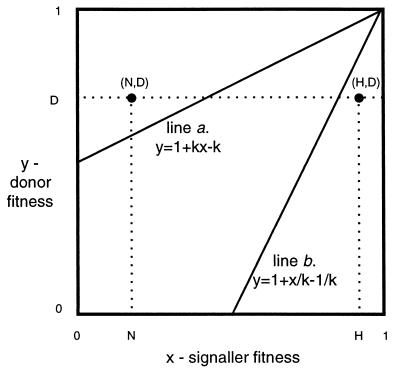
A trivial example of cost-free signaling, in which there is no gain to any signaler in deceiving any donor.
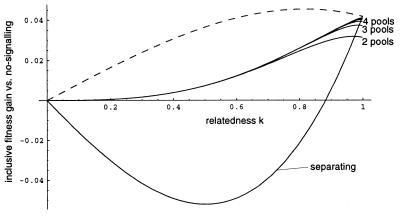
Fitness advantage of the signaler relative to the no-signaling equilibrium, as a function of the coefficient of relatedness k in the SPS game with signalers distributed uniformly on [0, 1]. The dotted curve is for complete information transfer at no cost, which we have included to illustrate the efficiency of the cost-free equilibria. The lowest curve is for complete information transfer, at the cost necessary to enforce the separating equilibrium. Intermediate curves are for partitions with 2, 3, 4, etc., cost-free signals.
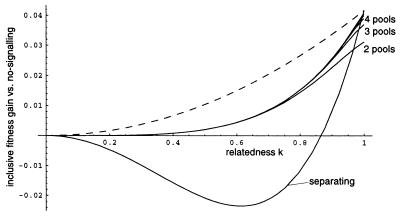
Fitness advantage of the donor relative to the no-signaling equilibrium, as a function of the coefficient of relatedness k. As in Fig. 2, the dotted curve is for complete information transfer at no cost, and the lowest curve is for complete information transfer at the cost necessary to enforce the separating equilibrium. Intermediate curves are for partitions with 2, 3, 4, etc., cost-free signals.
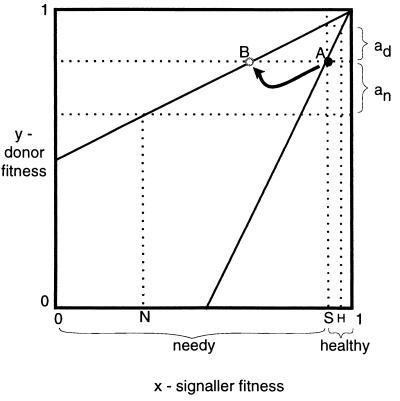
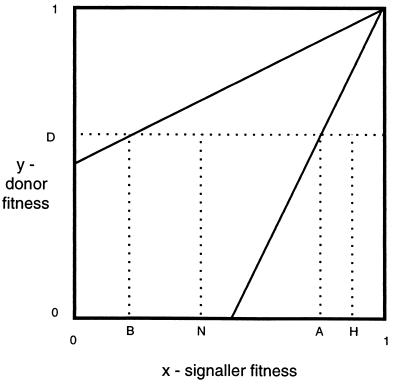
Stable cost-free signaling despite conflict of interest between some signaler–donor pairs. Axes are as in Fig. 1. Consider a signaling system with a stable two-pool cost-free signaling equilibrium, with the boundary between the two pools at S. A signaler at this boundary—represented by point A—would like to receive the resource from the donors in the region ad but not from those in the region an. Therefore, this signaler ideally would choose to be seen by donors as being at point B. However, in this signaling system, there is no signal available that would be understood as indicating quality B; the signalers can either signal that they are needy and be treated as if they have the mean fitness of signalers in the needy pool, N, or they can signal that they are healthy and thus be treated as if they have the mean fitness of those in the healthy pool, H. Although the signalers could deceive the donors in adby signaling needy, by doing so they also would deceive the donors in an into transferring. This action runs counter to the signalers’ interest because they do not benefit from receiving the resource from these donors. The benefit of deceiving ad is offset by the cost of deceiving an; the signaler at A has no incentive to signal needy. All of the signalers to the right of A will have even more to lose and less to gain by signaling “needy” and therefore will also signal “healthy.” Hence this cost-free signaling equilibrium is stable despite some conflict of interest.
A system in which costly signaling is better for signaler and donor than is cost-free signaling. Axes are as in Fig. 1. Signalers have fitnesses on [0, 1] with probability density function p(x), and all donors have fitness D. There can be no cost-free signaling equilibrium other than the no-signaling equilibrium; the costly signaling equilibrium with two pools, divided at B, is better for both players.
References
Publication types
MeSH terms
Grants and funding
LinkOut - more resources
Full Text Sources
