. 1998 Apr 28;95(9):5317-22.
doi: 10.1073/pnas.95.9.5317.

Antibacterial agents that inhibit two-component signal transduction systems

Affiliations

Antibacterial agents that inhibit two-component signal transduction systems

J F Barrett et al. Proc Natl Acad Sci U S A. .

Abstract

A class of antibacterials has been discovered that inhibits the growth of Gram-positive pathogenic bacteria. RWJ-49815, a representative of a family of hydrophobic tyramines, in addition to being a potent bactericidal Gram-positive antibacterial, inhibits the autophosphorylation of kinase A of the KinA::Spo0F two-component signal transduction system in vitro. Analogs of RWJ-49815 vary greatly in their ability to inhibit growth of bacteria and this ability correlates directly with their activity as kinase A inhibitors. Compared with the potent quinolone, ciprofloxacin, RWJ-49815 exhibits reduced resistance emergence in a laboratory passage experiment. Inhibition of the histidine protein kinase::response regulator two-component signal transduction pathways may present an opportunity to depress chromosomal resistance emergence by targeting multiple proteins with a single inhibitor in a single bacterium. Such inhibitors may represent a class of antibacterials that potentially may represent a breakthrough in antibacterial therapy.


Figures
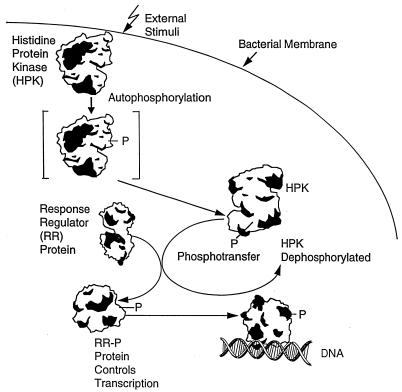
Figure 1
Figure 1
Two-component signal transduction in pathogenesis. Signals (external stimuli) residing in the host environment are recognized by the bacterium and stimulate the histidine protein kinase(s) to autophosphorylate (shown in the schematic as the bracketed HPK-P). Each phosphorylated histidine protein kinase (HPK) is mated to a specific response regulator (RR) to which it initiates phosphoryl transfer. Phosphorylation of the response regulator (RR-P) relieves inhibition of its transcriptional activation properties resulting in transcription and expression of the genes that it controls.
Figure 2
Figure 2
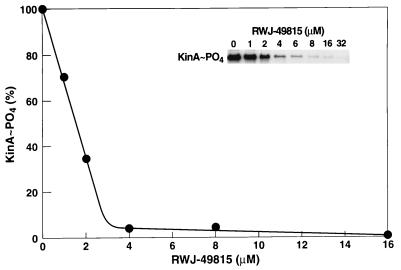
Inhibition of kinase A autophosphorylation by RWJ-49815. Results are expressed as percent of KinA∼P formed in the absence of inhibitor.
Figure 3
Figure 3
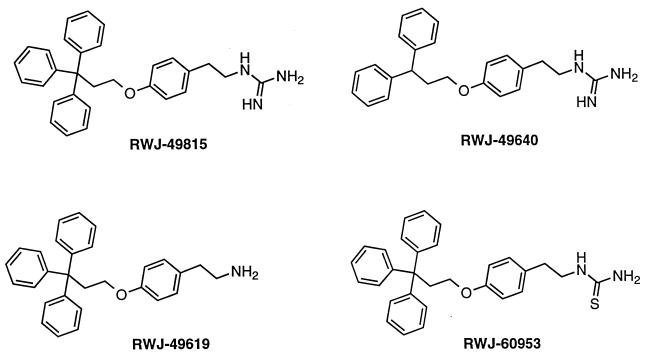
Structures of RWJ-49815 and analogs.
Figure 4
Figure 4
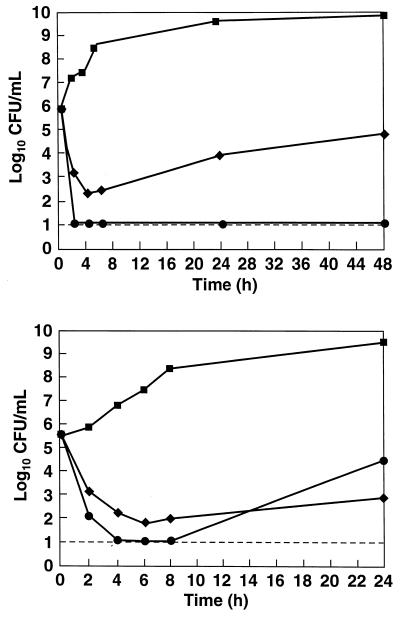
Antibacterial activity of RWJ-49815 against MRSA. (A) Time kill curve of RWJ-49815 against MRSA OC2089 at one times and four times MIC. (▪) Drug-free control; (♦) RWJ-49815 one times MIC; (•) RWJ-49815 four times MIC. (B) Time kill curve RWJ-49815 against MRSA OC2878 with a control drug, levofloxacin. The dotted line indicates the limit of detection of bacterial counts. (▪) Drug-free control; (♦) Levofloxacin two times MIC; (•) RWJ-49815 two times MIC.
Figure 5
Figure 5
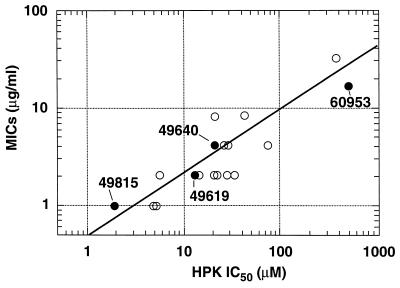
Correlation of antibacterial activity of RWJ-49815 with enzyme inhibition. The 18 tyramine derivatives (○), including the four identified by structures in this report (•), are plotted on log scales, comparing the target-based inhibition of activity (IC50s) vs. the MICs against MRSA strain OC2089.
Figure 6
Figure 6
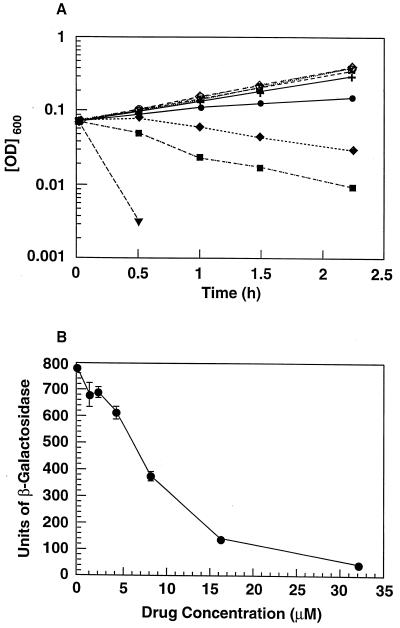
(A) Concentration-dependent effect of RWJ-49815 on the growth rate of E. coli strain OC3047 harboring the Taz-1 two-component system and reporter gene. Concentrations of RWJ-49815: (○) μM; (⋄) 1 μM; (□) 2 μM; (x) 4 μM; (+) 8 μM; (•) 16 μM; (♦) 32 μM; (▪) 64 μM; and (▾) 128 μM. Bacteria incubated with concentrations of RWJ-49815 up to 4 μM had mean generation times of 56 min that were indistinguishable from the no-drug control. Bacteria incubated with 8 μM RWJ-49815 had a doubling time of 67 min. (B) Effect of RWJ-49815 on the Taz-1 induction of β-galactosidase.

References

    1. Chu D T, Plattner J J, Katz L. J Med Chem. 1996;39:3853–3874. - PubMed
    1. Eliopoulos G M, Wennersten C B, Gold H S, Moellering R C. Antimicrob Agents Chemother. 1996;40:1745–1747. - PMC - PubMed
    1. Zurenko G E, Yagi B H, Schaadt R D, Allison J W, Kilburn J O, Glickman S E, Hutchinson D K, Barbachyn M R, Brickner S J. Antimicrob Agents Chemother. 1996;40:839–845. - PMC - PubMed
    1. Mason E O, Lamberth L B, Kaplan S L. Antimicrob Agents Chemother. 1996;40:1039–1040. - PMC - PubMed
    1. Brickner S J, Hutchinson D K, Barbachyn M R, Manninen P R, Ulanowicz D A, Garmon S A, Grega K C, Hendges S K, Toops D S, Ford C W, et al. J Med Chem. 1996;39:673–679. - PubMed

MeSH terms