


Intervention to increase mammography utilization in a public hospital
- PMID: 9565385
- PMCID: PMC1496943
- DOI: 10.1046/j.1525-1497.1998.00072.x
Intervention to increase mammography utilization in a public hospital
Abstract
Objective: To study the effects of three approaches to increasing utilization of screening mammography in a public hospital setting in Northwest Louisiana.
Design: Randomized intervention study.
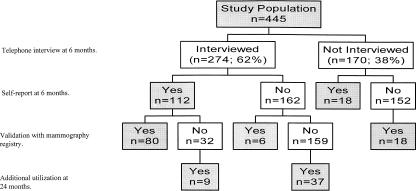
Population: Four hundred forty-five women aged 40 years and over, predominantly low-income and with low literacy skills, who had not had a mammogram in the preceding year.
Intervention: All interventions were chosen to motivate women to get a mammogram. Group 1 received a personal recommendation from one of the investigators. Group 2 received the recommendation plus an easy-to-read National Cancer Institute (NCI) brochure. Group 3 received the recommendation, the brochure, and a 12-minute interactive educational and motivational program, including a soap-opera-style video, developed in collaboration with women from the target population.
Measurements and main results: Mammography utilization was determined at 6 months and 2 years after intervention. A significant increase (p = .05) in mammography utilization was observed after the intervention designed in collaboration with patients (29%) as compared with recommendation alone (21%) or recommendation with brochure (18%) at 6 months. However, at 2 years the difference favoring the custom-made intervention was no longer significant.
Conclusions: At 6 months there was at least a 30% increase in the mammography utilization rate in the group receiving the intervention designed in collaboration with patients as compared with those receiving the recommendation alone or recommendation with brochure. Giving patients an easy-to-read NCI brochure and a personal recommendation was no more effective than giving them a recommendation alone, suggesting that simply providing women in a public hospital with a low-literacy-level, culturally appropriate brochure is not sufficient to increase screening mammography rates. In a multivariate analysis, the only significant predictor of mammography use at 6 months was the custom-made intervention.
Figures
Comment in
-
Intervention to increase mammography utilization in a public hospital.J Gen Intern Med. 1998 Nov;13(11):786. doi: 10.1046/j.1525-1497.1998.00240.x. J Gen Intern Med. 1998. PMID: 9831129 Free PMC article. No abstract available.
References
-
- Rimer BK, Trock B, Engstrom PF, Lerman C, King E. Why do some women get regular mammograms? Am J Prev Med. 1991;7:697–74. - PubMed
Publication types
MeSH terms
Grants and funding
LinkOut - more resources
Full Text Sources
Medical