. 1998 May;18(5):2502-13.
doi: 10.1128/MCB.18.5.2502.

Posttranslational regulation of Ty1 retrotransposition by mitogen-activated protein kinase Fus3

Affiliations

Posttranslational regulation of Ty1 retrotransposition by mitogen-activated protein kinase Fus3

D Conte Jr et al. Mol Cell Biol. 1998 May.

Erratum in

  • Mol Cell Biol 1998 Sep;18(9):5620

Abstract

Ty1 retrotransposons in Saccharomyces cerevisiae are maintained in a state of transpositional dormancy. We isolated a mutation, rtt100-1, that increases the transposition of genomic Ty1 elements 18- to 56-fold but has little effect on the transposition of related Ty2 elements. rtt100-1 was shown to be a null allele of the FUS3 gene, which encodes a haploid-specific mitogen-activated protein kinase. In fus3 mutants, the levels of Ty1 RNA, protein synthesis, and proteolytic processing were not altered relative to those in FUS3 strains but steady-state levels of TyA, integrase, and reverse transcriptase proteins and Ty1 cDNA were all increased. These findings suggest that Fus3 suppresses Ty1 transposition by destabilizing viruslike particle-associated proteins. The Fus3 kinase is activated through the mating-pheromone response pathway by phosphorylation at basal levels in naive cells and at enhanced levels in pheromone-treated cells. We demonstrate that suppression of Ty1 transposition in naive cells requires basal levels of Fus3 activation. Substitution of conserved amino acids required for activation of Fus3 derepressed Ty1 transposition. Moreover, epistasis analyses revealed that components of the pheromone response pathway that act upstream of Fus3, including Ste4, Ste5, Ste7, and Ste11, are required for the posttranslational suppression of Ty1 transposition by Fus3. The regulation of Ty1 transposition by Fus3 provides a haploid-specific mechanism through which environmental signals can modulate the levels of retrotransposition.


Figures
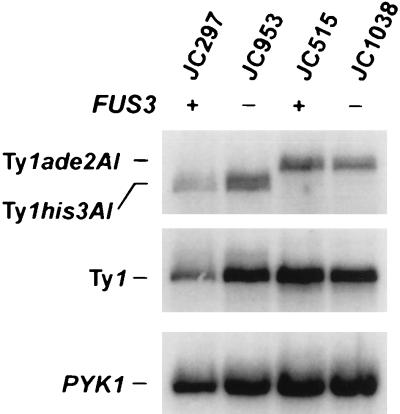
FIG. 1
FIG. 1
Northern analysis of total RNA from strains JC297 (FUS3) and JC953 (fus3-187), containing the Ty1his3AI-270 element, and strains JC515 (FUS3) and JC1038 (fus3Δ), containing the Ty1ade2AI-515 element. The riboprobes used to detect Ty1his3AI and Ty1ade2AI RNA (top), total Ty1 RNA (center), and PYK1 RNA (bottom) are described in Materials and Methods.
FIG. 2
FIG. 2
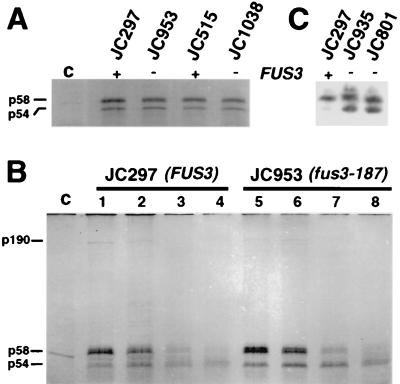
Posttranslational regulation of Ty1 by FUS3. (A) JC297 (FUS3), JC953 (fus3-187), JC515 (FUS3), and JC1038 (fus3Δ) cells were labeled with [35S]Met for 1 h and immunoprecipitated with TyA1 antiserum. The control (c) contains no antiserum. The products were analyzed by SDS-PAGE (10% polyacrylamide). (B) Cells were pulse-labeled with [35S]Met for 15 min and then chased with excess unlabeled methionine. Samples were harvested 15 min (lanes c, 1, and 5), 1 h (lanes 2 and 6), 8 h (lanes 3 and 7), and 20 h (lanes 4 and 8) after the addition of [35S]Met, and denatured cell lysates were incubated with preimmune serum (lane c) or TyA1 antiserum (lanes 1 to 8). The products (p190-TyA/ TyB, p58-TyA, and p54-TyA) were analyzed by SDS-PAGE (10% polyacrylamide). (C) Total cellular proteins isolated from JC297 (FUS3), JC935 (fus3-187), and JC801 (fus3-187) were separated by SDS-PAGE (10% polyacrylamide) and subjected to Western analysis with TyA1 antiserum.
FIG. 3
FIG. 3
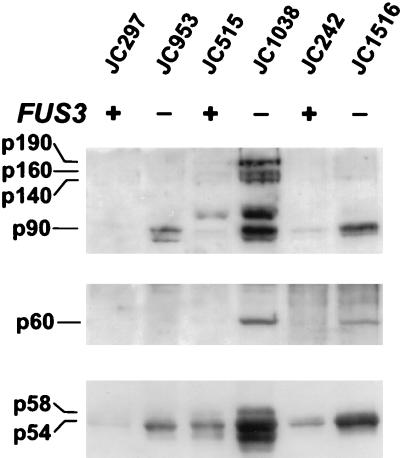
Ty1-VLP synthesis is increased in fus3 mutants. Western blot analysis of Ty1-VLPs from FUS3 (+) and fus3 (−) strains. VLPs were separated by SDS-PAGE (7.5% polyacrylamide). Western blots were probed with B2 antiserum to detect p90-IN (top panel). Size labels on the left indicate the position of p90-IN, which appears as a doublet (9), p190-TyA/TyB, and processing intermediates (p140 and p160). The band at 110 kDa is attributable to nonspecific proteolysis of TyB (33). The relative levels of p90 doublet in fus3 strains compared to that in the isogenic or congenic FUS3 strains, determined by scanning densitometry, are as follows: JC953/JC297, 43; JC1038/JC515, 38; JC1516/JC242, 21. B8 antiserum (center panel) was used to detect p60-RT. The p60 band from JC953 is visible in darker exposures of the Western blot. The relative levels of p60 in fus3 strains compared to the isogenic or congenic FUS3 strain are as follows: JC953/JC297, >14; JC1038/JC515, 200; JC1516/JC242, 66. TyA1 antiserum (bottom panel) detected p58 and p54 TyA. Lower-molecular-weight species recognized by this antiserum are probably a result of nonspecific proteolysis. The relative levels of p58 and p54 in fus3 strains compared to the isogenic or congenic FUS3 strain are as follows: JC953/JC297, 7; JC1038/JC515, 5; JC1516/JC242, 5.
FIG. 4
FIG. 4
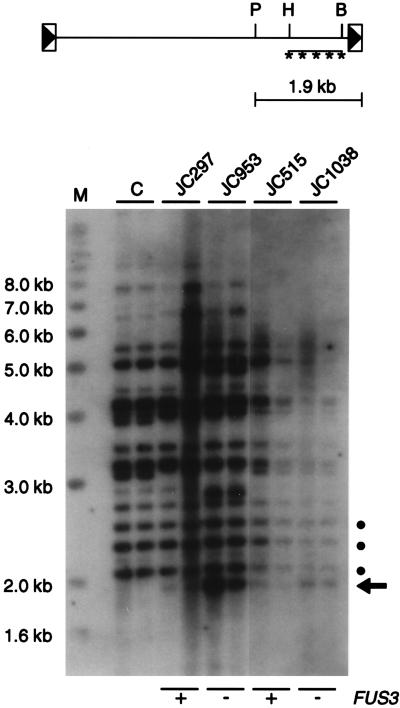
The level of Ty1 cDNA is increased in fus3 mutants. (Top) Structure of the unintegrated linear Ty1 cDNA and location of relevant PvuII (P), HindIII (H), and BglII (B) sites. The HindIII-BglII Ty1 DNA fragment that was used as a probe in Southern analysis is indicated by the horizontal line marked with asterisks. The 1.9-kb Ty1 cDNA band generated by PvuII digestion is represented as the line with crossbars. (Bottom) Total cellular DNA from two independent cultures of FUS3 (+) and fus3 (−) strains or an spt3-101 control strain (lane C) grown at 20°C was digested with PvuII, subjected to electrophoresis on a 1% agarose gel, and hybridized to the Ty1 DNA probe described above. Random-primer labeled 1-kb marker DNA (lane M) was included on the agarose gel as a size control. The 1.9-kb Ty1 cDNA band, indicated by the arrow, and three Ty1-genomic DNA junction fragments, indicated by solid circles, were quantitated by scanning densitometry. The ratio of the 1.9-kb Ty1 cDNA band to each of the three Ty1-genomic DNA junction bands was determined, and the three ratios from each of two independent DNA samples were averaged for each strain analyzed. The average ratio of Ty1 cDNA fragment to Ty1-genomic DNA fragment was 0.4 for strain JC297, 2.7 for strain JC953, 0.3 for strain JC515, and 3.1 for strain JC1038.
FIG. 5
FIG. 5
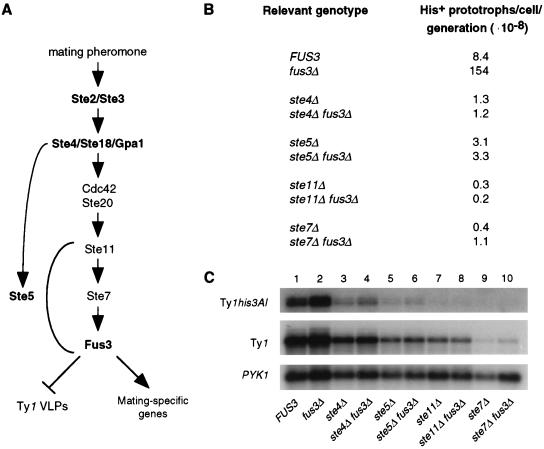
An intact mating-pheromone response pathway is required for Fus3-mediated repression of Ty1 retrotransposition. (A) Major components of the mating-pheromone response pathway. The receptor Ste2 (or Ste3), the components of the heterotrimeric G protein (Ste4, Ste18, and Gpa1), the scaffolding protein Ste5, and the MAP kinase Fus3 are shown in boldface type to indicate that they are specific to the pheromone response signal cascade. (B) The rate of His+ prototroph formation was determined for each strain as described in Materials and Methods. (C) Northern analysis of steady-state RNA from pheromone response pathway mutants. Each lane is labeled below with the relevant genotype of the strain analyzed. Riboprobes to detect Ty1his3AI-242 RNA (top), total Ty1 RNA (center) and PYK1 RNA (bottom) are described in Materials and Methods. The level of Ty1his3AI-242 RNA was normalized to PYK1 RNA. The ratios of Ty1his3AI-242 RNA to PYK1 RNA in each strain, relative to the FUS3 strain, were as follows: FUS3, 1.0; fus3Δ, 1.3; ste4Δ, 0.5; ste4Δ fus3Δ, 0.5; ste5Δ, 0.3; ste5Δ fus3Δ, 0.3; ste11Δ, 0.1; ste11Δ fus3Δ, 0.1; ste7Δ, 0.1; ste7Δ fus3Δ, 0.1. The ratios of total Ty1 RNA to PYK1 RNA relative to the FUS3 strain were as follows: FUS3, 1.0; fus3Δ, 0.9; ste4Δ, 1.1; ste4Δ fus3Δ, 1.0; ste5Δ, 0.7; ste5Δ fus3Δ, 0.7; ste11Δ, 0.5; ste11Δ fus3Δ, 0.4; ste7Δ, 0.1; ste7Δ fus3Δ, 0.1.

References

    1. Alani E, Cao L, Kleckner N. A method for gene disruption that allows repeated use of URA3 selection in the construction of multiply disrupted yeast strains. Genetics. 1987;116:541–545. - PMC - PubMed
    1. Bardwell L, Cook J G, Chang E C, Cairns B R, Thorner J. Signaling in the yeast pheromone response pathway: specific and high-affinity interaction of the mitogen-activated protein (MAP) kinases Kss1 and Fus3 with the upstream MAP kinase kinase Ste7. Mol Cell Biol. 1996;16:3637–3650. - PMC - PubMed
    1. Baur M, Esch R K, Errede B. Cooperative binding interactions required for function of the Ty1 sterile responsive element. Mol Cell Biol. 1997;17:4330–4337. - PMC - PubMed
    1. Best S, Letissier P, Towers G, Stoye J P. Positional cloning of the mouse retrovirus restriction gene Fv1. Nature. 1996;382:826–829. - PubMed
    1. Boeke J D, Corces V G. Transcription and reverse transcription of retrotransposons. Annu Rev Microbiol. 1989;43:403–434. - PubMed

Publication types

MeSH terms