Comparative Study
. 1998 May;18(5):2688-96.
doi: 10.1128/MCB.18.5.2688.

Ski6p is a homolog of RNA-processing enzymes that affects translation of non-poly(A) mRNAs and 60S ribosomal subunit biogenesis

Affiliations
Comparative Study

Ski6p is a homolog of RNA-processing enzymes that affects translation of non-poly(A) mRNAs and 60S ribosomal subunit biogenesis

L Benard et al. Mol Cell Biol. 1998 May.

Abstract

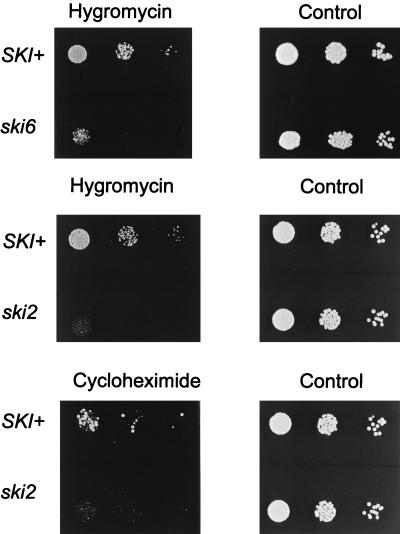
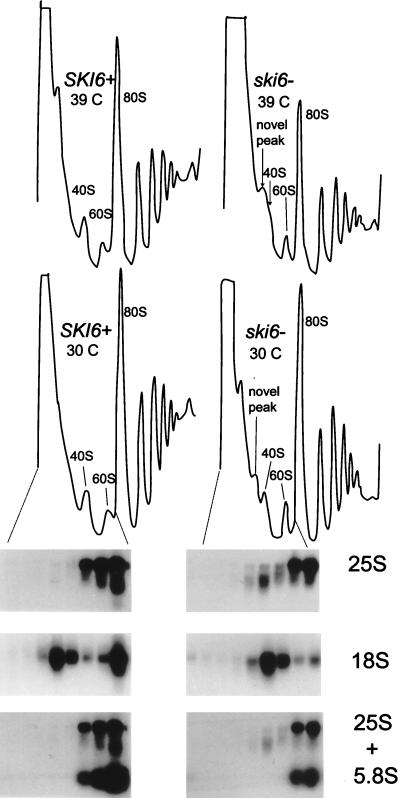
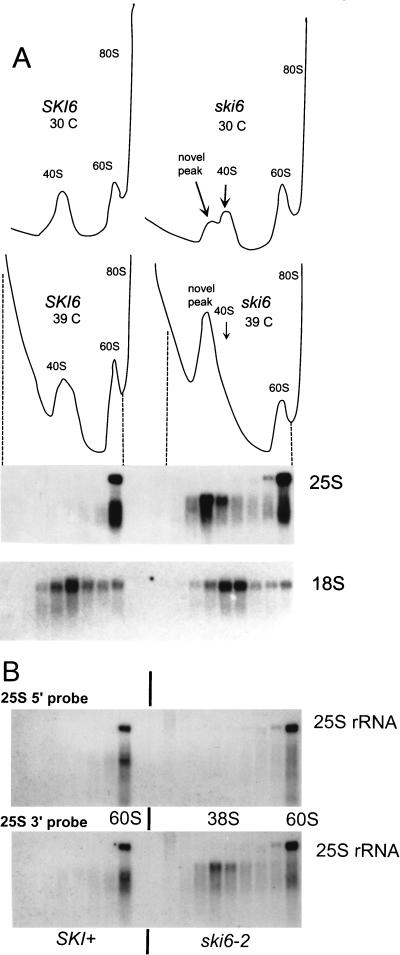
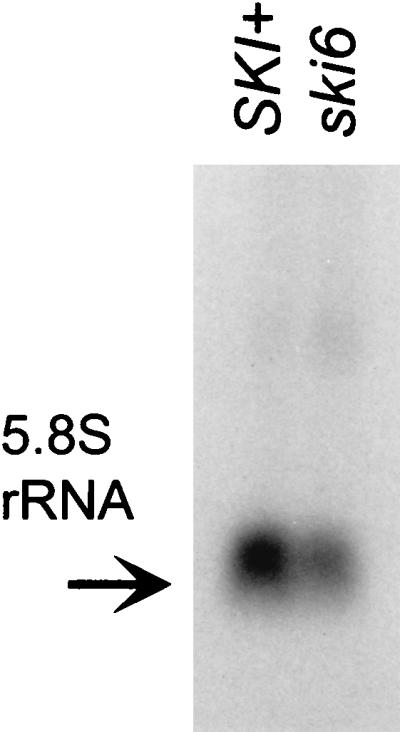
We mapped and cloned SKI6 of Saccharomyces cerevisiae, a gene that represses the copy number of the L-A double-stranded RNA virus, and found that it encodes an essential 246-residue protein with homology to a tRNA-processing enzyme, RNase PH. The ski6-2 mutant expressed electroporated non-poly(A) luciferase mRNAs 8- to 10-fold better than did the isogenic wild type. No effect of ski6-2 on expression of uncapped or normal mRNAs was found. Kinetics of luciferase synthesis and direct measurement of radiolabeled electroporated mRNA indicate that the primary effect of Ski6p was on efficiency of translation rather than on mRNA stability. Both ski6 and ski2 mutants show hypersensitivity to hygromycin, suggesting functional alteration of the translation apparatus. The ski6-2 mutant has normal amounts of 40S and 60S ribosomal subunits but accumulates a 38S particle containing 5'-truncated 25S rRNA but no 5.8S rRNA, apparently an incomplete or degraded 60S subunit. This suggests an abnormality in 60S subunit assembly. The ski6-2 mutation suppresses the poor expression of the poly(A)- viral mRNA in a strain deficient in the 60S ribosomal protein L4. Thus, a ski6 mutation bypasses the requirement of the poly(A) tail for translation, allowing better translation of non-poly(A) mRNA, including the L-A virus mRNA which lacks poly(A). We speculate that the derepressed translation of non-poly(A) mRNAs is due to abnormal (but full-size) 60S subunits.


Figures
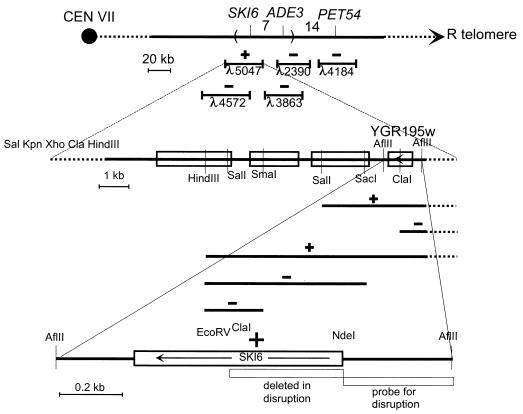
FIG. 1
FIG. 1
Cloning of SKI6. The location of SKI6 was determined on the linkage map, and genomic clones in this area were screened for complementation (see text). Complementation tests of subclones localized SKI6 to YGR195w. The region deleted in the ski6::HIS3 disruption and the probe used are shown.
FIG. 2
FIG. 2
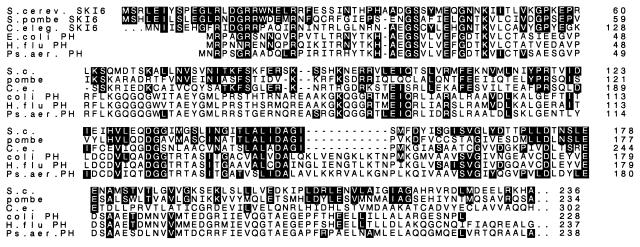
Ski6 protein is homologous to tRNA-processing enzymes of bacteria (9, 27) and proteins encoded by uncharacterized ORFs of Schizosaccharomyces pombe (pombe; GenBank accession no. D89141) (64) and Caenorhabditis elegans (C. eleg. or C. e.; EMBL accession no. Z49909) (62). S.c. or S. cerev., S. cerevisiae; coli or E. coli, Escherichia coli; H. flu, Haemophilus influenzae; Ps. aer., Pseudomonas aeruginosa.
FIG. 3
FIG. 3
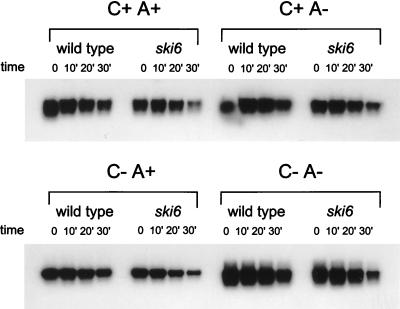
SKI6 does not affect stability of electroporated luciferase mRNA. Labeled mRNA was electroporated into wild-type and ski6-2 cells. The kinetics of luciferase synthesis (Fig. 4) and mRNA degradation were determined on portions of the same samples taken at 0, 10, 20, and 30 min. Extracted RNA was analyzed by agarose gel electrophoresis and autoradiography as described previously (31).
FIG. 4
FIG. 4
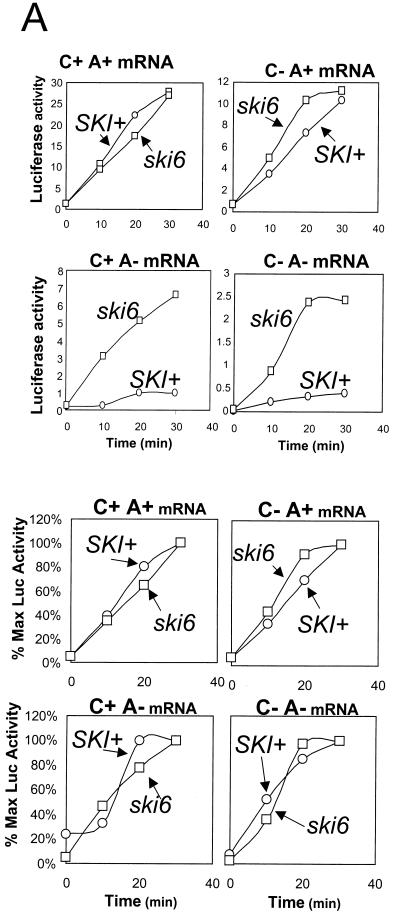
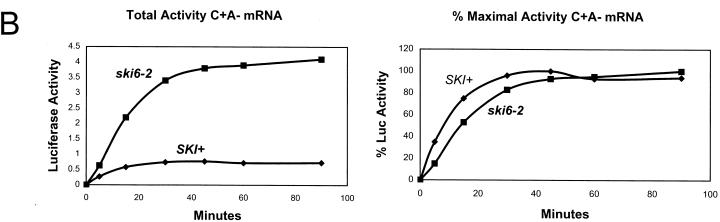
Kinetics of luciferase accumulation in ski6-2 and SKI+ cells indicates an effect on translation rather than mRNA degradation. (A) Kinetics of luciferase activity accumulation are plotted in the upper panels (luciferase activity in light units per microgram of protein), and percent maximal luciferase activity (% Max Luc Activity) is plotted in the lower panels. (B) Comparison of ski6-2 and SKI+ cells in translation of C+ A mRNA over a 90-min time course. If accumulation were low in wild-type cells for C+ A or C A mRNAs because of mRNA degradation, then activity would accumulate rapidly and stop at later time points. The plateau (100%) would be expected early. In fact, the kinetics as percent maximal activity are similar for SKI+ and ski6 strains for all types of mRNA. The differences in rates of accumulation must be due to differences in translation rate. The percentage was calculated as follows: 100 {[(value at time t) − (value at t = 0)]/[30-min value]}.
FIG. 4
FIG. 4
Kinetics of luciferase accumulation in ski6-2 and SKI+ cells indicates an effect on translation rather than mRNA degradation. (A) Kinetics of luciferase activity accumulation are plotted in the upper panels (luciferase activity in light units per microgram of protein), and percent maximal luciferase activity (% Max Luc Activity) is plotted in the lower panels. (B) Comparison of ski6-2 and SKI+ cells in translation of C+ A mRNA over a 90-min time course. If accumulation were low in wild-type cells for C+ A or C A mRNAs because of mRNA degradation, then activity would accumulate rapidly and stop at later time points. The plateau (100%) would be expected early. In fact, the kinetics as percent maximal activity are similar for SKI+ and ski6 strains for all types of mRNA. The differences in rates of accumulation must be due to differences in translation rate. The percentage was calculated as follows: 100 {[(value at time t) − (value at t = 0)]/[30-min value]}.
FIG. 5
FIG. 5
Drug sensitivity assay. Different dilutions of log-phase cultures were tested for their sensitivities to hygromycin B or cycloheximide (see Materials and Methods).
FIG. 6
FIG. 6
ski6-2 cells show a novel species of rRNA whose origin is 25S rRNA. Polysome profiles of ski6-2 (ski6−) and wild-type (SKI6+) cells grown at either 30 or 39°C are shown. The A260 is plotted on the vertical axis. Northern analysis of fractions from polysome profiles at 30°C were made by using probes for 25S (p25S), 18S (p18S), or 5.8S (p5.8S) rRNAs (see Materials and Methods).
FIG. 7
FIG. 7
(A) Long-term centrifugation on sucrose gradients allows a better separation of the novel 38S species from the usual 40S peak. The A260 is plotted on the vertical axis. Northern analysis of fractions from polysome profiles at 39°C was done by using probes against the 25S (p25S) and 18S (p18S) rRNAs (see Materials and Methods). The dashed lines show the points on the UV scan corresponding to the fractions analyzed by Northern hybridization. (B) Hybridization of the blots from panel A with probes specific for either the 5′ end (p25S5′) or 3′ end (p25S3′) of 25S rRNA.
FIG. 8
FIG. 8
A ski6-2 strain shows a deficiency in 5.8S rRNA accumulation. Northern blot analysis was done with 30 μg of total RNA extracted from cells grown at 30°C. The same blots were hybridized with 18S rRNA as a control (data not shown). Blots of each were quantitated by scanning.
FIG. 9
FIG. 9
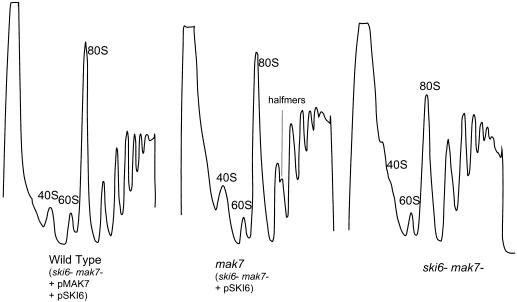
ski6-2 suppresses mak7-1 without relieving the 60S ribosomal subunit deficiency of mak7-1 strains. The mak7-1 ski6-2 strain 4566-2C (=MATa trp1 leu2 ura3 ski6-2 mak7-1 his ade3) was transformed with either pSKI6 or pYRC50 (41) or both to make isogenic strains defective in one or both genes. Polysome profiles were obtained as described in Materials and Methods.

References

    1. Ball S G, Tirtiaux C, Wickner R B. Genetic control of L-A and L-BC dsRNA copy number in killer systems of Saccharomyces cerevisiae. Genetics. 1984;107:199–217. - PMC - PubMed
    1. Blanc A, Goyer C, Sonenberg N. The coat protein of the yeast double-stranded RNA virus L-A attaches covalently to the cap structure of eukaryotic mRNA. Mol Cell Biol. 1992;12:3390–3398. - PMC - PubMed
    1. Blanc A, Ribas J C, Wickner R B, Sonenberg N. His-154 is involved in the linkage of the Saccharomyces cerevisiae L-A double-stranded RNA virus Gag protein to the cap structure of mRNAs and is essential for M1 satellite virus expression. Mol Cell Biol. 1994;14:2664–2674. - PMC - PubMed
    1. Bruenn J, Keitz B. The 5′ ends of yeast killer factor RNAs are pppGp. Nucleic Acids Res. 1976;3:2427–2436. - PMC - PubMed
    1. Carroll K, Wickner R B. Translation and M1 double-stranded RNA propagation: MAK18 = RPL41B and cycloheximide curing. J Bacteriol. 1995;177:2887–2891. - PMC - PubMed

Publication types

MeSH terms

LinkOut - more resources