. 1998 May;18(5):2738-47.
doi: 10.1128/MCB.18.5.2738.

Bub1p kinase activates the Saccharomyces cerevisiae spindle assembly checkpoint

Affiliations

Bub1p kinase activates the Saccharomyces cerevisiae spindle assembly checkpoint

K A Farr et al. Mol Cell Biol. 1998 May.

Abstract

Saccharomyces cerevisiae BUB1 encodes a protein kinase required for spindle assembly checkpoint function. In the presence of spindle damage, BUB1 is required to prevent cell cycle progression into anaphase. We have identified a dominantly acting BUB1 allele that appears to activate the spindle assembly checkpoint pathway in cells with undamaged spindles. High-level expression of BUB1-5 did not cause detectable spindle damage, yet it delayed yeast cells in mitosis at a stage following bipolar spindle assembly but prior to anaphase spindle elongation. Delayed cells possessed a G2 DNA content and elevated Clb2p mitotic cyclin levels. Unlike cells delayed in mitosis by spindle damage or MPS1 kinase overexpression, hyperphosphorylated forms of the Mad1p checkpoint protein did not accumulate. Similar to cells overexpressing MPS1, the BUB1-5 delay was dependent upon the functions of the other checkpoint genes, including BUB2 and BUB3 and MAD1, MAD2, and MAD3. We found that the mitotic delay caused by BUB1-5 or MPS1 overexpression was interdependent upon the function of the other. This suggests that the Bub1p and Mps1p kinases act together at an early step in generating the spindle damage signal.


Figures
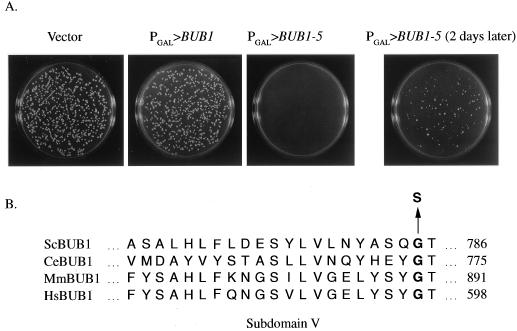
FIG. 1
FIG. 1
BUB1-5 slows cell growth when overexpressed. (A) A wild-type strain (MAY589) was transformed with a PGAL plasmid vector (pBM272) or plasmids containing PGAL>BUB1 (pTR134) or PGAL>BUB1-5 (pKF14) and plated on galactose-containing medium. The plates in the left three panels were incubated at 26°C for 4 days. The panel on the right is the PGAL>BUB1-5 plate photographed after another two days at 26°C. (B) The BUB1-5 mutation changes a glycine to serine within the kinase domain. This position occurs within the kinase domain region designated as subdomain V and is conserved among known Bub1p homologs. Sc, S. cerevisiae; Ce, C. elegans; Mm, Mus musculus; Hs, Homo sapiens.
FIG. 2
FIG. 2
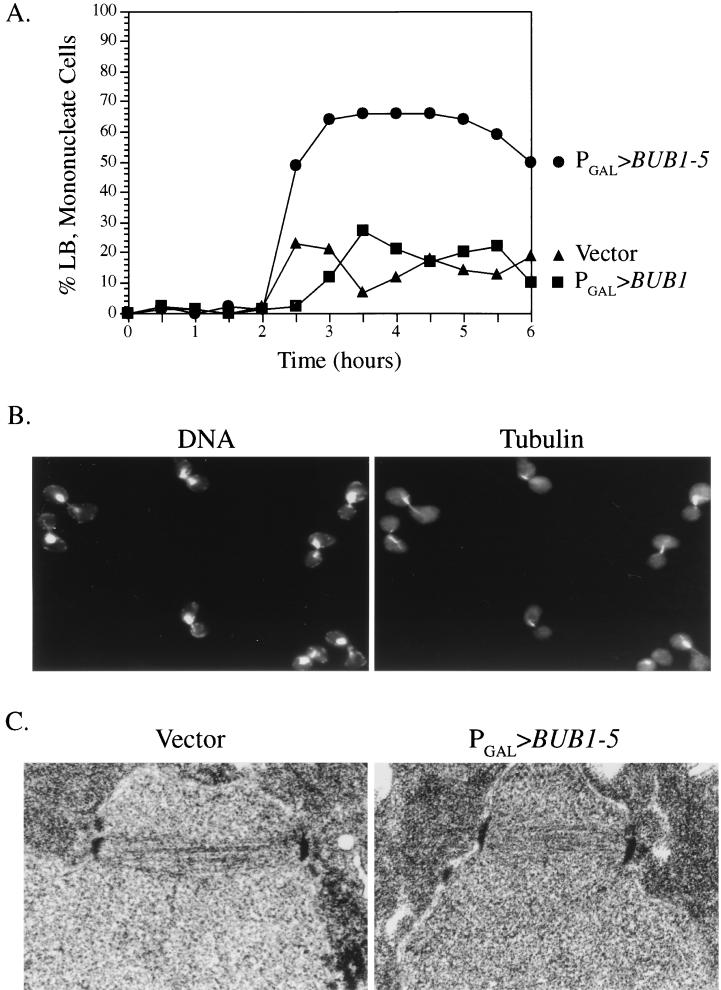
BUB1-5 overexpression causes a mitotic delay. (A) Wild-type cells carrying the indicated plasmid construct were synchronized with α-factor and released into galactose-containing medium at 26°C. At specific time points, samples were fixed, stained with DAPI, and observed by microscopy. The percentages of total cells with large-budded (LB) morphologies (diameter of bud cell, ≥75% of diameter of mother cell) and single nuclei are displayed. This morphology is characteristic of mitotic cells. ▴, vector plasmid; ▪, PGAL>BUB1 plasmid; •, PGAL>BUB1-5 plasmid. (B) Images of PGAL>BUB1-5 cells prepared as described for panel A and stained for DNA with DAPI and antitubulin with a specific antibody. (C) Thin-section electron micrograph of PGAL vector (left) and PGAL>BUB1-5 (right) cells fixed after growth in galactose for 3 h.
FIG. 3
FIG. 3
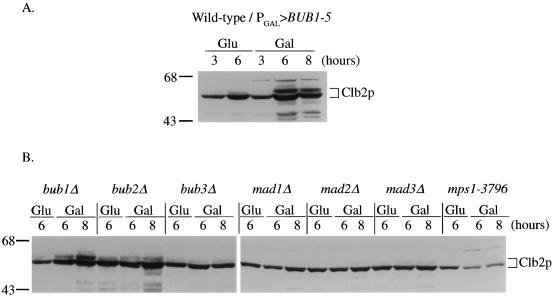
BUB1-5 overexpression affects Clb2p mitotic cyclin levels. (A) Wild-type cells carrying the PGAL>BUB1-5 construct were grown in raffinose-containing medium and then switched to glucose (Glu) or galactose (Gal) medium for the indicated number of hours. Protein extracts were prepared and subjected to polyacrylamide gel electrophoresis and Western blot analysis with an antibody specific for the mitotic cyclin Clb2p. (B) The indicated checkpoint mutant cells, carrying the PGAL>BUB1-5 plasmid, were grown in galactose for the indicated number of hours and examined for Clb2p levels as in panel A.
FIG. 4
FIG. 4
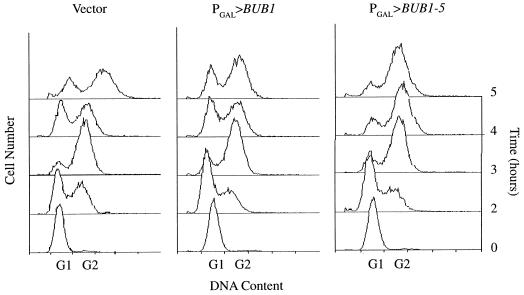
BUB1-5 overexpression causes arrest after DNA synthesis. Wild-type cells carrying the indicated construct were synchronized with α-factor and released into galactose-containing medium at 26°C. At the indicated time points, samples were prepared for flow-cytometric analysis of DNA content. Displayed is cell number as a function of DNA content. G1 and G2 roughly indicate the positions of cells with unreplicated and replicated DNA, respectively.
FIG. 5
FIG. 5
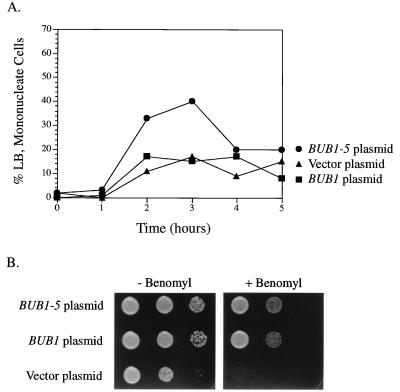
Normally expressed BUB1-5 causes a slight mitotic delay and complements bub1Δ. (A) Wild-type cells carry the indicated constructs that express BUB1 alleles from its normal promoter. These cells were synchronized with α-factor, released into galactose-containing medium, and examined for mitotic cells as described for Fig. 2A. A second trial of this experiment yielded a similar increase in the number of large-budded (LB) mononucleate cells for the BUB1-5 strain only. ▴, vector plasmid; ▪, BUB1 plasmid; •, BUB1-5 plasmid. (B) A bub1Δ strain was transformed with the indicated construct expressing BUB1 alleles from its normal promoter. These cells were spotted onto rich medium and the same medium containing 10 μg of benomyl per ml. Each spot to the right is a 1:50 dilution of the corresponding spot on the left. Plasmids used: BUB1, pKF44; BUB1-5, pKF48.
FIG. 6
FIG. 6
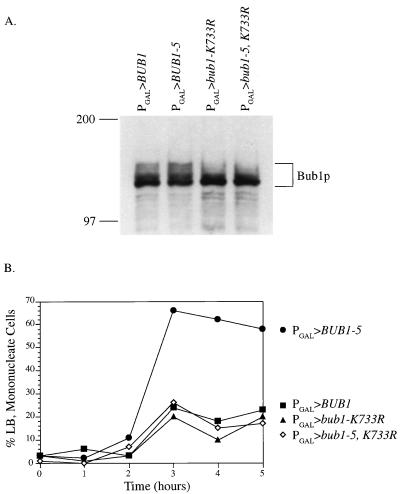
The BUB1-5 mitotic delay requires a functional kinase domain. (A) Wild-type cells carrying the indicated construct were induced in galactose for 4 h. Protein extracts were then prepared and subjected to gel electrophoresis and immunoblotting with Bub1p antibody. As previously described (20), multiple forms of Bub1p were observed. These have been determined to be due to different phosphorylation states (3b). (B) Wild-type cells carrying the indicated construct were synchronized with α-factor, released into galactose-containing medium, and examined for mitotic cells as described for Fig. 2A. The K733R mutation inactivates kinase function. ▪, PGAL>BUB1 plasmid; •, PGAL>BUB1-5 plasmid; ▴, PGAL>bub1-K733R plasmid; ◊, PGAL>bub1-5, K733R plasmid.
FIG. 7
FIG. 7
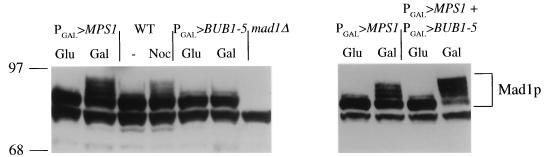
BUB1-5 overexpression does not lead to Mad1p hyperphosphorylation. Wild-type cells carrying the indicated construct(s) were grown in glucose (Glu)- or galactose (Gal)-containing medium for 5 h or treated with 10 μg of nocodazole per ml (in glucose medium) for 4 h. Protein extracts were analyzed by gel electrophoresis and Western blotting probed with an antibody specific for Mad1p. To help identify Mad1p-specific bands, a mad1Δ strain was also examined. We detected no difference in Mad1p forms between PGAL>BUB1-5-containing cells grown in glucose or galactose even when the film was greatly overexposed.
FIG. 8
FIG. 8
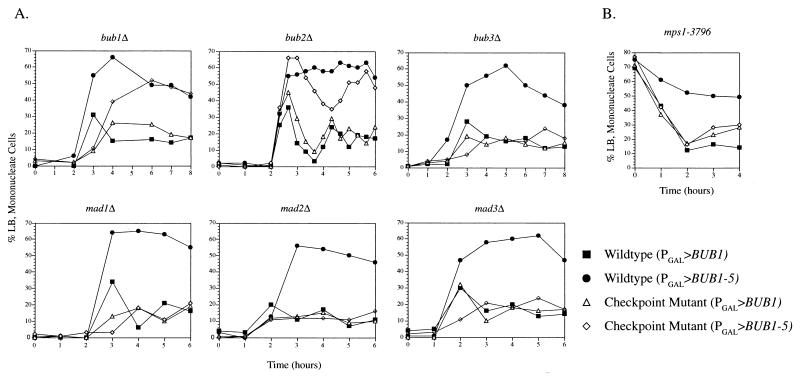
The BUB1-5 mitotic delay requires the other spindle assembly checkpoint genes. (A) Cells with the indicated checkpoint mutation and carrying the PGAL>BUB1 or PGAL>BUB1-5 construct were synchronized with α-factor, released into galactose-containing medium, and examined for mitotic cells, as described for Fig. 2A. (B) The temperature-sensitive mps1-3796 mutant was transformed with the PGAL>BUB1 or PGAL>BUB1-5 construct. These cells were synchronized in S phase with hydroxyurea at 26°C and were switched to galactose-containing medium (plus hydroxyurea) for 3 h to induce BUB1 expression. This was followed by release from the hydroxyurea block by transfer into the same medium at 33°C. Passage of the cells through mitosis was evidenced by the reduction of large-budded (LB) mononucleate cells in the culture. The experiments in this figure were repeated 2 (mad2Δ), 3 (bub1Δ, mad1Δ), 4 (mad3Δ), 5 (bub3Δ, mps1-3796), and 10 (bub2Δ) times, always yielding the same results. Mutant strains: bub1Δ, MAY4537; bub2Δ, MAY2055; bub3Δ, MAY4574; mad1Δ, MAY3728; mad2Δ, MAY4428; mad3Δ, MAY4612; mps1-3796Δ, AS131-2d.

References

    1. Byers B, Goetsch L. Preparation of yeast cells for thin-section electron microscopy. Methods Enzymol. 1991;194:602–608. - PubMed
    1. Chen R, Waters J C, Salmon E D, Murray A W. Association of spindle assembly checkpoint component XMAD2 with unattached kinetochores. Science. 1996;274:242–246. - PubMed
    1. Dougherty, C., and M. A. Hoyt. Unpublished observations.
    1. Elledge S J. Cell cycle checkpoints: preventing an identity crisis. Science. 1996;274:1664–1672. - PubMed
    1. Farr, K. A., and M. A. Hoyt. Unpublished observations.

Publication types

MeSH terms

LinkOut - more resources