. 1998 May 15;18(10):3929-42.
doi: 10.1523/JNEUROSCI.18-10-03929.1998.

Sensitive periods for visual calibration of the auditory space map in the barn owl optic tectum

Affiliations

Sensitive periods for visual calibration of the auditory space map in the barn owl optic tectum

M S Brainard et al. J Neurosci. .

Abstract

Previous studies have identified sensitive periods for the developing barn owl during which visual experience has a powerful influence on the calibration of sound localization behavior. Here we investigated neural correlates of these sensitive periods by assessing developmental changes in the capacity of visual experience to alter the map of auditory space in the optic tectum of the barn owl. We used two manipulations. (1) We equipped owls with prismatic spectacles that optically displaced the visual field by 23 degrees to the left or right, and (2) we restored normal vision to prism-reared owls that had been raised wearing prisms. In agreement with previous behavioral experiments, we found that the capacity of abnormal visual experience to shift the tectal auditory space map was restricted to an early sensitive period. However, this period extended until later in life (approximately 200 d) than described previously in behavioral studies (approximately 70 d). Furthermore, unlike the previous behavioral studies that found that the capacity to recover normal sound localization after restoration of normal vision was lost at approximately 200 d of age, we found that the capacity to recover a normal auditory space map was never lost. Finally, we were able to reconcile the behaviorally and neurophysiologically defined sensitive periods by taking into account differences in the richness of the environment in the two sets of experiments. We repeated the behavioral experiments and found that when owls were housed in a rich environment, the capacity to adjust sound localization away from normal extended to later in life, whereas the capacity to recover to normal was never lost. Conversely, when owls were housed in an impoverished environment, the capacity to recover a normal auditory space map was restricted to a period ending at approximately 200 d of age. The results demonstrate that the timing and even the existence of sensitive periods for plasticity of a neural circuit and associated behavior can depend on multiple factors, including (1) the nature of the adjustment demanded of the system and (2) the richness of the sensory and social environment in which the plasticity is studied.


Figures

Fig. 1.
Fig. 1.
Effects of prism experience on ITD tuning of tectal units in a juvenile and an adult owl. A, ITD tuning before prism experience (○) and after 28 d of prism experience (•) for an owl that was equipped with prisms at 88 d of age. Measurements were made at single tectal sites that had matched, frontally located VRFs. The best ITD measured before prisms were mounted was close to the value of ITD corresponding with the location of the VRF for the site (open arrow). The best ITD after 28 d of prism experience was shifted toward the value of ITD corresponding with the optically displaced VRF (filled arrow). B, Best ITD as a function of VRF location for recordings made at 13 tectal sites before prisms were mounted (○) and at 13 sites after 28 d of prism experience (•). The line indicates the normal relationship between best ITD and VRF azimuth determined from previous studies (see Materials and Methods). C, Differences between the measured values of best ITD and normal values predicted from VRF locations for all sites before prisms were mounted (open bars) and after 28 d of prism experience (solid bars). The vertical dashed lines indicate the ITD values corresponding to no adjustment (0 μsec) or the maximum predicted adjustment (57 μsec). D–F, ITD tuning from the tectum of an adult owl that was equipped with prisms at >1 year of age. Measurements were made immediately before prisms were mounted and after 183 d of prism experience. Conventions are as inA–C.
Fig. 2.
Fig. 2.
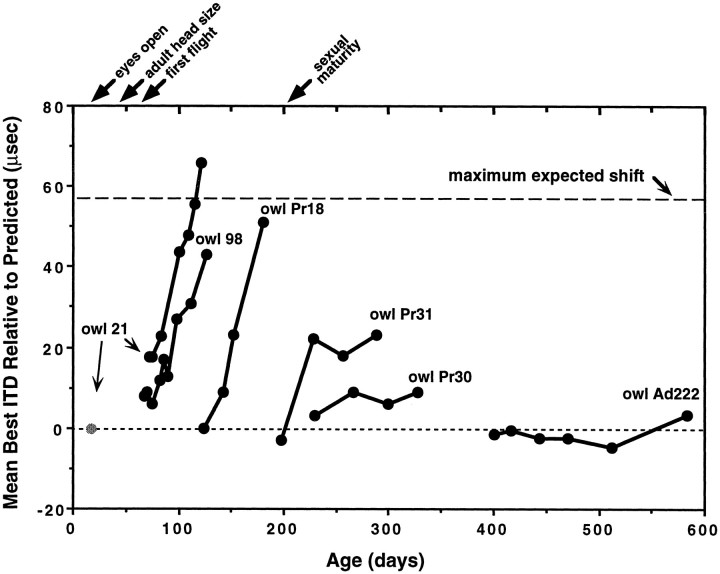
Time course of changes in ITD tuning after mounting of prisms. For owls 21 and 98, the data points represent the best ITD for single tectal sites that were measured repeatedly using chronically implanted electrodes. For the other owls, points reflect the average value of best ITD relative to the normal value predicted by VRF location sampled at multiple tectal sites. Positive values indicate shifts of tuning in the adaptive direction; a value of 0 μsec indicates normal tuning and +57 μsec indicates the maximum expected shift in best ITD. The first point for each owl represents the mean best ITD relative to normal measured immediately before mounting of prisms. For owl 21, this value could not be measured and is therefore plotted as 0 μsec, the expected value (shaded circle). Owl Ad222 was at least 1 year old when prisms were mounted, but its exact age is not known; the time axis for this bird is therefore only approximate. At the top of the plot are indicated the approximate ages of various developmental events. The eyes first open at ∼10–12 d of age, although the ocular media remains cloudy until 16–18 d of age, and the eyes do not achieve final adult alignment until ∼45 d of age (Knudsen, 1989). The width of the skull and the feathers of the facial ruff reach adult size at ∼40 d of age (Haresign and Moiseff, 1988; Knudsen et al., 1984a). Owls begin to fly for the first time at ∼60 d of age (Bunn et al., 1982). Owls become capable of breeding at ∼200 d of age (E. I. Knudsen, personal observation).
Fig. 3.
Fig. 3.
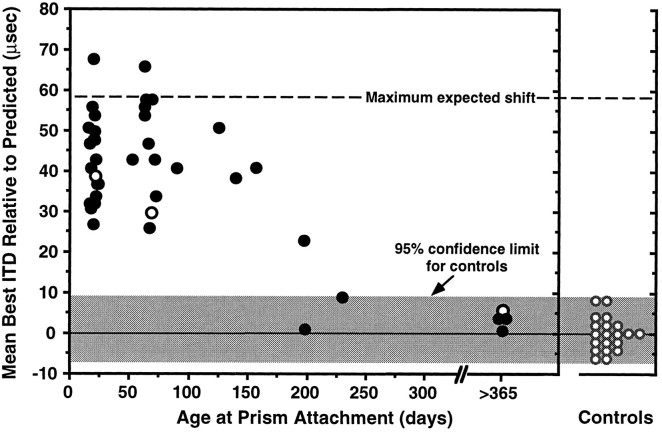
Shift in ITD tuning in the tectum as a function of the age at which owls were equipped with prisms. Each data point reflects the mean shift in best ITD for an individual owl after at least 2 months of prism experience. The data are based on both chronic recordings and tectal sampling. Positive values indicate shifts in the adaptive direction. Open symbols represent data from owls that exhibited auditory thresholds that were elevated relative to normal by 20–40 dB. Data from 20 normal adult owls are plotted for comparison. For the control owls, positive values indicate mean best ITDs that were more right-ear leading than predicted from the locations of VRFs.
Fig. 4.
Fig. 4.
Effect of prism experience on population ITD tuning curves in four adult owls. Each population ITD tuning curve (see Materials and Methods) was based on ITD tuning curves measured at 13–18 sites sampled either before (○) or after (•) a long period of prism experience (indicated above each graph). Error bars represent SEM. Owls Pr30 and Ad222 experienced R23° prisms; owls Ad712 and Ad831 experienced L23° prisms. The arrowindicates the direction of adaptive shift for each owl.
Fig. 5.
Fig. 5.
During the sensitive period, ITD tuning could be alternately shifted in both directions in the tectum of an individual owl. A, The timeline indicates the ages at which prisms were mounted and measurements were made. B, Histograms indicate the distribution of best ITDs relative to predicted normal for recording sites tested before prism experience (88 d; open bars), after 28 d of experience with R23° prisms (116 d;solid bars), and after 56 d with L23° prisms (180 d; striped bars).
Fig. 6.
Fig. 6.
Time course of adjustment to normal ITD tuning after restoration of normal vision for three prism-reared owls. Changes in ITD tuning were followed at two tectal sites in each owl using chronic recording electrodes. Data from the two sites are distinguished by different symbol types. Each point represents the best ITD recorded at a single site in a given recording session. The first point of each series was collected immediately before prism removal.
Fig. 7.
Fig. 7.
Recovery of normal ITD tuning as a function of the age at which prisms were removed. For each owl, a vertically aligned pair of points (connected by a shaded arrow) indicates the best ITD immediately before prism removal (○) and at least 1 month after prism removal (•). Mean best ITDs reflect measurements made with either chronic electrodes or by sampling the tectum at multiple sites. Error bars indicate 1 SD.
Fig. 8.
Fig. 8.
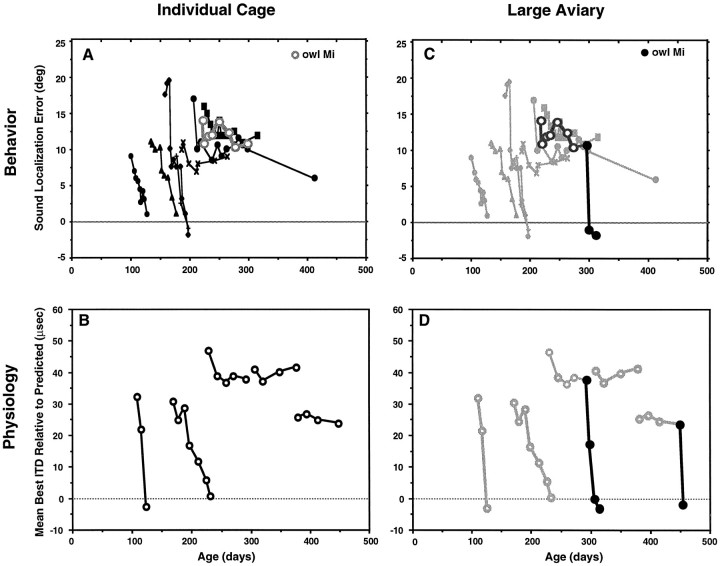
The influence of environmental richness on the capacity to adjust sound localization accuracy and the tectal map of ITD to normal after restoration of normal vision to prism-reared owls.A, Adjustment of sound localization accuracy by owls housed in individual cages. The open circles represent data from owl Mi measured in this study; the other data are from a previous study (Knudsen and Knudsen, 1990). Each point indicates the mean auditory orientation error for an individual owl in a single experimental session. The first point of each series indicates the error immediately before prism removal. When prisms were removed before ∼200 d of age, sound localization accuracy rapidly adjusted to normal; when prisms were removed later, sound localization accuracy did not adjust. B, Adjustment of ITD tuning in the tecta of owls housed in individual cages. Each point indicates the mean best ITD relative to normal for an individual owl. The first point of each series indicates the mean best ITD relative to normal immediately before prism removal. When prisms were removed before 200 d of age, ITD tuning adjusted to normal; when they were removed later, ITD tuning failed to adjust. C, Adjustment of sound localization accuracy to normal by an adult owl (owl Mi) that was housed in a large aviary. After prisms were removed at 219 d of age, the owl was first transferred to an individual cage (○) where it remained for 76 d, exhibiting little adjustment of sound localization accuracy. At 295 d of age, the owl was transferred to a large aviary, and sound localization accuracy rapidly adjusted to normal (•). The data for owls housed in individual cages (from A) are shaded and included for comparison. D, Adjustment of ITD tuning in the tecta of adult owls that were housed in large aviaries. Two of the adult owls that had failed to adjust ITD tuning while housed in individual cages (shaded symbols, replotted from B for comparison) were subsequently transferred to a large aviary, after which ITD tuning was adjusted to normal.
Fig. 9.
Fig. 9.
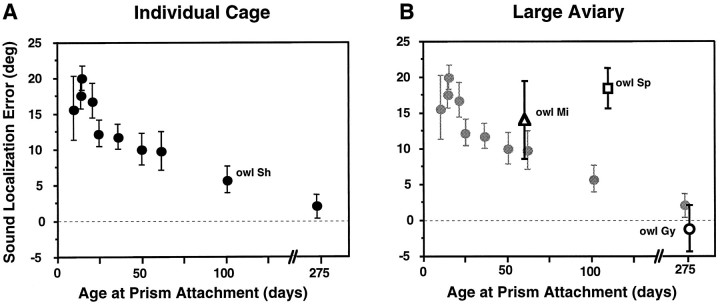
The influence of environmental richness on the sensitive period for the adjustment of sound localization accuracy in response to prism experience. Each data point represents the mean (±SD) auditory orientation error measured for an individual owl after at least 60 d of experience with 23° prisms; positive errors indicate shifts in the adaptive direction. A, These data are from a previous study (Knudsen and Knudsen, 1990) and show the effect of prism experience on sound localization accuracy for owls housed in individual cages. B, The open symbols represent data from three owls measured in this study and show the adjustment of sound localization accuracy for owls housed in large aviaries. The data from A areshaded and plotted for comparison. The data fromowl Sp (□) indicate adjustment of sound localization accuracy at an age when little adjustment occurred in owls housed in individual cages (compare with owl Sh inA). No adjustment occurred in the adult owl, owl Gy (○), although it was housed in a large aviary.

References

    1. Baptista LF, Gaunt SLL. Social interaction and development in birds. In: Snowdon CT, Hausberger M, editors. Social influences on vocal development. Cambridge UP; Cambridge: 1997. pp. 23–40.
    1. Baptista L, Petrinovich L. Song development in the white-crowned sparrow: social factors and sex differences. Anim Behav. 1986;34:1359–1371.
    1. Bolhuis JJ. Mechanisms of avian imprinting: a review. Biol Rev. 1991;66:303–345. - PubMed
    1. Bottjer SW, Hewer SJ. Castration and antisteroid treatment impair vocal learning in male zebra finches. J Neurobiol. 1992;23:337–353. - PubMed
    1. Brainard MS, Knudsen EI. Experience-dependent plasticity in the inferior colliculus: a site for visual calibration of the neural representation of auditory space in the barn owl. J Neurosci. 1993;13:4589–4608. - PMC - PubMed

Publication types

MeSH terms

LinkOut - more resources