


Chaperone coexpression plasmids: differential and synergistic roles of DnaK-DnaJ-GrpE and GroEL-GroES in assisting folding of an allergen of Japanese cedar pollen, Cryj2, in Escherichia coli
- PMID: 9572938
- PMCID: PMC106217
- DOI: 10.1128/AEM.64.5.1694-1699.1998
Chaperone coexpression plasmids: differential and synergistic roles of DnaK-DnaJ-GrpE and GroEL-GroES in assisting folding of an allergen of Japanese cedar pollen, Cryj2, in Escherichia coli
Abstract
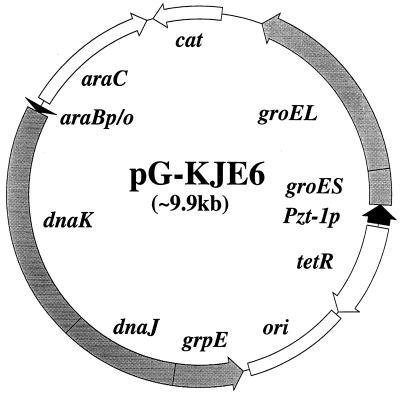
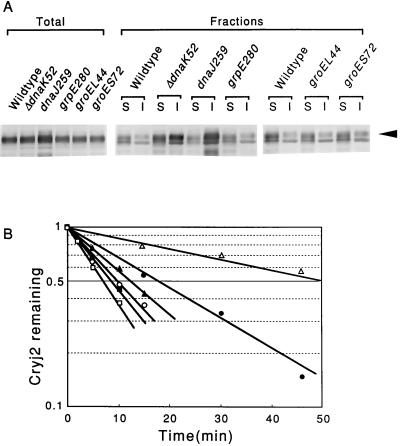
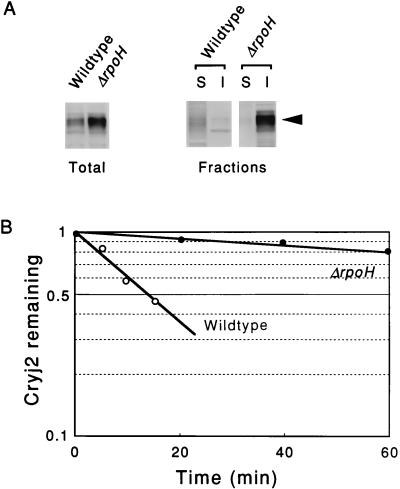
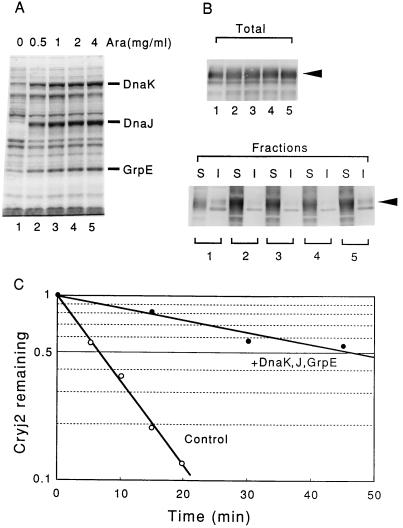
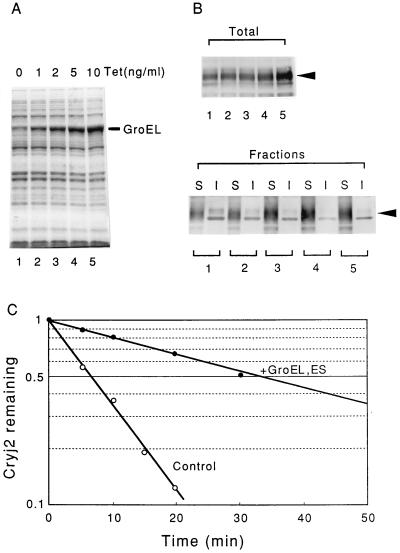
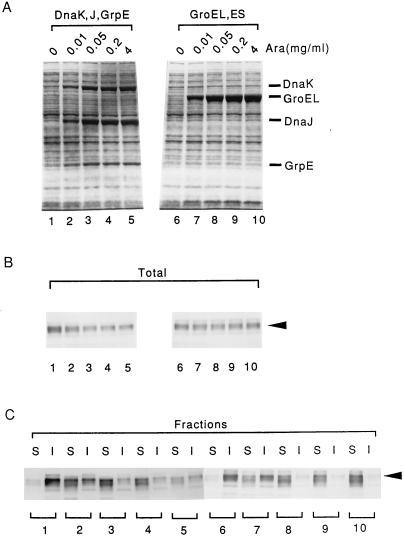
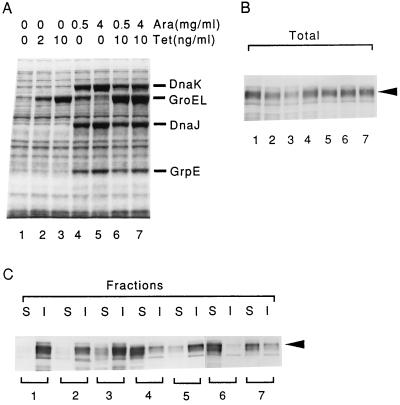
Plasmids that can be used for controlled expression of the DnaK-DnaJ-GrpE and/or GroEL-GroES chaperone team were constructed in order to facilitate assessment of the effects of these chaperone teams on folding or assembly or recombinant proteins in Escherichia coli. A typical pACYC184-based plasmid which was obtained could express the major DnaK-DnaJ-GrpE and GroEL-GroES chaperone teams from separate promoters when L-arabinose and tetracycline, respectively, were added in a dose-dependent fashion. The model protein used to determine whether this system was useful was an allergen of Japanese cedar pollen, Cryj2, which was unstable when it was produced in E. coli K-12. The effects of chaperone coexpression on the folding, aggregation, and stability of Cryj2 were examined in the wild type and in several mutant bacteria. Coexpression of the DnaK-DnaJ-GrpE and/or GroEL-GroES chaperone team at appropriate levels resulted in marked stabilization and accumulation of Cryj2 without extensive aggregation. Experiments performed with mutants that lack each of the chaperone proteins (DnaK, DnaJ, GrpE, GroEL, and GroES) or heat shock transcription factor sigma 32 revealed that both chaperone teams are critically involved in Cryj2 folding but that they are involved in distinct ways. In addition, it was observed that the two chaperone teams have synergistic roles in preventing aggregation of Cryj2 in the absence of sigma 32 at certain temperatures.
Figures
References
-
- Casadaban M. Transposition and fusion of the lac gene to selected promoters in E. coli using bacteriophage lambda and mu. J Mol Biol. 1976;104:541–555. - PubMed
-
- Georgopoulos C, Liberek K, Zylicz M, Ang D. Properties of the heat shock proteins of Escherichia coli and the autoregulation of the heat shock response. In: Morimoto R I, Tissieres A, Georgopoulos C, editors. The biology of heat shock proteins and molecular chaperones. Cold Spring Harbor, N.Y: Cold Spring Harbor Laboratory Press; 1994. pp. 209–249.
-
- Gross C A. Function and regulation of the heat shock proteins. In: Neidhardt F C, Curtiss III R, Ingraham J L, Lin E C C, Low K B, Magasanik B, Reznikoff W S, Riley M, Schaechter M, Umbarger H E, editors. Escherichia coli and Salmonella: cellular and molecular biology. Washington, D.C: AMS Press; 1996. pp. 1382–1399.
-
- Hartl F U. Molecular chaperones in cellular protein folding. Nature. 1996;381:571–580. - PubMed
MeSH terms
Substances
LinkOut - more resources
Full Text Sources
Other Literature Sources
Molecular Biology Databases
Research Materials
