


Ammonia-hyperproducing bacteria from New Zealand ruminants
- PMID: 9572953
- PMCID: PMC106232
- DOI: 10.1128/AEM.64.5.1796-1804.1998
Ammonia-hyperproducing bacteria from New Zealand ruminants
Abstract
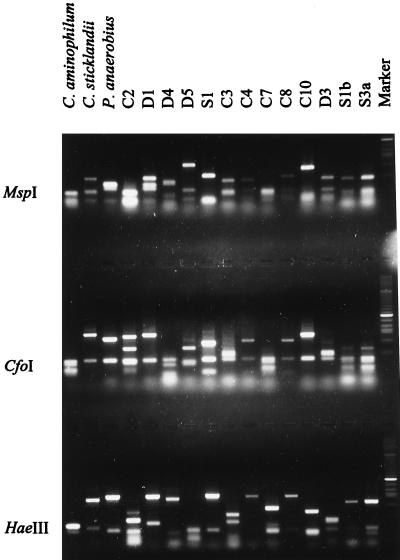
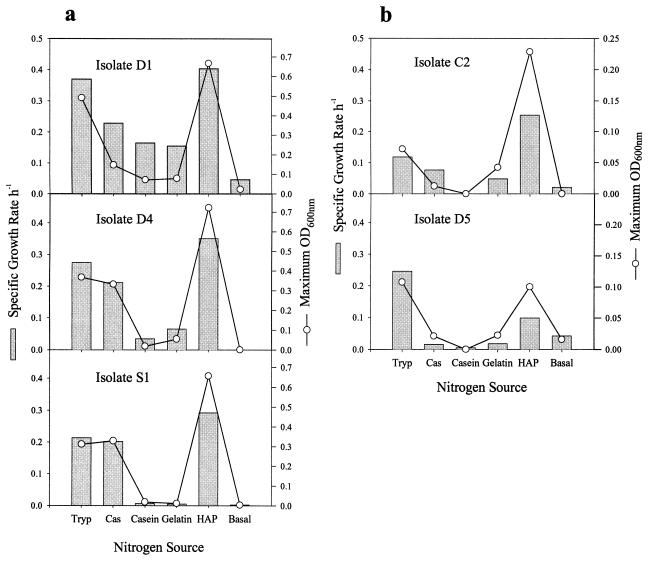
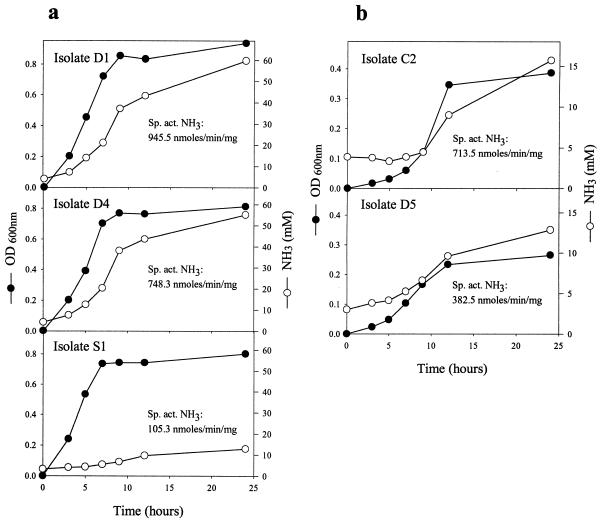
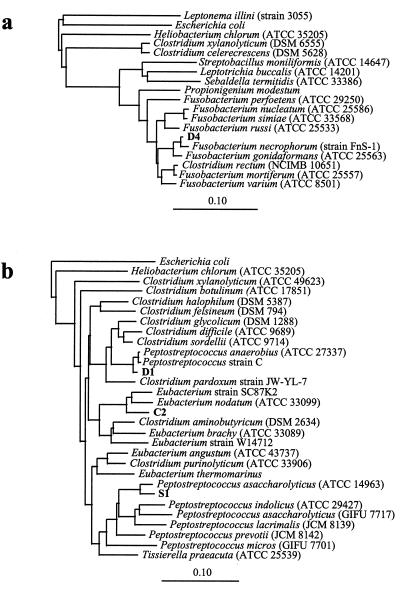
Pasture-grazed dairy cows, deer, and sheep were tested for the presence of ammonia-hyperproducing (HAP) bacteria in roll tubes containing a medium in which tryptone and Casamino Acids were the sole nitrogen and energy sources. Colonies able to grow on this medium represented 5.2, 1.3, and 11.6% of the total bacterial counts of dairy cows, deer, and sheep, respectively. A total of 14 morphologically distinct colonies were purified and studied further. Restriction fragment length polymorphisms of 16S rRNA genes indicated that all isolates differed from the previously described HAP bacteria, Clostridium aminophilum, Clostridium sticklandii, and Peptostreptococcus anaerobius. Carbon source utilization experiments showed that five isolates (C2, D1, D4, D5, and S1) were unable to use any, or very few, of the carbon sources tested. Biochemical tests and phylogenetic analyses of 16S ribosomal DNA sequences indicated that all isolates were monensin sensitive; that D1 and S1 belonged to the genus Peptostreptococcus, that D4 and D5 belonged to the family Bacteroidaceae, where D4 was similar to Fusobacterium necrophorum; and that C2 was most similar to an unidentified species from the genus Eubacterium. Growth on liquid medium containing tryptone and Casamino Acids as the sole nitrogen and energy source showed that D1, D4, and S1 grew rapidly (specific growth rates of 0.40, 0.35, and 0.29 h-1, respectively), while C2 and D5 were slow growers (0.25 and 0.10 h-1, respectively). Ammonia production rates were highest in D1 and D4, which produced 945.5 and 748.3 nmol/min per mg of protein, respectively. Tests of individual nitrogen sources indicated that D1 and D4 grew best on tryptone, S1 grew equally well on Casamino Acids or tryptone, and C2 and D5 grew poorly on all nitrogen sources. The intact proteins casein and gelatin did not support significant growth of any of the isolates. These isolates extend the diversity of known HAP rumen bacteria and indicate the presence of significant HAP bacterial populations in pasture-grazed New Zealand ruminants.
Figures
References
-
- Abou Akkada A R, Blackburn T H. Some observations on the nitrogen metabolism of rumen proteolytic bacteria. J Gen Microbiol. 1963;31:461–469. - PubMed
-
- Attwood G T, Reilly K. Identification of proteolytic rumen bacteria isolated from New Zealand cattle. J Appl Bacteriol. 1995;79:22–29. - PubMed
-
- Blackburn T H, Hobson P N. Further studies on the isolation of proteolytic bacteria from the sheep rumen. J Gen Microbiol. 1962;29:69–81. - PubMed
-
- Bradford M M. A rapid and sensitive method for the quantitation of microgram quantities of protein utilizing the principle of protein-dye binding. Anal Biochem. 1976;72:248–254. - PubMed
Publication types
MeSH terms
Substances
Associated data
- Actions
- Actions
- Actions
- Actions
LinkOut - more resources
Full Text Sources
Other Literature Sources
Molecular Biology Databases
Miscellaneous
