. 1998 May 1;64(5):1910-8.
doi: 10.1128/AEM.64.5.1910-1918.1998.

Grazing Pressure by a Bacterivorous Flagellate Reverses the Relative Abundance of Comamonas acidovorans PX54 and Vibrio Strain CB5 in Chemostat Cocultures

Affiliations

Grazing Pressure by a Bacterivorous Flagellate Reverses the Relative Abundance of Comamonas acidovorans PX54 and Vibrio Strain CB5 in Chemostat Cocultures

MW Hahn et al. Appl Environ Microbiol. .

Abstract

The response of the bacterial strains Comamonas acidovorans PX54 (beta subclass of the class Proteobacteria) and Vibrio strain CB5 (gamma subclass of the class Proteobacteria) to grazing by the bacterivorous flagellate Ochromonas sp. was examined in one-stage chemostat experiments under conditions of low growth rates with a complex carbon source. The two bacterial strains were cultured together; they were cultured without flagellates in the first phase of the experiments and in the presence of the flagellates in the second phase. Monoclonal and polyclonal antibodies were used to determine the numbers and sizes of C. acidovorans PX54 and Vibrio strain CB5 cells. The flagellates caused strong changes in total bacterial cell numbers, in the relative abundances of the individual bacterial strains, and in bacterial cell size distribution. Vibrio strain CB5 dominated the total bacterial cell numbers during the flagellate-free phase of the experiments with a relative abundance of 93%, but this declined to 33% after inoculation with the flagellate. In contrast to Vibrio strain CB5, C. acidovorans PX54 responded to grazing with a strong expansion of cell length distribution toward large, filamentous cells. These changes in cell morphology resulted in a high percentage of inedible cells in the C. acidovorans PX54 population but not in the Vibrio strain CB5 population, which caused the observed change in the relative abundances of the strains. Batch culture experiments without the flagellate demonstrated that the elongation of C. acidovorans PX54 cells was dependent on their growth rate. This indicates that the occurrence of filamentous C. acidovorans PX54 cells is not a direct response to chemical stimuli released by the flagellates but rather a response to increased growth rates due to flagellate grazing.


Figures
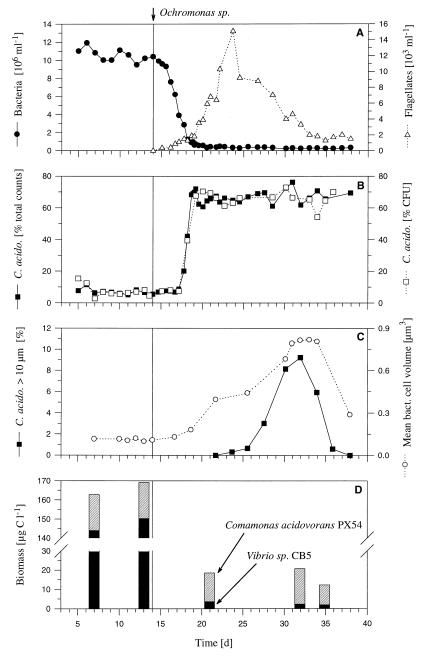
FIG. 1
FIG. 1
Influence of grazing by the bacterivorous flagellate Ochromonas sp., inoculated on day 14 into C. acidovorans PX54 and Vibrio strain CB5 chemostat cultures (Flag1 experiment). (A) Total bacterial abundance and flagellate abundance. (B) Relative abundance of C. acidovorans PX54 determined either by immunofluorescence microscopy or by distinguishing colony types on agar plates. (C) Mean cell volume of the total bacterial community and percentage of C. acidovorans PX54 cells larger than 10 μm (filamentous cells). (D) Biomasses of C. acidovorans PX54 and Vibrio strain CB5 populations in the flagellate-free and flagellate-controlled phases. Inoculation of the bacterivorous flagellate Ochromonas sp. is indicated by vertical lines.
FIG. 2
FIG. 2
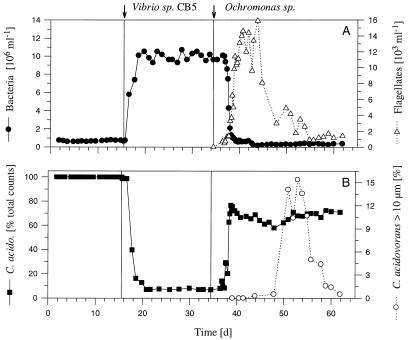
Influence of grazing by Ochromonas sp. on the model community consisting of C. acidovorans PX54 and Vibrio strain CB5 (Flag2 experiment). (A) Bacterial abundance before and after inoculation with Vibrio strain CB5 and after introduction of the predator Ochromonas sp. and abundance of this flagellate. (B) Relative abundance of C. acidovorans PX54 and percentage of C. acidovorans PX54 cells larger than 10 μm (filamentous cells).
FIG. 3
FIG. 3
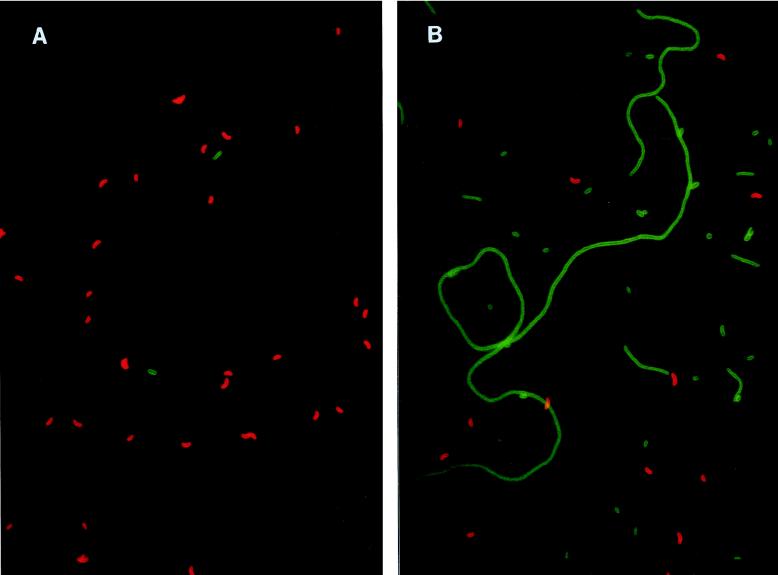
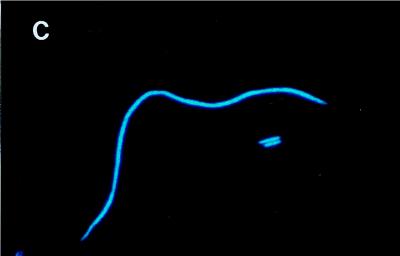
(A and B) Microphotographs of C. acidovorans PX54 (green) and Vibrio strain CB5 (red) stained with fluorescently labelled antibodies (Flag1 experiment). (A) Before flagellate inoculation (day 8). (B) After flagellate inoculation (day 32). (C) Filamentous C. acidovorans PX54 cells grown in a flagellate-free batch culture (late exponential growth stage; cells stained with DAPI).
FIG. 3
FIG. 3
(A and B) Microphotographs of C. acidovorans PX54 (green) and Vibrio strain CB5 (red) stained with fluorescently labelled antibodies (Flag1 experiment). (A) Before flagellate inoculation (day 8). (B) After flagellate inoculation (day 32). (C) Filamentous C. acidovorans PX54 cells grown in a flagellate-free batch culture (late exponential growth stage; cells stained with DAPI).
FIG. 4
FIG. 4
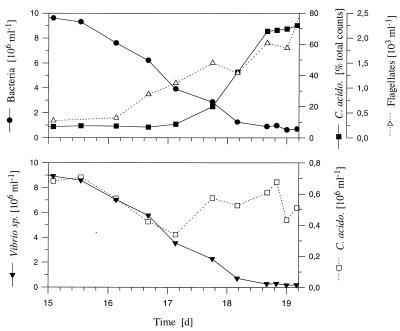
Transient stage after introduction of the flagellate (on day 14) into a chemostat culture of C. acidovorans PX54 and Vibrio strain CB5 (Flag1 experiment). In the beginning, the total bacterial numbers of both species decreased at similar rates, indicating nonselective grazing by the flagellate (lower panel). After day 16, Vibrio strain CB5 abundance continued to decrease but C. acidovorans PX54 abundance increased again and the relative species composition changed (upper panel).
FIG. 5
FIG. 5
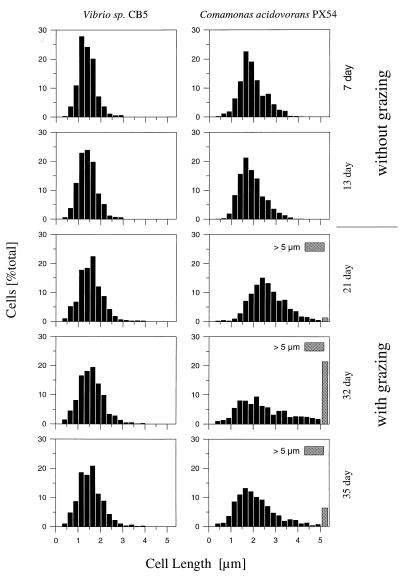
Size class distribution of Vibrio strain CB5 cells (left panels) and C. acidovorans PX54 cells (right panels) in corresponding chemostat samples from flagellate-free and flagellate-controlled phases (Flag1 experiment). Cells longer than 5 μm were pooled in one size class (>5 μm). To avoid distortion of size class distribution, measured cell lengths were corrected for size overestimation caused by cell staining with fluorescently labelled antibodies but not for size overestimation caused by DAPI staining (for details, see Materials and Methods).
FIG. 6
FIG. 6
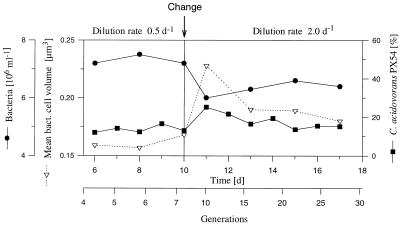
Influence of growth rate on the cell size and abundance of C. acidovorans PX54 and Vibrio strain CB5 in chemostat cultures (Dilut experiment). The change in dilution rate (growth rate) from 0.5 to 2.0 day−1 at day 10 simulated nonselective grazing similar to size-selective grazing by Ochromonas sp. in flagellate-controlled phases of the Flag1 and Flag2 experiments.
FIG. 7
FIG. 7
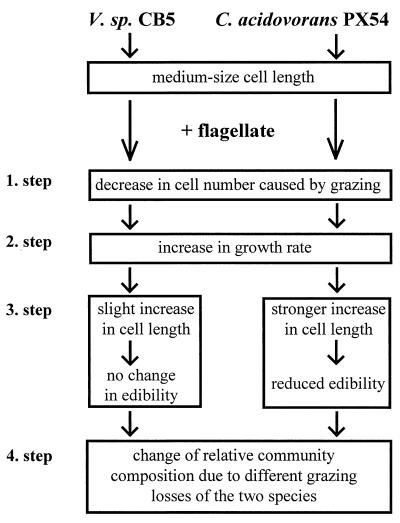
Four-step mechanism explaining the observed changes in relative species composition of binary chemostat cultures after introduction of the flagellate Ochromonas sp. Changes were caused by a combination of a grazing-controlled increase in the bacterial growth rate with the different growth rate-dependent elongation of cells of the two species and size-selective grazing by the flagellate.

References

    1. Andersson A, Lee C, Azam F, Hagström Å. Release of amino acids and inorganic nutrients by heterotrophic marine microflagellates. Mar Ecol Prog Ser. 1985;23:99–106.
    1. Andersson A, Larsson U, Hagström Å. Size-selective grazing by a microflagellate on pelagic bacteria. Mar Ecol Prog Ser. 1986;33:51–57.
    1. Arndt H, Mathes J. Large heterotrophic flagellates form a significant part of protozooplankton biomass in lakes and rivers. Ophelia. 1991;33:225–234.
    1. Bloem J, Starink M, Bär-Gilissen M-J B, Cappenberg T E. Protozoan grazing, bacterial activity, and mineralization in two-stage continuous cultures. Appl Environ Microbiol. 1988;54:3113–3121. - PMC - PubMed
    1. Bremer H, Dennis P P. Modulation of chemical composition and other parameters of the cell by growth rate. In: Neidhardt F C, Curtiss III R, Ingraham J L, Lin E C C, Low K B, Magasanik B, Reznikoff W S, Riley M, Schaechter M, Umbarger H E, editors. Escherichia coli and Salmonella: cellular and molecular biology. 2nd ed. Washington, D.C: American Society for Microbiology; 1996. pp. 1553–1569.

LinkOut - more resources