


The L-isoaspartyl protein repair methyltransferase enhances survival of aging Escherichia coli subjected to secondary environmental stresses
- PMID: 9573145
- PMCID: PMC107212
- DOI: 10.1128/JB.180.10.2623-2629.1998
The L-isoaspartyl protein repair methyltransferase enhances survival of aging Escherichia coli subjected to secondary environmental stresses
Abstract
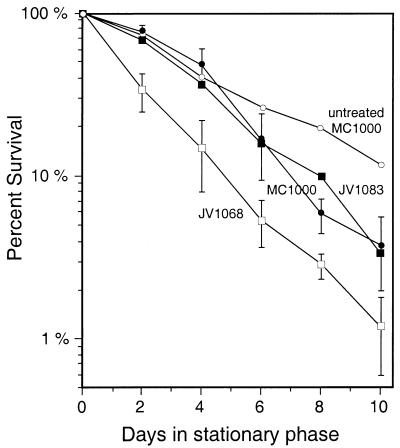
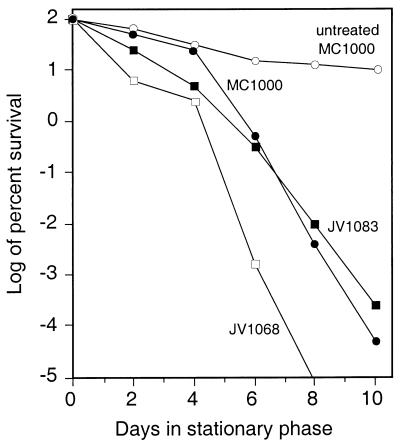
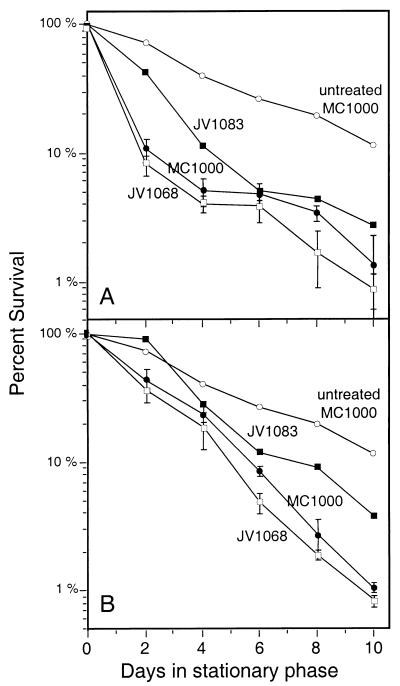
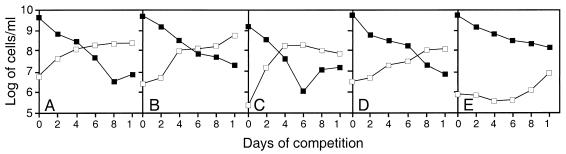
Like its homologs throughout the biological world, the L-isoaspartyl protein repair methyltransferase of Escherichia coli, encoded by the pcm gene, can convert abnormal L-isoaspartyl residues in proteins (which form spontaneously from asparaginyl or aspartyl residues) to normal aspartyl residues. Mutations in pcm were reported to greatly reduce survival in stationary phase and when cells were subjected to heat or osmotic stresses (C. Li and S. Clarke, Proc. Natl. Acad. Sci. USA 89:9885-9889, 1992). However, we subsequently demonstrated that those strains had a secondary mutation in rpoS, which encodes a stationary-phase-specific sigma factor (J. E. Visick and S. Clarke, J. Bacteriol. 179:4158-4163, 1997). We now show that the rpoS mutation, resulting in a 90% decrease in HPII catalase activity, can account for the previously observed phenotypes. We further demonstrate that a new pcm mutant lacks these phenotypes. Interestingly, the newly constructed pcm mutant, when maintained in stationary phase for extended periods, is susceptible to environmental stresses, including exposure to methanol, oxygen radical generation by paraquat, high salt concentrations, and repeated heating to 42 degrees C. The pcm mutation also results in a competitive disadvantage in stationary-phase cells. All of these phenotypes can be complemented by a functional pcm gene integrated elsewhere in the chromosome. These data suggest that protein denaturation and isoaspartyl formation may act synergistically to the detriment of aging E. coli and that the repair methyltransferase can play a role in limiting the accumulation of the potentially disruptive isoaspartyl residues in vivo.
Figures

References
-
- Casadaban M J, Cohen S N. Analysis of gene control signals by DNA fusion and cloning in Escherichia coli. J Mol Biol. 1980;138:179–207. - PubMed
-
- Clark D P, Beard J P. Altered phospholipid composition in mutants of Escherichia coli sensitive or resistant to organic solvents. J Gen Microbiol. 1979;113:267–274. - PubMed
-
- Clarke S. Propensity for spontaneous succinimide formation from aspartyl and asparaginyl residues in cellular proteins. Int J Pept Protein Res. 1987;30:808–821. - PubMed
Publication types
MeSH terms
Substances
Grants and funding
LinkOut - more resources
Full Text Sources
Molecular Biology Databases
