. 1998 Jun;72(6):4858-65.
doi: 10.1128/JVI.72.6.4858-4865.1998.

3'-Azido-3'-deoxythymidine (AZT) mediates cross-resistance to nucleoside analogs in the case of AZT-resistant human immunodeficiency virus type 1 variants

Affiliations

3'-Azido-3'-deoxythymidine (AZT) mediates cross-resistance to nucleoside analogs in the case of AZT-resistant human immunodeficiency virus type 1 variants

E J Arts et al. J Virol. 1998 Jun.

Abstract

Difficulties in deciphering the mechanisms of 3'-azido-3'-deoxythymidine (AZT)-resistance by human immunodeficiency virus type 1 (HIV-1) variants are due in part to an inability to reconstitute resistance in vitro using AZT-resistant reverse transcriptases. We decided to characterize mechanisms of AZT resistance in tissue culture infections by studying the ability of drug-resistant viruses to synthesize viral DNA in the presence or absence of drug. Through use of PCR amplifications, we discovered an AZT-mediated stimulation of reverse transcription by AZT-resistant viruses carrying the M41L and T215Y mutations that can apparently override the inhibitory effects of AZT-5'-triphosphate. In addition, the presence of AZT also causes viruses containing the M41L and T215Y substitutions to have diminished sensitivity to other nucleoside analogs (i.e., ddC, ddI, and d4T). This AZT-mediated cross-resistance may help to explain the virological failure of treatment regimens that included ddI plus AZT or ddC plus AZT in situations in which the T215Y and/or M41L mutations were present (F. Brun-Vézinet, C. Boucher, C. Loveday, D. Descamps, V. Fauveau, J. Izopet, D. Jeffries, S. Kaye, C. Krzyanowski, A. Nunn, R. Schuurman, J. M. Seigneurin, C. Tamalet, R. Tedder, J. Weber, and G. J. Weverling, Lancet 350:983-990, 1997). Our results suggest that the use of AZT may be contraindicated in those patients for whom resistance to this compound (M41L and/or T215Y) has been demonstrated.


Figures
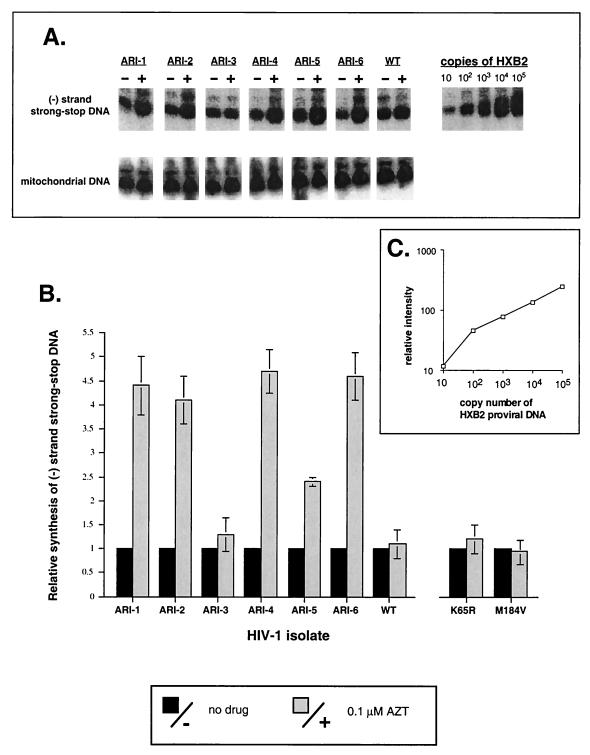
FIG. 1
FIG. 1
Synthesis of minus-strand strong-stop DNA by wild-type and AZT-resistant HIV-1 isolates. Jurkat cells were exposed to wild-type or AZT-resistant isolates (ARI-1 through ARI-6; Table 1) in the presence or absence of AZT (0.1 μM). Minus-strand strong-stop HIV-1 DNA and mitochondrial DNA were PCR amplified from cellular extracts of LMW DNA and then electrophoresed on 5% denaturing polyacrylamide gels (A). Using phosphor-imaging analysis, amount of minus-strand strong-stop DNA produced in the presence of AZT with one viral isolate is presented relative to the amount of mitochondrial DNA in that sample and to the amount of minus-strand strong-stop DNA produced in the absence of drug (B). PCR-amplified minus-strand strong-stop DNA from cells exposed to K65R HIV-1 or M184V HIV-1 are not shown in panel A, but quantitations of three independent experiments with these viruses as well as the ARI viruses are presented in panel B.
FIG. 2
FIG. 2
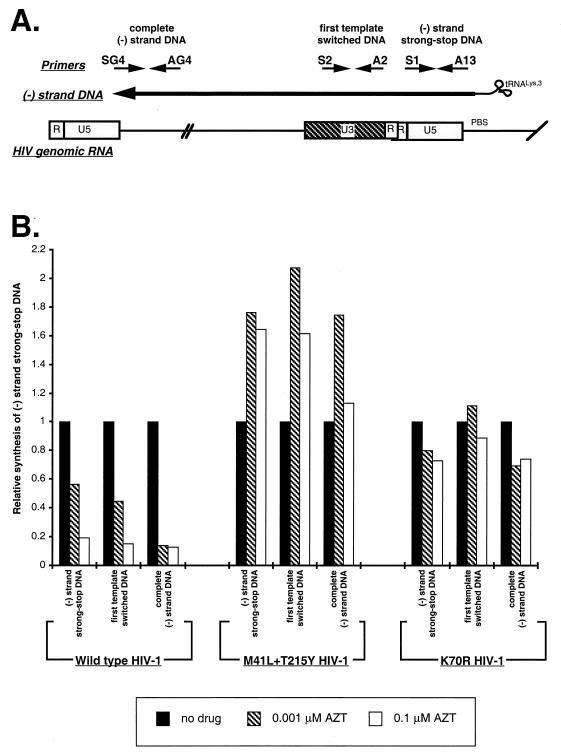
Synthesis of minus-strand DNA in AZT-treated MT4 cells infected by wild-type HIV-1 or AZT-resistant HIV-1 clones. MT4 cells were untreated or treated with AZT (0.001 and 0.1 μM) and then exposed to wild-type HIV-1, K70R HIV-1, or M41L plus T215Y HIV-1. Minus-strand strong-stop DNA (immediately upstream of initiation of reverse transcription), first template switched DNA (200 nt upstream of initiation), and complete minus-strand DNA (∼9,000 nt upstream of initiation) was PCR amplified from LMW DNA extracts. These products are schematically illustrated in panel A. Each bar (B) represents the amount of PCR-amplified minus-strand DNA product relative to the amount of PCR-amplified mitochondrial DNA in the same sample and the amount of PCR-amplified minus-strand DNA product in the absence of drug (adjusted to 1).
FIG. 3
FIG. 3
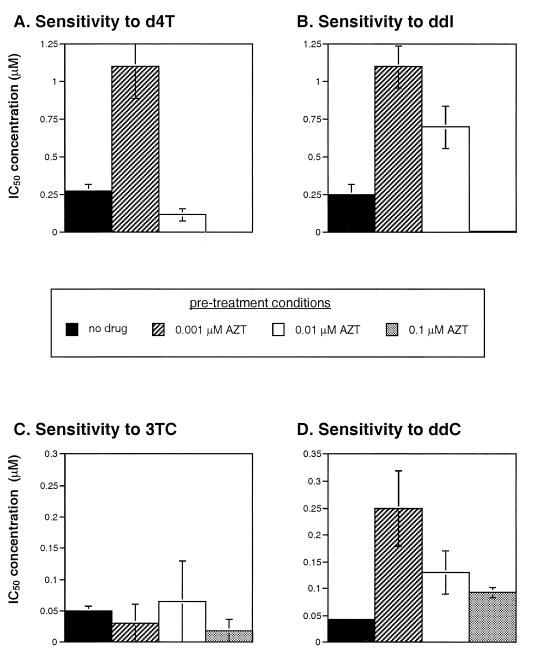
Sensitivity of AZT-resistant (M41L and T215Y) virus to other nucleoside analogs in the presence or absence of AZT. MT4 cells were untreated or pretreated with 0.001, 0.01, and 0.1 μM AZT prior to addition of the M41L and T215Y virus. IC50s were then determined for d4T (A), ddI (B), 3TC (C), and ddC (D).

References

    1. Arts E J, Wainberg M A. Preferential incorporation of nucleoside analogs after template switching during human immunodeficiency virus reverse transcription. Antimicrob Agents Chemother. 1994;38:1008–1016. - PMC - PubMed
    1. Arts E J, Mak J, Kleiman L, Wainberg M A. DNA found in human immunodeficiency virus type 1 particles may not be required for infectivity. J Gen Virol. 1994;75:1605–1613. - PubMed
    1. Arts E J, Marois J P, Gu Z, Le Grice S F J, Wainberg M A. Effects of 3′-deoxynucleoside 5′-triphosphate concentrations on chain termination by nucleoside analogs during human immunodeficiency virus type-1 reverse transcription of minus-strand strong-stop DNA. J Virol. 1996;70:712–720. - PMC - PubMed
    1. Arts E J, Wainberg M A. Mechanisms of nucleoside analog antiviral activity and resistance during human immunodeficiency virus reverse transcription. Antimicrob Agents Chemother. 1996;40:527–540. - PMC - PubMed
    1. Back N K, Nijhuis M, Keuken W, Boucher C A, Oude Essink B O, Kuilenburg A B, Gennip A H, Berkhout B. Reduced replication of 3TC-resistant HIV-1 variants in primary cells due to a processivity defect of the reverse transcriptase enzyme. EMBO J. 1996;15:4040–4049. - PMC - PubMed

Publication types