


A novel polymorphism at codon 333 of human immunodeficiency virus type 1 reverse transcriptase can facilitate dual resistance to zidovudine and L-2',3'-dideoxy-3'-thiacytidine
- PMID: 9573280
- PMCID: PMC110074
- DOI: 10.1128/JVI.72.6.5093-5098.1998
A novel polymorphism at codon 333 of human immunodeficiency virus type 1 reverse transcriptase can facilitate dual resistance to zidovudine and L-2',3'-dideoxy-3'-thiacytidine
Abstract
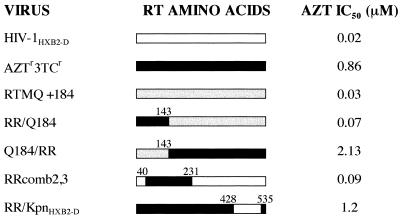
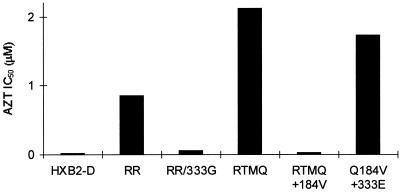
Recent clinical trials examining 3'-azido-3'-deoxythymidine (AZT, zidovudine, or Retrovir) combined with L-2', 3'-dideoxy-3'-thiacytidine (3TC or lamivudine) have shown that combination therapy with these nucleoside analogs affords significant virological and clinical benefits. The addition of 3TC to AZT delays AZT resistance in therapy-naive patients and can restore viral AZT susceptibility in patients who previously received AZT alone. In some AZT-experienced patients, the virological response to AZT-3TC therapy is not sustained and virus resistant to both drugs can be identified. To gain insight into the possible mechanism of dual resistance, we studied a recently described variant resistant to both AZT and 3TC and obtained by simultaneous passage of an AZT-resistant clinical isolate in cell culture with AZT and 3TC. Genetic mapping and site-directed mutagenesis experiments demonstrated that a polymorphism at codon 333 (Gly to Glu) of human immunodeficiency virus type 1 reverse transcriptase (RT) was critical in facilitating dual resistance in a complex background of AZT and 3TC resistance mutations. To assess the potential clinical relevance of RT codon 333 changes, we studied dually resistant viruses from patients taking AZT and 3TC. Genetic mapping of RT molecular clones derived from patients' plasma samples demonstrated that in some cases polymorphism at codon 333 was responsible for facilitating dual resistance.
Figures
References
-
- Bartlett J A, Benoit S L, Johnson V A, Quinn J B, Sepulveda G E, Ehmann W C, Soukas C T, Fallon M A, Self P L, Rubin M. Lamivudine plus zidovudine compared with zalcitabine plus zidovudine in patients with HIV infection. Ann Intern Med. 1996;125:161–172. - PubMed
-
- Boucher C A, Cammack N, Schipper P, Schuurman R, Rouse P, Wainberg M A, Cameron J M. High-level resistance to (−) enantiomeric 2′-deoxy-3′-thiacytidine in vitro is due to one amino acid substitution in the catalytic site of human immunodeficiency virus type 1 reverse transcriptase. Antimicrob Agents Chemother. 1993;37:2231–2234. - PMC - PubMed
-
- Boucher C A, O’Sullivan E, Mulder J W, Ramautarsing C, Kellam P, Darby G, Lange J M, Goudsmit J, Larder B A. Ordered appearance of zidovudine resistance mutations during treatment of 18 human immunodeficiency virus-positive subjects. J Infect Dis. 1992;165:105–110. - PubMed
-
- D’Aquila R T, Johnson V A, Welles S L, Japour A J, Kuritzkes D R, DeGruttola V, Reichelderfer P S, Coombs R W, Crumpacker C S, Kahn J O, Richman D D. Zidovudine resistance and HIV-1 disease progression during antiretroviral therapy. AIDS Clinical Trials Group Protocol 116B/117 Team and the Virology Committee Resistance Working Group. Ann Intern Med. 1995;122:401–408. - PubMed
-
- Eron J J, Benoit S L, Jemsek J, MacArthur R D, Santana J, Quinn J B, Kuritzkes D R, Fallon M A, Rubin M the North American HIV Working Party. Treatment with lamivudine, zidovudine, or both in HIV-positive patients with 200 to 500 CD4+ cells per cubic millimeter. N Engl J Med. 1995;333:1662–1669. - PubMed
Publication types
MeSH terms
Substances
Grants and funding
LinkOut - more resources
Full Text Sources
Other Literature Sources
Medical
