. 1998 May;36(5):1201-8.
doi: 10.1128/JCM.36.5.1201-1208.1998.

Ultrastructure, immunofluorescence, western blot, and PCR analysis of eight isolates of Encephalitozoon (Septata) intestinalis established in culture from sputum and urine samples and duodenal aspirates of five patients with AIDS

Affiliations

Ultrastructure, immunofluorescence, western blot, and PCR analysis of eight isolates of Encephalitozoon (Septata) intestinalis established in culture from sputum and urine samples and duodenal aspirates of five patients with AIDS

G P Croppo et al. J Clin Microbiol. 1998 May.

Abstract

Microsporidia are ancient, intracellular, eukaryotic protozoan parasites that form spores and that lack mitochondria. Currently, as many as eight species included under six genera are known to infect humans, mostly patients with AIDS. Among these, Enterocytozoon bieneusi, the agent of gastrointestinal (GI) disease, is the most frequently identified microsporidian in clinical laboratories in the United States. Encephalitozoon (Septata) intestinalis, the agent that causes a disseminated infection including infection of the GI tract, is the second most frequently identified microsporidian parasite. In spite of this, not many isolates of E. intestinalis have been established in culture. We describe here the continuous cultivation of eight isolates of E. intestinalis obtained from different samples including the urine, sputum, and duodenal aspirate or biopsy specimens from five AIDS patients originating from California, Colorado, and Georgia. The specific identification was made on the bases of ultrastructural, antigenic, and PCR analyses.


Figures
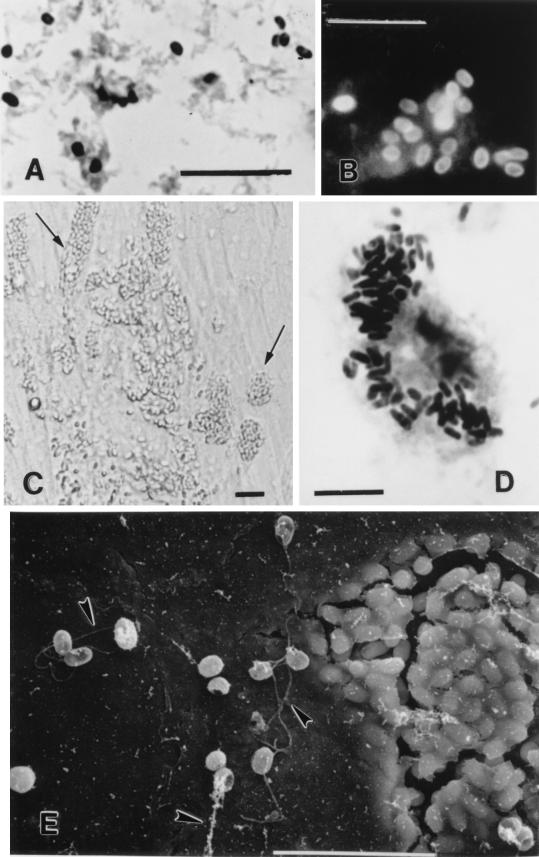
FIG. 1
FIG. 1
Optical and scanning electron microscopic images of microsporidia spores after treatment by various procedures. (A) Stool smear stained by the quick-hot Gram-chromotrope technique. Bar, 10 μm. (B) Stool smear from the same patient whose stool smear was used in panel A reacted with the anti-E. intestinalis serum. Bar, 10 μm. (C) Growth of E. intestinalis in cell culture. Note the host cells filled with spores (at the arrows). Differential interference contrast optics were used. Bar, 5 μm. (D) Smear of the culture supernatant from the same flask used for panel C but stained by the quick-hot Gram-chromotrope technique. Note the cell filled with darkly staining spores. Bar, 10 μm. (E) Scanning electron microscopic appearance of E. intestinalis from cell culture. Note the delicate thread-like polar tubules at the arrowheads. Bar, 10 μm.
FIG. 2
FIG. 2
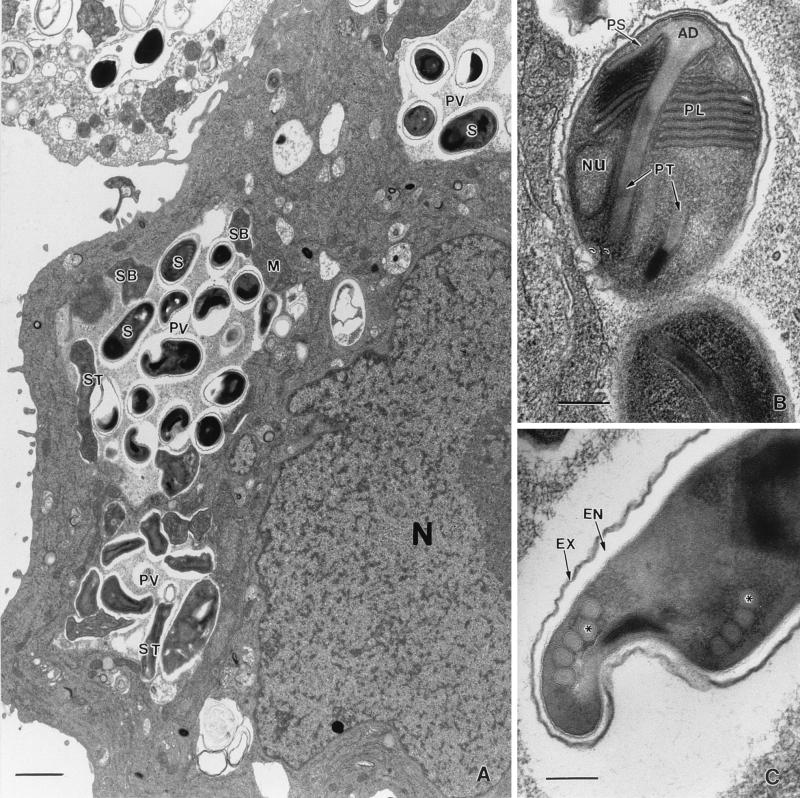
Ultrastructure of E. intestinalis within host cells. (A) Infected E6 cell demonstrating the classical septated parasitophorous vacuole (PV), a characteristic feature of E. intestinalis, filled with spores (S). M, meront; SB, sporoblast; ST, sporont; N, host cell nucleus. Bar, 1 μm. (B) Spore demonstrating a lamellar polaroplast (PL), a polar tubule (PT) with the anchoring disk (AD), and a nucleus (Nu). PS, polar sac. Bar, 200 nm. (C) Spore with four to five turns of the polar tubule (at the asterisk). EX, exospore; EN, endospore. Bar, 200 nm.
FIG. 3
FIG. 3
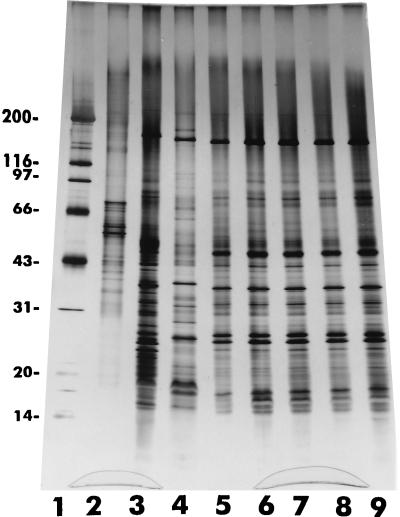
Silver-stained SDS-polyacrylamide gel showing remarkable similarities of the protein profiles of several isolates of E. intestinalis (lanes 4 to 9) with one another and differences from those of E. cuniculi (lane 2) and E. hellem (lane 3). Lane 4, CDC:V297; lane 5, CDC:V309; lane 6, CDC:V308; lane 7, CDC:V315; lane 8, CDC:V324; lane 9, CDC:V307. Lane 1 is the profile of E6 cells from an uninoculated culture. The numbers on the left are in kilodaltons.
FIG. 4
FIG. 4
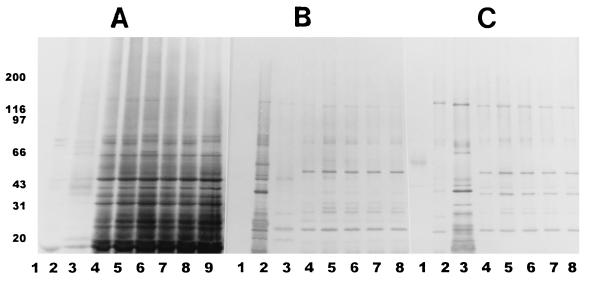
Western blot profiles of several E. intestinalis isolates (lanes 4 to 9) along with those of E. cuniculi and E. hellem. (A) Anti-E. intestinalis; (B) anti-E. hellem; (C) anti-E. cuniculi. Lanes 1, E6 cells; lanes 2, E. hellem; lanes 3, E. cuniculi; lanes 4, E. intestinalis CDC:V297; lanes 5, E. intestinalis CDC:V309; lanes 6, E. intestinalis CDC:V308; lanes 7, E. intestinalis CDC:V315; lanes 8, E. intestinalis CDC:V324; lane 9, E. intestinalis CDC:V307. Note that strain CDC:V307 was not included in the Western blot profiles in panels B and C. The numbers on the left are in kilodaltons.
FIG. 5
FIG. 5
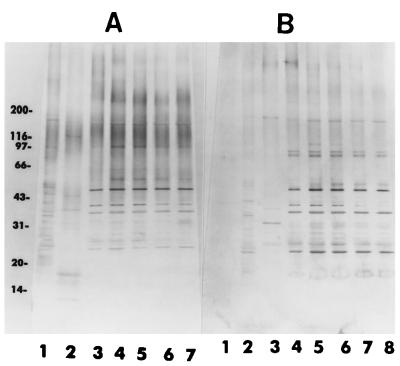
Western blot profiles of the various microsporidial isolates after reactions with the sera from one patient (A; lane 1, E. hellem; lane 2, E. cuniculi; lanes 3 to 7, E. intestinalis) and a second patient (B; lane 1, E6 cells; lane 2, E. hellem; lane 3, E. cuniculi; lanes 4 to 8, E. intestinalis, as described in the legend to Fig. 4A and B). The numbers on the left are in kilodaltons.
FIG. 6
FIG. 6
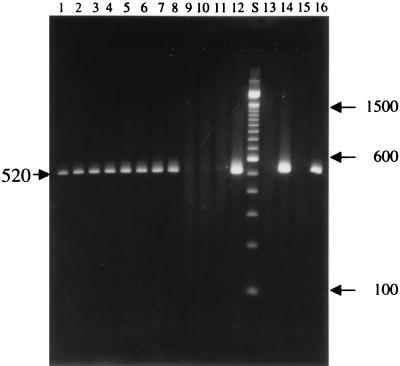
Agarose gel electrophoresis analysis of SSU rRNA fragments amplified by PCR with species-specific primers diagnostic for E. intestinalis (lanes 1 to 12), E. hellem (lanes 13 and 14), and E. cuniculi (lanes 15 and 16). Lanes 1 to 7, amplification of E. intestinalis isolates; lanes 8, 13, and 15, amplification of E. intestinalis CDC:V297; lane 9, amplification of uninfected E6 cells; lanes 10 and 14, amplification of E. hellem CDC:0291:V213; lanes 11 and 16, amplification of E. cuniculi; lane 12, amplification of the SSU rRNA cloned region of CDC:V297; lane S, a 100-bp molecular size marker. Numbers on the right and on the left of the gel are DNA fragment sizes (in base pairs).

References

    1. Black S S, Steinhort L A, Bertucci D C, Rogers L B, Didier E S. Encephalitozoon hellem in budgerigars. Vet Pathol. 1997;34:189–198. - PubMed
    1. Bornay-Llinares, F., et al. Unpublished data.
    1. Cali A, Kotler D P, Orenstein J M. Septata intestinalis, n.g., n.sp., an intestinal microsporidian associated with chronic diarrhea and dissemination in AIDS patients. J Protozool. 1993;40:101–112. - PubMed
    1. Canning E U, Lom J, Dykova I. The microsporidia of vertebrates. New York, N.Y: Academic Press, Inc.; 1986.
    1. Coyle C M, Wittner M, Kotler D P, Noyer C, Orenstein J M, Tanowitz H B, Weiss L M. Prevalence of microsporidiosis due to Enterocytozoon bieneusi and Encephalitozoon (Septata) intestinalis among patients with AIDS-related diarrhea: determination by polymerase chain reaction to the microsporidian small-subunit rRNA gene. Clin Infect Dis. 1996;23:1002–1006. - PubMed

Publication types