


Effects of ammonia inhalation and acetic acid pretreatment on colonization kinetics of toxigenic Pasteurella multocida within upper respiratory tracts of swine
- PMID: 9574688
- PMCID: PMC104811
- DOI: 10.1128/JCM.36.5.1260-1265.1998
Effects of ammonia inhalation and acetic acid pretreatment on colonization kinetics of toxigenic Pasteurella multocida within upper respiratory tracts of swine
Abstract
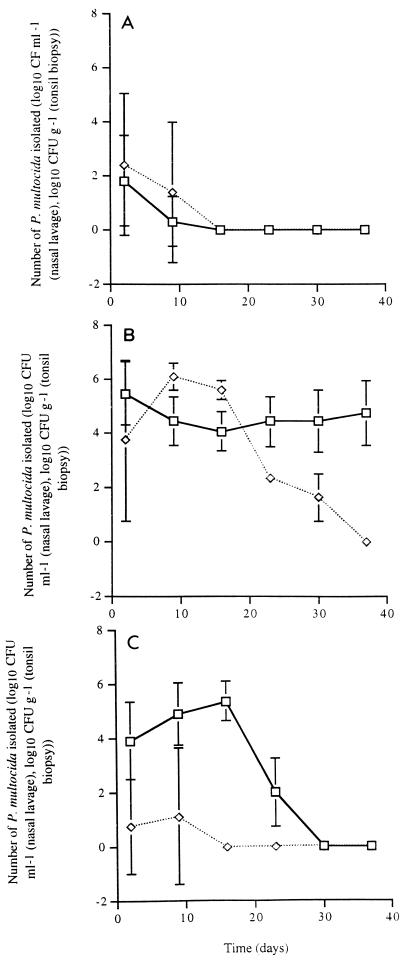
Pigs reared in intensive production systems are continuously exposed to ammonia released by the microbial degradation of their excrement. Exposure to this gas has been shown to increase the severity of the disease progressive atrophic rhinitis by facilitating colonization of the pig's upper respiratory tract by Pasteurella multocida. The etiological mechanism responsible for this synergy was investigated by studying the colonization kinetics of P. multocida enhanced by ammonia and comparing them with those evoked by an established disease model. Three-week-old Large White piglets were weaned and allocated to five experimental groups (groups A to E). Pigs in groups A and B were exposed continuously to ammonia at 20 ppm for the first 2 weeks of the study. Pigs in group C were pretreated with 0.5 ml of 1% acetic acid per nostril on days -2 and -1 of the study. On day 0 all the pigs in groups A, C, and D were inoculated with 1.4 x 10(8) toxigenic P. multocida organisms given by the intranasal route. The kinetics of P. multocida colonization were established by testing samples obtained at weekly intervals throughout the study. The study was terminated on day 37, and the extent of turbinate atrophy was determined by using a morphometric index. The results of the study showed that exposure to aerial ammonia for a limited period had a marked effect on the colonization of toxigenic P. multocida in the nasal cavities of pigs, which resulted in the almost total exclusion of commensal flora. In contrast, ammonia had only a limited effect on P. multocida colonization at the tonsil. The exacerbation of P. multocida colonization by ammonia was restricted to the period of ammonia exposure, and the number of P. multocida organisms colonizing the upper respiratory tract declined rapidly upon the cessation of exposure to ammonia. During the exposure period, the ammonia levels in mucus recovered from the nasal cavity and tonsil were found to be 7- and 3.5-fold higher, respectively, than the levels in samples taken from unexposed controls. Acetic acid pretreatment also induced marked colonization of the nasal cavity which, in contrast to that induced by ammonia, persisted throughout the time course of the study. Furthermore, acetic acid pretreatment induced marked but transient colonization of the tonsil. These findings suggest that the synergistic effect of ammonia acts through an etiological mechanism different from that evoked by acetic acid pretreatment. A strong correlation was found between the numbers of P. multocida organisms isolated from the nasal cavity and the severity of clinical lesions, as determined by using a morphometric index. The data presented in the paper highlight the potential importance of ammonia as an exacerbating factor in respiratory disease of intensively reared livestock.
Figures
References
-
- Ackerman M R, Cheville N F, Gallagher J E. Colonisation of the pharangeal tonsil and respiratory tract of the gnotobiotic pig by toxigenic strain of Pasteurella multocida type D. Vet Pathol. 1991;28:267–274. - PubMed
-
- Baekbo P. Proceedings of the 11th Congress of the International Pig Veterinary Society. 1990. Air quality in Danish pig herds; p. 395.
-
- Chanter N, Magyar T, Rutter J M. Interactions between Bordetella bronchiseptica and toxigenic Pasteurella multocida in atrophic rhinitis of pigs. Res Vet Sci. 1989;47:48–53. - PubMed
-
- Chanter N, Rutter J M. Pasteurellosis in pigs. In: Adlam C, Rutter J M, editors. Pasteurella and pasteurellosis. Orlando, Fla: Academic Press, Inc.; 1989. pp. 161–195.
-
- Chanter N, Rutter J M, Luther P D. Rapid detection of toxigenic Pasteurella multocida by an agar overlay method. Vet Rec. 1986;119:629–630. - PubMed
Publication types
MeSH terms
Substances
LinkOut - more resources
Full Text Sources
