


Molecular epidemiology of oral treponemes associated with periodontal disease
- PMID: 9574713
- PMCID: PMC104836
- DOI: 10.1128/JCM.36.5.1399-1403.1998
Molecular epidemiology of oral treponemes associated with periodontal disease
Abstract
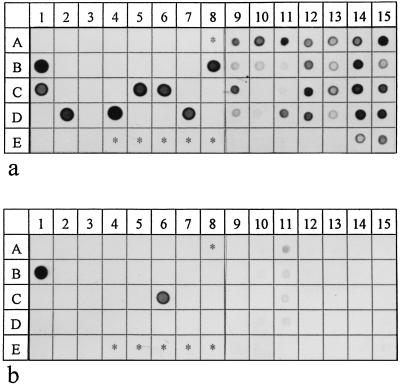
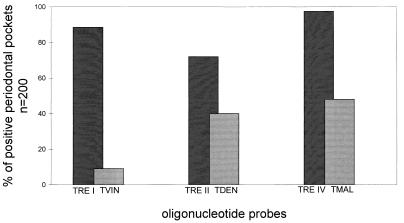
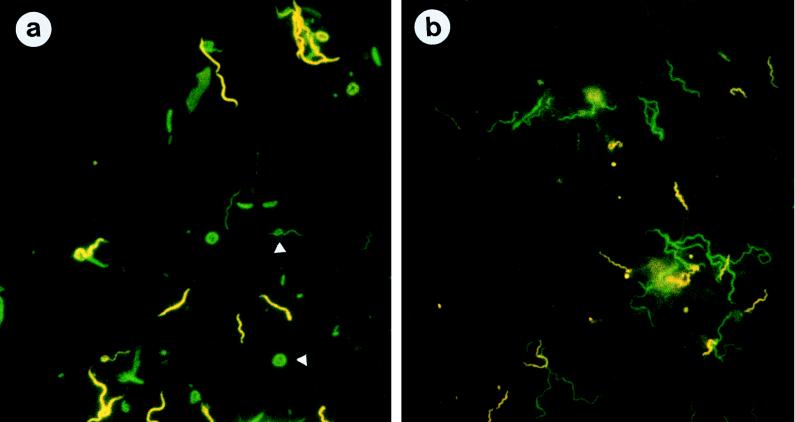
Periodontitis, a disease responsible for tooth loss worldwide, is characterized by chronic inflammation of the periodontium, eventually leading to destruction of periodontal ligaments and supporting alveolar bone. Spirochetes, identified by dark-field microscopy as being the most predominant bacteria in advanced lesions, are thought to play a causative role. Various spirochetal morphotypes were observed, but most of these morphotypes are as yet uncultivable. To assess the role of these organisms we designed oligonucleotide probes for the identification of both cultivable and so far uncultivable spirochetes in periodontitis patients. Subgingival plaque specimens taken from diseased sites (n = 200) and healthy control sites (n = 44) from 53 patients with rapidly progressive periodontitis (RPP) were submitted to direct in situ hybridization or dot blot hybridization after prior amplification with eubacterial primers. Spirochetes were found in all patients, but their distributions varied considerably. Parallel use of oligonucleotide probes specific for cultivable or so far uncultivable treponemes suggested the presence of novel yet unknown organisms at a high frequency. These uncultivable treponemes were visualized by fluorescence in situ hybridization, and their morphologies, sizes, and numbers could be estimated. All RPP patients included in this study harbored oral treponemes that represent either novel species, e.g., Treponema maltophilum, or uncultivable phylotypes. Therefore, it is necessary to include these organisms in etiologic considerations and to strengthen efforts to cultivate these as yet uncultivable treponemes.
Figures
Similar articles
-
Molecular epidemiology of oral treponemes in patients with periodontitis and in periodontitis-resistant subjects.J Clin Microbiol. 2006 Sep;44(9):3078-85. doi: 10.1128/JCM.00322-06. J Clin Microbiol. 2006. PMID: 16954230 Free PMC article.
-
Diversity of Treponema denticola and Other Oral Treponeme Lineages in Subjects with Periodontitis and Gingivitis.Microbiol Spectr. 2021 Oct 31;9(2):e0070121. doi: 10.1128/Spectrum.00701-21. Epub 2021 Sep 29. Microbiol Spectr. 2021. PMID: 34585987 Free PMC article.
-
Association of Treponema spp. with canine periodontitis.Vet Microbiol. 2008 Mar 18;127(3-4):334-42. doi: 10.1016/j.vetmic.2007.09.011. Epub 2007 Sep 29. Vet Microbiol. 2008. PMID: 17997236
-
[Incidence and significance of treponemes in animals].Berl Munch Tierarztl Wochenschr. 2005 Jan-Feb;118(1-2):24-36. Berl Munch Tierarztl Wochenschr. 2005. PMID: 15690633 Review. German.
-
Genetics of human and animal uncultivable treponemal pathogens.Infect Genet Evol. 2018 Jul;61:92-107. doi: 10.1016/j.meegid.2018.03.015. Epub 2018 Mar 22. Infect Genet Evol. 2018. PMID: 29578082 Review.
Cited by
-
Upregulation of intercellular adhesion molecule 1 and proinflammatory cytokines by the major surface proteins of Treponema maltophilum and Treponema lecithinolyticum, the phylogenetic group IV oral spirochetes associated with periodontitis and endodontic infections.Infect Immun. 2005 Jan;73(1):268-76. doi: 10.1128/IAI.73.1.268-276.2005. Infect Immun. 2005. PMID: 15618163 Free PMC article.
-
Periodontal disease as a specific, albeit chronic, infection: diagnosis and treatment.Clin Microbiol Rev. 2001 Oct;14(4):727-52, table of contents. doi: 10.1128/CMR.14.4.727-752.2001. Clin Microbiol Rev. 2001. PMID: 11585783 Free PMC article. Review.
-
Topology and functional characterization of major outer membrane proteins of Treponema maltophilum and Treponema lecithinolyticum.Mol Oral Microbiol. 2025 Feb;40(1):17-36. doi: 10.1111/omi.12484. Epub 2024 Sep 12. Mol Oral Microbiol. 2025. PMID: 39263909
-
Comparative analysis of oral treponemes associated with periodontal health and disease.BMC Infect Dis. 2013 Apr 11;13:174. doi: 10.1186/1471-2334-13-174. BMC Infect Dis. 2013. PMID: 23578286 Free PMC article.
-
Investigation of the effect of type 2 diabetes mellitus on subgingival plaque microbiota by high-throughput 16S rDNA pyrosequencing.PLoS One. 2013 Apr 22;8(4):e61516. doi: 10.1371/journal.pone.0061516. Print 2013. PLoS One. 2013. PMID: 23613868 Free PMC article.
References
-
- Africa C W, Parker J R, Reddy J. Bacteriological studies of subgingival plaque in a periodontitis resistant population. I. Darkfield microscopic studies. J Periodontol Res. 1985;20:1–7. - PubMed
-
- Armitage G C, Dickinson W R, Jenderseck R S, Levine S M, Chambers D W. Relationship between the percentage of subgingival spirochetes and the severity of periodontal disease. J Periodontol. 1982;53:550–556. - PubMed
Publication types
MeSH terms
Substances
LinkOut - more resources
Full Text Sources
