


Biodiversity and ecosystem functioning: a mechanistic model
- PMID: 9576935
- PMCID: PMC20430
- DOI: 10.1073/pnas.95.10.5632
Biodiversity and ecosystem functioning: a mechanistic model
Abstract
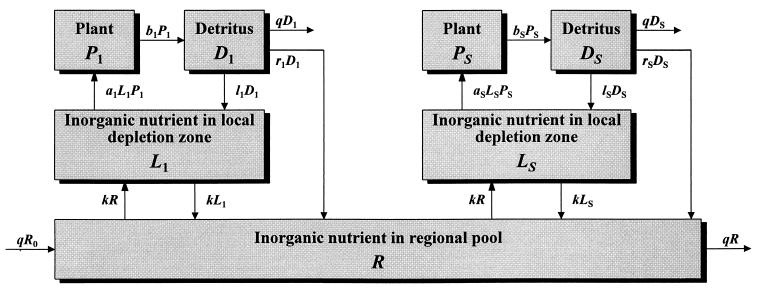
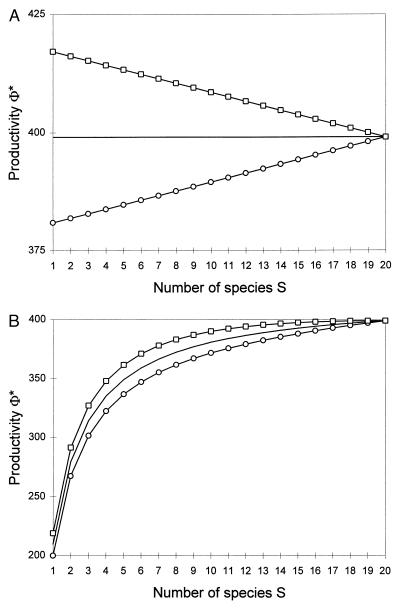
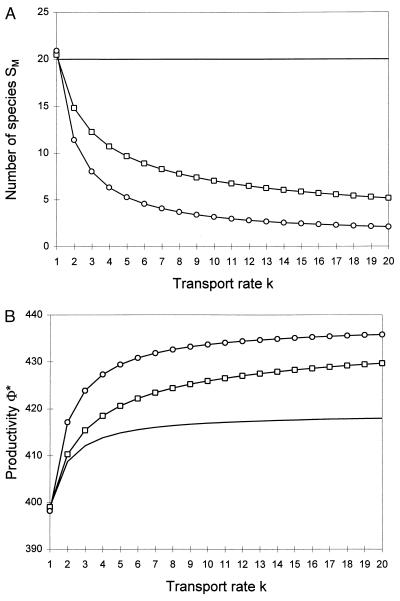
Recent experiments have provided some evidence that loss of biodiversity may impair the functioning and sustainability of ecosystems. However, we still lack adequate theories and models to provide robust generalizations, predictions, and interpretations for such results. Here I present a mechanistic model of a spatially structured ecosystem in which plants compete for a limiting soil nutrient. This model shows that plant species richness does not necessarily enhance ecosystem processes, but it identifies two types of factors that could generate such an effect: (i) complementarity among species in the space they occupy below ground and (ii) positive correlation between mean resource-use intensity and diversity. In both cases, the model predicts that plant biomass, primary productivity, and nutrient retention all increase with diversity, similar to results reported in recent field experiments. These two factors, however, have different implications for the understanding of the relationship between biodiversity and ecosystem functioning. The model also shows that the effect of species richness on productivity or other ecosystem processes is masked by the effects of physical environmental parameters on these processes. Therefore, comparisons among sites cannot reveal it, unless abiotic conditions are very tightly controlled. Identifying and separating out the mechanisms behind ecosystem responses to biodiversity should become the focus of future experiments.
Figures
References
-
- Ehrlich P R, Wilson E O. Science. 1991;253:758–762. - PubMed
-
- Schulze E-D, Mooney H A. Biodiversity and Ecosystem Function. New York: Springer; 1993.
-
- UNEP. Global Biodiversity Assessment. Cambridge, U.K.: Cambridge Univ. Press; 1995.
-
- Ewel J J, Mazzarino M J, Berish C W. Ecol Appl. 1991;1:289–302. - PubMed
-
- Naeem S, Thompson L J, Lawler S P, Lawton J H, Woodfin R M. Nature (London) 1994;368:734–737.
Publication types
MeSH terms
LinkOut - more resources
Full Text Sources
