. 1998 May 12;95(10):5734-9.
doi: 10.1073/pnas.95.10.5734.

Genetic induction of immune tolerance to human clotting factor VIII in a mouse model for hemophilia A

Affiliations

Genetic induction of immune tolerance to human clotting factor VIII in a mouse model for hemophilia A

G L Evans et al. Proc Natl Acad Sci U S A. .

Abstract

Patients with severe coagulation factor VIII deficiency require frequent infusions of human factor VIII (hFVIII) concentrates to treat life-threatening hemorrhages. Because these patients are immunologically hFVIII-naive, a significant treatment complication is the development of inhibitors or circulating alloantibodies against hFVIII, which bind the replaced glycoprotein, increase its plasma clearance, and inhibit its activity, preventing subsequent treatments from having a therapeutic effect. A genetic approach toward the induction of immunologic unresponsiveness to hFVIII has the conceptual advantage of a long-term, stable elimination of undesired immune responses against hFVIII. Here, we report that in a factor VIII (FVIII)-deficient mouse model for severe hemophilia A, genetic modification of donor bone marrow cells with a retroviral vector encoding hFVIII, and transplant to hemophiliac mouse recipients, results in the induction of immune tolerance to FVIII in 50% of treated animals after immunization with hFVIII, despite the fact that hFVIII protein or activity is undetectable. In tolerized animals, the titers of anti-hFVIII binding antibodies and of hFVIII inhibitor antibodies were significantly reduced, and there was evidence for hFVIII unresponsiveness in CD4(+) T cells. Importantly, the plasma clearance of hFVIII was significantly decreased in tolerized animals and was not significantly different from that seen in a FVIII-naive hemophiliac mouse. This model system will prove useful for the evaluation of genetic therapies for hFVIII immunomodulation and bring genetic therapies for hFVIII tolerance closer to clinical application for patients with hemophilia A.


Figures
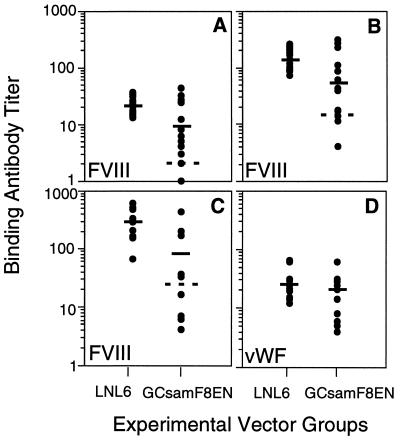
Figure 1
Figure 1
Humoral immune responses against hFVIII and hvWf in hemophilia A mice after allogeneic transplant of BM transduced with GCsamF8EN or LNL6 retroviral vectors and immunization with clinical grade hFVIII. Anti-hFVIII (AC) and anti-hvWf (D) binding antibody titers were measured by ELISA for the LNL6 control group (Left) and the GCsamF8EN vector group (Right), after each of three immunizations. Solid bars represent average titers; broken bars separate the GCsamF8EN group into two subgroups (high and low hFVIII responders). (A) Primary immunization. (B) First boost. (C) Second boost, anti-hFVIII response. (D) Second boost, anti-hvWf response. Data were pooled from two independent transplant experiments, and 2–4 independent measurements of antibody titers.
Figure 2
Figure 2
Clearance of hFVIII in the two vector groups immediately after the secondary FVIII immunization. At time zero, 1 μg of clinical grade hFVIII was injected i.v., and at the times indicated, plasma was collected and hFVIII was measured by ELISA as described in Materials and Methods. Data shown are average detectable plasma concentrations of hFVIII ± SD for the LNL6 control animals (A; n = 9), for the GCsamF8EN low titer anti-hFVIII antibody responders (B, filled symbols, n = 6), and the GCsamF8EN high titer responders (B, open symbols, n = 3). The broken lines represent hFVIII clearance in FVIII-naive, untreated exon 17 FVIII-deficient mice, determined in separate experiments.
Figure 3
Figure 3
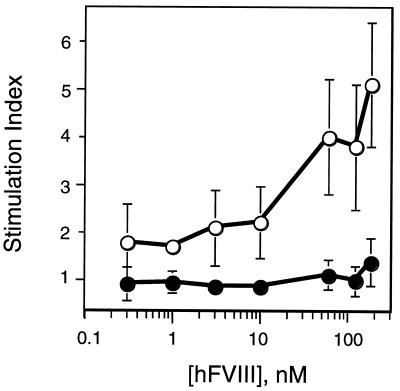
hFVIII-dependent proliferation of mouse CD4+ splenocytes derived from the two vector groups 35 wk posttransplant. Incorporation of [3H]thymidine into CD4+ splenocyte DNA was measured for the LNL6 group (open symbols) and for the GCsamF8EN group, low titer anti-FVIII antibody responders (filled symbols), after culture for 4½ days in the presence of purified B domain-deleted hFVIII. Animals were from two independent BM transplant experiments. The stimulation index represents the incorporation of 3H with the indicated concentration of FVIII divided by control incorporation with no FVIII for the same T cell source. The control values (average ± SD) were: LNL6, 14,232 ± 7,115 cpm and GCsamF8EN, 26,699 ± 13,265 cpm. Accessory cells alone gave <100 cpm. Data are presented as average stimulation index ± SD for n = 6 (LNL6) and n = 4 (GCsamF8EN).
Figure 4
Figure 4
Semiquantitative analysis of hFVIII retroviral vector (GCsamF8EN) DNA and RNA sequences in recipients at 26–35 wk posttransplant. Genomic DNA and total RNA were prepared in parallel from the same BM source. Representative data shown are from 8 of 13 analyzed GCsamF8EN BM transplant recipients. (A) Vector DNA was measured via coamplification of hFVIII vector sequences and mouse β-globin sequences by semiquantitative PCR, using NIH 3T3/GCsamF8EN DNA quantitative standards (Left). The estimated percent gene transfer for experimental animals (–8) is shown at the top of each lane (Right). T, tolerant. NT, nontolerant. (B) Vector-specific hFVIII RNA was measured by semiquantitative RT-PCR using Raji/GCsamF8EN (Raji/FVIII) RNA and BM RNA from LNL6 recipients as positive and negative controls respectively. RT, reverse transcriptase. β2-m, β2-microglobulin. (−), PCR reactions without added reverse transcriptase; (+), reverse transcriptase added.

References

    1. Antonarakis S E, Youssoufian H, Kazazian H H., Jr Mol Biol Med. 1987;4:81–94. - PubMed
    1. Wion K L, Kelly D, Summerfield J A, Tuddenham E G D, Lawn R M. Nature (London) 1985;317:726–728. - PubMed
    1. Vehar G A, Keyt B, Eaton D, Rodriguez H, O’Brien D P, Rotblat F, Oppermann H, Keck R, Lawn R M, Capon D J. Nature (London) 1984;312:337–342. - PubMed
    1. Weiss H J, Sussman I I, Hoyer L W. J Clin Invest. 1977;60:390–404. - PMC - PubMed
    1. Brettler D. Baillieres Clin Haematol. 1996;9:319–329. - PubMed