. 1998 Jun;66(6):2434-40.
doi: 10.1128/IAI.66.6.2434-2440.1998.

Structure-function relationship of antibacterial synthetic peptides homologous to a helical surface region on human lactoferrin against Escherichia coli serotype O111

Affiliations

Structure-function relationship of antibacterial synthetic peptides homologous to a helical surface region on human lactoferrin against Escherichia coli serotype O111

D S Chapple et al. Infect Immun. 1998 Jun.

Abstract

Lactoferricin includes an 11-amino-acid amphipathic alpha-helical region which is exhibited on the outer surface of the amino-terminal lobe of lactoferrin. Synthetic peptides homologous to this region exhibited potent antibacterial activity against a selected range of both gram-negative and gram-positive bacteria. An analog synthesized with methionine substituted for proline at position 26, which is predicted to disrupt the helical region, abolished antibacterial activity against Escherichia coli and considerably reduced antibacterial activity against Staphylococcus aureus and an Acinetobacter strain. The mode of action of human lactoferrin peptide (HLP) 2 against E. coli serotype O111 (NCTC 8007) was established by using flow cytometry, surface plasmon resonance, and transmission electron microscopy. Flow cytometry was used to monitor membrane potential, membrane integrity, and metabolic processes by using the fluorescent probes bis-1,3-(dibutylbarbituric acid)-trimethine oxonol, propidium iodide, and carbonyl cyanide m-chlorophenylhydrazone, respectively. HLP 2 was found to act at the cell membrane, causing complete loss of membrane potential after 10 min and of membrane integrity within 30 min, with irreversible damage to the cell as shown by rapid loss of viability. The number of particles, measured by light scatter on the flow cytometer, dropped significantly, showing that bacterial lysis resulted. The peptide was shown to bind to E. coli O111 lipopolysaccharide by using surface plasmon resonance. Transmission electron microscopy revealed bacterial distortion, with the outer membrane becoming detached from the inner cytoplasmic membrane. We conclude that HLP 2 causes membrane disruption of the outer membrane, resulting in lysis, and that structural considerations are important for antibacterial activity.


Figures
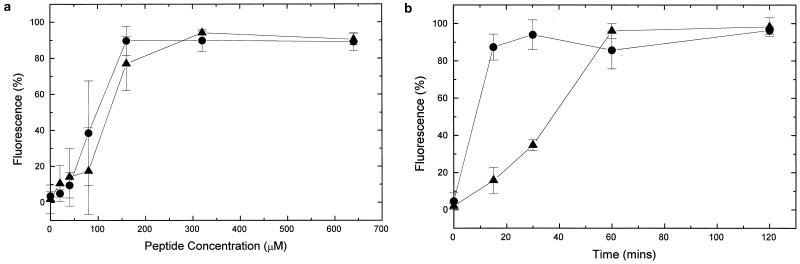
FIG. 1
FIG. 1
Dose-response (a) and time-response (b) assays, by flow cytometry, of a starting inoculum of 108 E. coli O111 (NCTC 8007) cells per ml versus HLP 2. The percentages of fluorescent bacterial cells in the presence of PI (▴) or DiBAC4(3) (•) are shown. Results are means ± standard errors from at least three experiments.
FIG. 2
FIG. 2
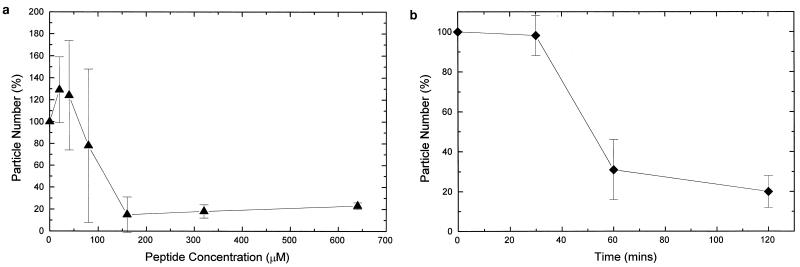
(a) Percentages of particles present after incubation for 2 h of E. coli O111 (NCTC 8007) with various concentrations of HLP 2 compared to that for the control (containing no HLP 2), measured by using flow cytometry. (b) Percentages of particles after incubation of E. coli NCTC 8007 with HLP 2 at the MIC for various time intervals compared to that for control samples containing no HLP 2. Experiments were repeated at least three times, with a starting inoculum of 108 bacteria/ml. Error bars indicate standard errors.
FIG. 3
FIG. 3
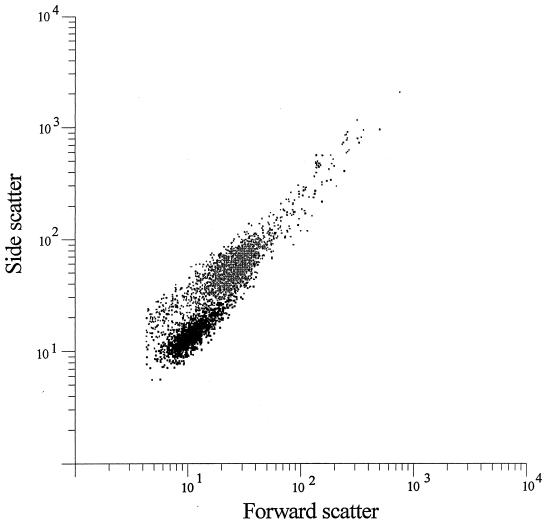
Typical side and forward light scatter of control bacteria (black) and bacteria incubated with HLP 2 for 2 h (grey).
FIG. 4
FIG. 4
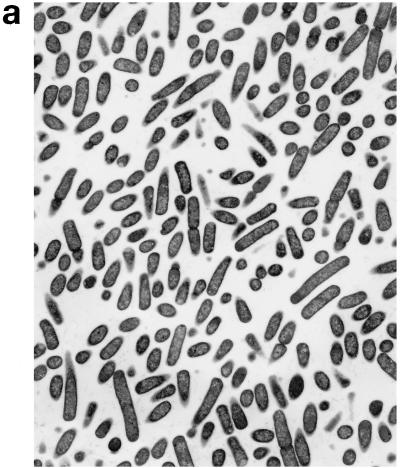
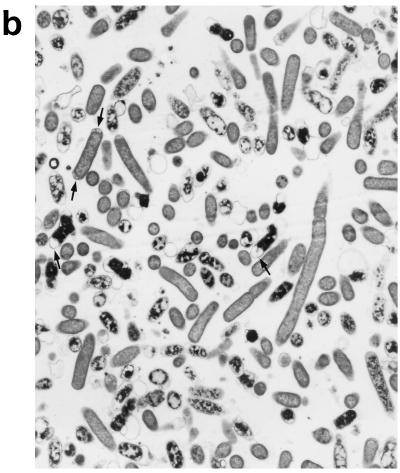
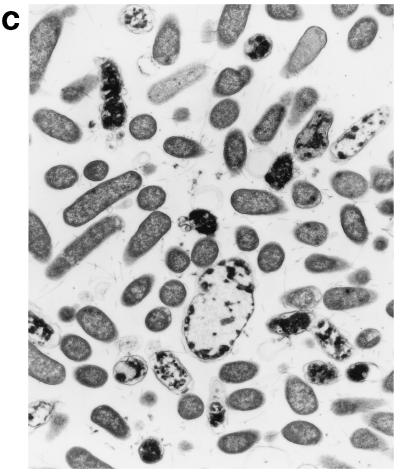
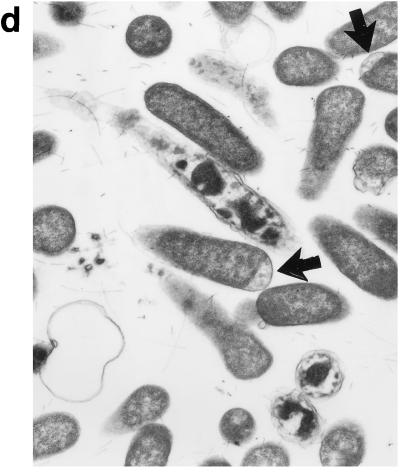
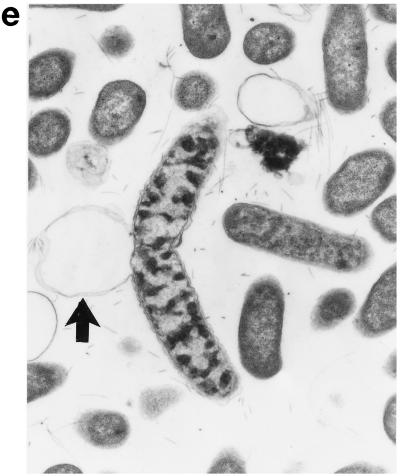
Electron micrographs of E. coli O111 NCTC 8007. (a) Control (magnification, ×3,600); (b and c) after 2 h of incubation with HLP 2 at the MIC (magnifications, ×3,600 [b] and ×7,200 [c]); (d and e) after 2 h of incubation with HLP 2 at half the MIC (magnification, ×13,500). The original inoculum size was 108 bacteria/ml. Arrows indicate separation of the outer membrane.
FIG. 4
FIG. 4
Electron micrographs of E. coli O111 NCTC 8007. (a) Control (magnification, ×3,600); (b and c) after 2 h of incubation with HLP 2 at the MIC (magnifications, ×3,600 [b] and ×7,200 [c]); (d and e) after 2 h of incubation with HLP 2 at half the MIC (magnification, ×13,500). The original inoculum size was 108 bacteria/ml. Arrows indicate separation of the outer membrane.
FIG. 4
FIG. 4
Electron micrographs of E. coli O111 NCTC 8007. (a) Control (magnification, ×3,600); (b and c) after 2 h of incubation with HLP 2 at the MIC (magnifications, ×3,600 [b] and ×7,200 [c]); (d and e) after 2 h of incubation with HLP 2 at half the MIC (magnification, ×13,500). The original inoculum size was 108 bacteria/ml. Arrows indicate separation of the outer membrane.
FIG. 4
FIG. 4
Electron micrographs of E. coli O111 NCTC 8007. (a) Control (magnification, ×3,600); (b and c) after 2 h of incubation with HLP 2 at the MIC (magnifications, ×3,600 [b] and ×7,200 [c]); (d and e) after 2 h of incubation with HLP 2 at half the MIC (magnification, ×13,500). The original inoculum size was 108 bacteria/ml. Arrows indicate separation of the outer membrane.
FIG. 4
FIG. 4
Electron micrographs of E. coli O111 NCTC 8007. (a) Control (magnification, ×3,600); (b and c) after 2 h of incubation with HLP 2 at the MIC (magnifications, ×3,600 [b] and ×7,200 [c]); (d and e) after 2 h of incubation with HLP 2 at half the MIC (magnification, ×13,500). The original inoculum size was 108 bacteria/ml. Arrows indicate separation of the outer membrane.

References

    1. Akin D T, Lu M Q, Kendall S, Rundegren J, Arnold R R. Bactericidal activity of different forms of lactoferrin. Adv Exp Med Biol. 1994;357:61–70. - PubMed
    1. Appelmelk B J, Am Y, Geerts M, Thijs B G, DeBoar H A, MacLaren D M, DeGraff J, Nuijens J H. Lactoferrin is a lipid A-binding protein. Infect Immun. 1994;62:2628–2632. - PMC - PubMed
    1. Arnold R R, Cole R M, McGhee J R. A bactericidal effect for human lactoferrin. Science. 1977;197:263–265. - PubMed
    1. Bellamy W, Takase M, Yamauchi K, Wakabayashi H, Kawase K, Tomita M. Identification of the bactericidal domain of lactoferrin. Biochim Biophys Acta. 1992;1121:130–136. - PubMed
    1. Bortner C A, Miller R D, Arnold R R. Bactericidal effect of lactoferrin on Legionella pneumophila. Infect Immun. 1986;51:373–377. - PMC - PubMed

Publication types

MeSH terms