


doi: 10.1128/IAI.66.6.2991-2995.1998.
Acute and chronic phases of Toxoplasma gondii infection in mice modulate the host immune responses
Affiliations
- PMID: 9596779
- PMCID: PMC108301
- DOI: 10.1128/IAI.66.6.2991-2995.1998
Item in Clipboard
Acute and chronic phases of Toxoplasma gondii infection in mice modulate the host immune responses
Infect Immun.
1998 Jun.
Abstract
Murine antibody responses to soluble proteins are generally restricted to the immunoglobulin G1 (IgG1) isotype. When mice were infected with Toxoplasma gondii Beverley and concomitantly immunized with a soluble unrelated protein antigen, a modification in the isotypic distribution of antibodies directed against this nonparasite antigen was observed, with a preferential production of IgG2a. Interestingly, when mice were immunized with a soluble protein antigen during the chronic phase (day 40) of infection with T. gondii Beverley, a similar modification in the isotypic distribution of antiprotein antibodies was observed.
Figures
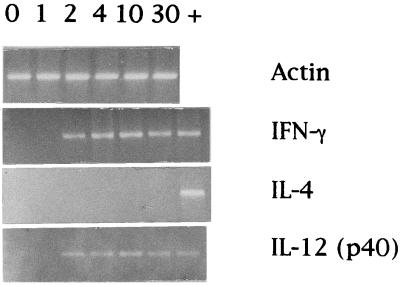
Detection of IL-12 (p40), IFN-γ, IL-4, and actin mRNAs in spleen cells of BALB/c mice infected with 20 cysts of T. gondii Beverley. Spleen cells were harvested at time zero (control animals) and at 1, 2, 4, 10, and 30 days p.i. as indicated above the lanes and then frozen in TRIzol; mRNA preparations were reverse transcribed, and specific messages were amplified by PCR. Products of PCR amplification were detected by ethidium bromide staining in agarose gels. Lane +, control for cytokine mRNAs.
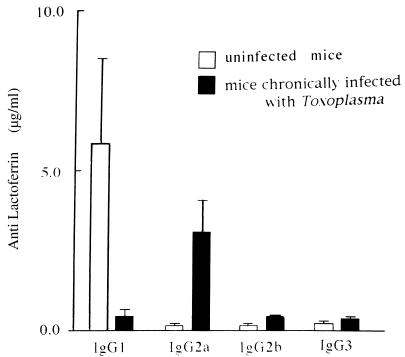
Isotypic distribution of antilactoferrin antibodies in uninfected BALB/c mice and in animals infected for 40 days with T. gondii Beverley. Antilactoferrin antibodies in individual sera obtained 3 weeks after lactoferrin immunization were assayed. Results are shown as means ± standard errors for groups of four or five mice. Essentially identical results were obtained in three experiments.
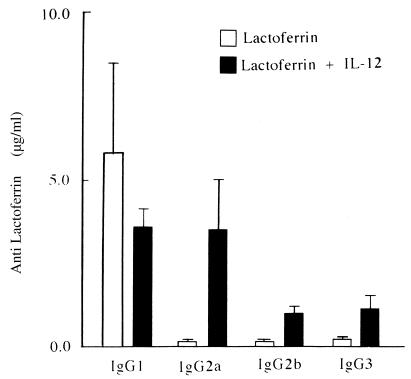
Isotypic distribution of antilactoferrin antibodies in BALB/c mice immunized on day 0 with 100 μg of lactoferrin per mouse alone or together with 50 ng of rIL-12. Antilactoferrin antibodies in individual sera obtained 3 weeks later were assayed by ELISA. Results are shown as means ± standard errors for groups of four or five mice.
References
-
- Abdel-Wahab R M, Morsy T A, Abdel-Rahim M I, Essa M H, Al-Alfy Y E. The histopathological picture of concomitant infection with Leishmania major and Toxoplasma gondii in albino mice. J Egypt Soc Parasitol. 1989;19:1–2. - PubMed
-
- Afonso L C C, Scharton T M, Vieira L Q, Wysocka M, Trichieri G, Scott P. The adjuvant effect of interleukin-12 in a vaccine against Leishmania major. Science. 1994;263:235–237. - PubMed
-
- Albright J W, Holmes K L, Albright J F. Fluctuations in subsets of splenocytes and isotypes of Ig in young adult and aged mice resulting from Trypanosoma musculi infections. J Immunol. 1990;144:3970–3979. - PubMed
-
- Beverley J K A. Congenital transmission of toxoplasmosis through successive generations of mice. Nature (London) 1959;183:1348–1350. - PubMed
Publication types
MeSH terms
Substances
LinkOut - more resources
Full Text Sources
