


Human antibody response to Helicobacter pylori lipopolysaccharide: presence of an immunodominant epitope in the polysaccharide chain of lipopolysaccharide
- PMID: 9596783
- PMCID: PMC108305
- DOI: 10.1128/IAI.66.6.3006-3011.1998
Human antibody response to Helicobacter pylori lipopolysaccharide: presence of an immunodominant epitope in the polysaccharide chain of lipopolysaccharide
Abstract
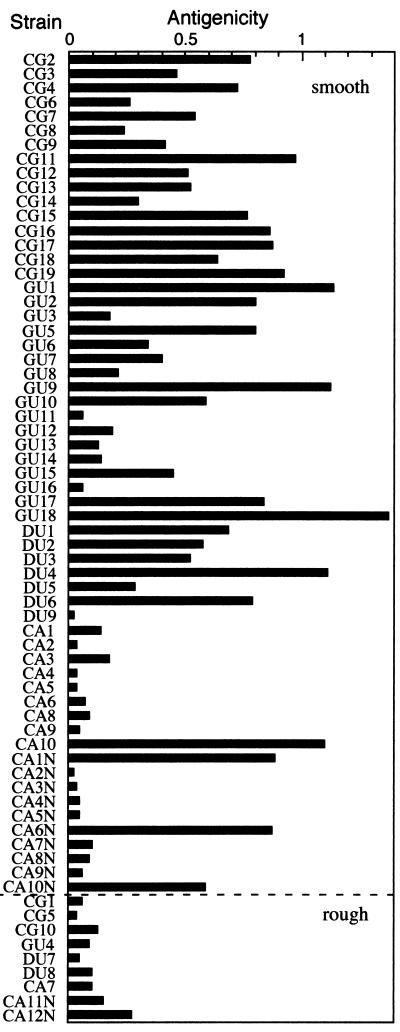
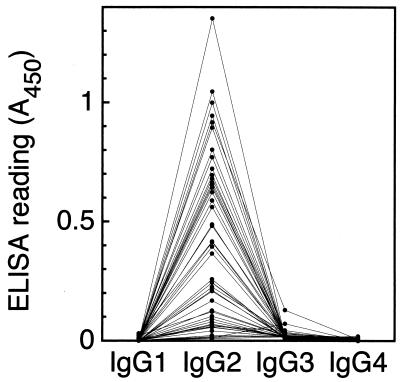
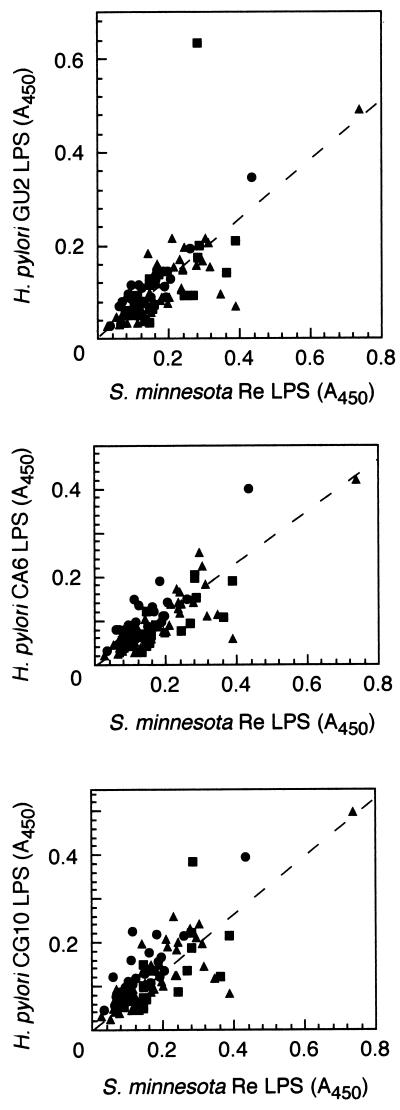
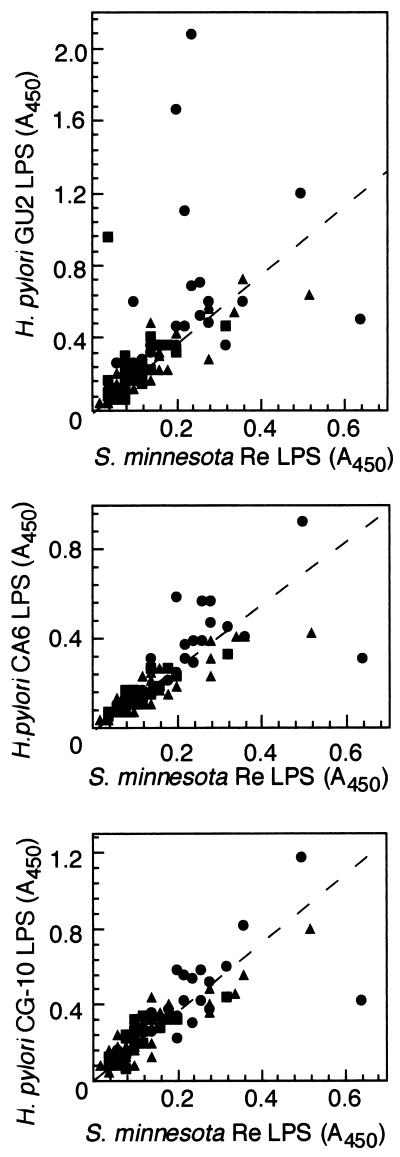
We have examined the antibody response to Helicobacter pylori lipopolysaccharides (LPS) in humans. We used sera from patients with gastroduodenal diseases and healthy adults infected or not infected with H. pylori. Data from the experiments for antibody binding to LPS suggested that the polysaccharide chains from many H. pylori strains showed high immunogenicity in humans. Sera from most (above 70%) H. pylori-infected individuals contained immunoglobulin G (IgG) antibodies against the polysaccharide region highly immunogenic H. pylori LPS. The IgG titers of individual serum samples that reacted strongly with highly immunogenic LPS were quite similar (r2 = 0.84 to 0.98). The results suggest wide distribution among H. pylori strains of a highly antigenic epitope in the polysaccharide moieties of their LPS. Also, the similarity in the titers of individual serum samples against highly immunogenic LPS points to the existence of epitopes sharing a common structural motif. However, some strains showed low antigenicity, even those with polysaccharide-carrying LPS. The dominant subclass of IgG that reacted with the highly immunogenic LPS was IgG2, which was preferentially raised against polysaccharide antigens. Recently, a structure that mimics that of the Lewis antigens was identified in the O-polysaccharide fraction of H. pylori LPS; however, no correlation between antigenicity of the polysaccharide chain in humans and the presence of Lewis antigens was found. The IgA and IgM titers against H. pylori LPS seemed to be mostly nonspecific and directed against lipid A. In a few cases, however, sera from individuals infected with H. pylori gave strong IgA and IgM titers against the highly immunogenic polysaccharide. In conclusion, the LPS of many H. pylori strains possess an antigenic epitope in their polysaccharide regions that is immunogenic in humans. However, our results show that the antigenic epitope is unlikely to be immunologically related to structures mimicking Lewis antigens.
Figures
References
-
- Appelmelk B J, Simoons-Smit I, Negrini R, Moran A P, Aspinall G O, Forte J G, de Vries T, Quan H, Verboom T, Maaskant J J, Ghiara P, Kuipers E J, Bloemena E, Tadema T M, Townsend R R, Tyagarajan K, Crothers J M, Jr, Monterio M A, Savio A, de Graaff J. Potential role of molecular mimicry between Helicobacter pylori lipopolysaccharide and host Lewis blood group antigens in autoimmunity. Infect Immun. 1996;64:2031–2040. - PMC - PubMed
MeSH terms
Substances
LinkOut - more resources
Full Text Sources
Other Literature Sources
Medical
Miscellaneous
