


Stage specificity, dose response, and doubling dose for mouse minisatellite germ-line mutation induced by acute radiation
- PMID: 9600951
- PMCID: PMC27647
- DOI: 10.1073/pnas.95.11.6251
Stage specificity, dose response, and doubling dose for mouse minisatellite germ-line mutation induced by acute radiation
Abstract
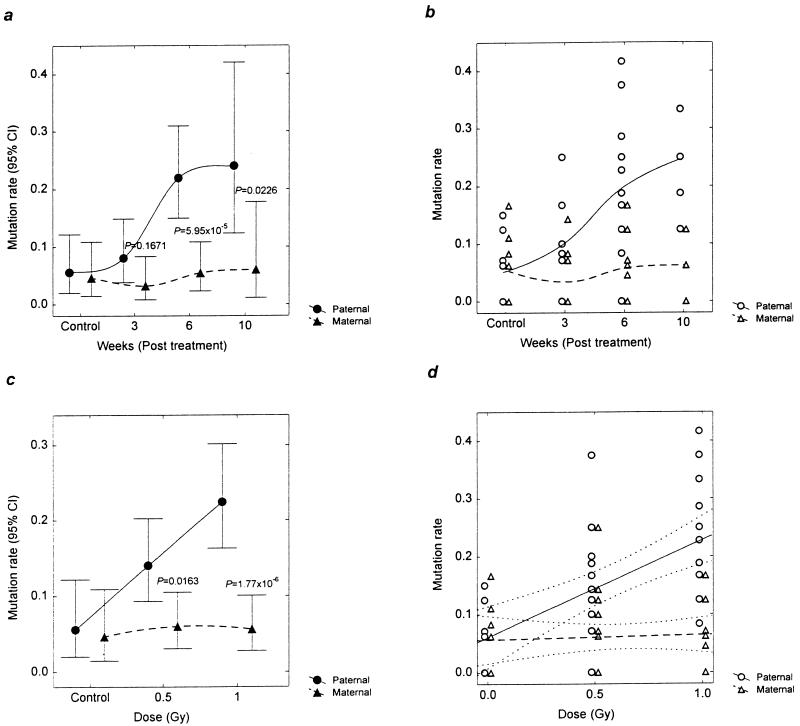
Germ-line mutation induction at mouse minisatellite loci by acute irradiation with x-rays was studied at premeiotic and postmeiotic stages of spermatogenesis. An elevated paternal mutation rate was found after irradiation of premeiotic spermatogonia and stem cells, whereas the frequency of minisatellite mutation after postmeiotic irradiation of spermatids was similar to that in control litters. In contrast, paternal irradiation did not affect the maternal mutation rate. A linear dose-response curve for paternal mutation induced at premeiotic stages was found, with a doubling dose of 0.33 Gy, a value close to those obtained in mice after acute spermatogonia irradiation using other systems for mutation detection. High frequencies of spontaneous and induced mutations at minisatellite loci allow mutation induction to be evaluated at low doses of exposure in very small population samples, which currently makes minisatellite DNA the most powerful tool for monitoring radiation-induced germ-line mutation.
Figures
References
-
- Dubrova Y E, Jeffreys A J, Malashenko A M. Nat Genet. 1993;5:92–94. - PubMed
-
- Sadamoto S, Suzuki S, Kamiya K, Kominami R, Dohi K, Niwa O. Int J Radiat Biol. 1994;65:549–557. - PubMed
-
- Fan Y J, Wang Z, Sadamoto S, Ninomiya Y, Kotomura N, Kamiya K, Dohi K, Kominami R, Niwa O. Int J Radiat Biol. 1995;68:177–183. - PubMed
-
- Dubrova Y E, Nesterov V N, Krouchinsky N G, Ostapenko V A, Neumann R, Neil D L, Jeffreys A J. Nature (London) 1996;380:683–686. - PubMed
-
- Dubrova Y E, Nesterov V N, Krouchinsky N G, Ostapenko V A, Vergnaud G, Giraudeau F, Buard J, Jeffreys A J. Mutat Res. 1997;381:267–278. - PubMed
Publication types
MeSH terms
Substances
Grants and funding
LinkOut - more resources
Full Text Sources
