. 1998 May 26;95(11):6361-6.
doi: 10.1073/pnas.95.11.6361.

Chaperone-facilitated copper binding is a property common to several classes of familial amyotrophic lateral sclerosis-linked superoxide dismutase mutants

Affiliations

Chaperone-facilitated copper binding is a property common to several classes of familial amyotrophic lateral sclerosis-linked superoxide dismutase mutants

L B Corson et al. Proc Natl Acad Sci U S A. .

Abstract

Mutations in Cu, Zn superoxide dismutase (SOD1) cause the neurodegenerative disease familial amyotrophic lateral sclerosis from an as-yet-unidentified toxic property(ies). Analysis in Saccharomyces cerevisiae of a broad range of human familial amyotrophic lateral sclerosis-linked SOD1 mutants (A4V, G37R, G41D, H46R, H48Q, G85R, G93C, and I113T) reveals one property common to these mutants (including two at residues that coordinate the catalytic copper): Each does indeed bind copper and scavenge oxygen-free radicals in vivo. Neither decreased copper binding nor decreased superoxide scavenging activity is a property shared by all mutants. The demonstration that shows that all mutants tested do bind copper under physiologic conditions supports a mechanism of SOD1 mutant-mediated disease arising from aberrant copper-mediated chemistry catalyzed by less tightly folded (and hence less constrained) mutant enzymes. The mutant enzymes also are shown to acquire the catalytic copper in vivo through the action of CCS, a specific copper chaperone for SOD1, which in turn suggests that a search for inhibitors of this SOD1 copper chaperone may represent a therapeutic avenue.


Figures
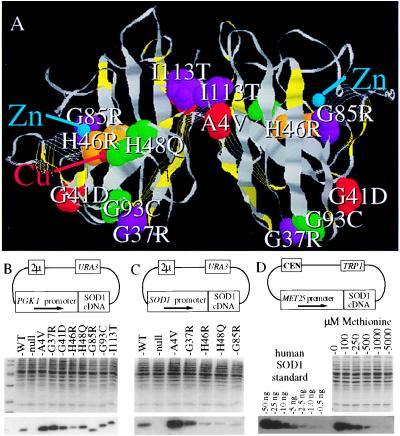
Figure 1
Figure 1
Representative human FALS–SOD1 mutants expressed in sod1Δ yeast. (A) Homodimeric Cu, Zn SOD1 enzyme with FALS-associated point mutations shown in color, carboxyl–terminal truncations illustrated as strands, and the FALS–SOD1 point mutations characterized in yeast shown as space-filling atoms. (B-D) cDNAs encoding human wild-type SOD1 and FALS–SOD1 mutants were subcloned into yeast expression plasmids under the control of the PGK1 promoter (B), the yeast SOD1 promoter (C), or the methionine repressible promoter MET25 promoter (D). After transformation into sod1Δ yeast, each culture was grown to mid log phase, and 10 μg of each protein extract was electrophoresed on an SDS/PAGE gel and was stained with Coomassie blue (B-D, Middle) or was transferred to nitrocellulose and was immunoblotted with an SOD1 antibody (B-D, Bottom). The immunoblot in D is of the MET25 human wild-type SOD1 titration.
Figure 2
Figure 2
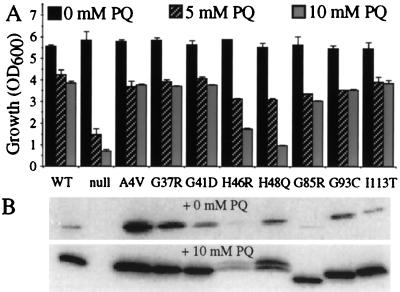
All FALS–SOD1 mutants retain in vivo free radical scavenging activity in sod1Δ yeast. (A) sod1Δ yeast (JS004) harboring each of the nine PGK–SOD1 expression plasmids or vector alone (null) were diluted to a low density in rich media, the indicated level of paraquat (PQ) was added, and, after 36 hr, culture growth was measured spectrophotometrically. Values represent the average and range of two or three individual cultures in a single experiment. (B) Immunoblot of SOD1 levels in one representative set of cultures. [Note that added paraquat resulted in significant elevations in wild-type or mutant SOD1 accumulations (B, Bottom). Because the PGK1 promoter is not known to be affected by oxidative stress, the apparent induction of SOD1 by paraquat probably reflects selection for yeast cells with higher copy numbers of the 2μ expression plasmid, which are naturally quite variable in number.]
Figure 3
Figure 3
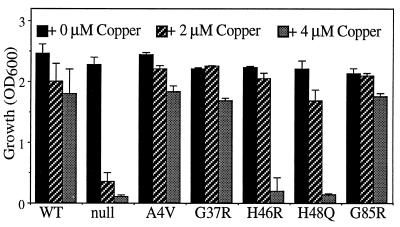
FALS–SOD1 metalloproteins retain in vivo copper buffering. (A) sod1Δcup1Δ (JS004) yeast harboring yeast SOD1-promoted FALS–SOD1 expression plasmids were diluted to a low density in minimal media, the indicated level of copper sulfate was added, cultures were permitted to grow for 3 days, and culture growth was measured spectrophotometrically. All values represent the average and range of three independent cultures in a single experiment.
Figure 4
Figure 4
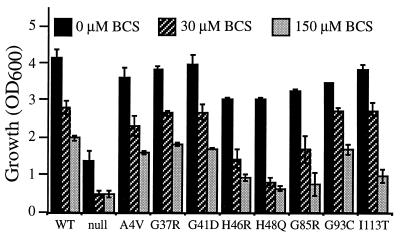
FALS–SOD1 metalloenzymes retain variable degrees of free radical scavenging activity when copper is limited by the addition of a copper chelator. sod1Δcup1Δ (JS004) yeast harboring the PGK–SOD1 expression plasmids or vector alone (null) were diluted to a low density in rich media, the indicated level of BCS (a copper chelator) was added, paraquat (a free radical-generating drug) was added to 5 mM, and culture growth was measured spectrophotometrically after 48 hr. Values represent the average and range of two independent cultures in one experiment.
Figure 5
Figure 5
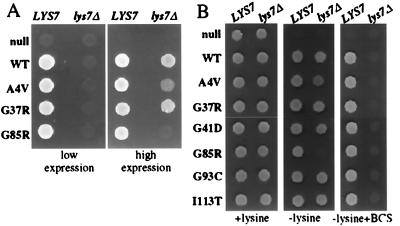
FALS–SOD1 mutants depend on the SOD1 copper chaperone for efficient copper loading in vivo. (A) Cells (106) of sod1Δ (VC107) or sod1Δlys7Δ (VC277) yeast harboring integrated SOD1-promoted FALS–SOD1 constructs (Left) or high copy SOD1-promoted plasmids (Right) were spotted onto plates lacking lysine and permitted to grow for 2 days. (B) sod1Δ and sod1Δlys7Δ yeast harboring the high copy PGK–SOD1 constructs were spotted onto SC plates with lysine (Left), without lysine (Center), or without lysine and with 250 μM BCS (Right).

References

    1. Rosen D R, Siddique T, Patterson D, Figlewicz D A, Sapp P, Hentati A, Donaldson D, Goto J, O’Regan J P, Deng H X, et al. Nature (London) 1993;362:59–62. - PubMed
    1. Deng H-X, Hentati A, Tainer J A, Iqbal Z, Cayabyab A, Hung W-Y, Getzoff E D, Hu P, Herzfeldt B, Roos R P, et al. Science. 1993;261:1047–1051. - PubMed
    1. Wong P C, Pardo C A, Borchelt D R, Lee M K, Copeland N G, Jenkins N A, Sisodia S S, Cleveland D W, Price D L. Neuron. 1995;14:1105–1116. - PubMed
    1. Bruijn L I, Becher M W, Lee M K, Anderson K L, Jenkins N A, Copeland N G, Sisodia S S, Rothstein J D, Borchelt D R, Price D L, et al. Neuron. 1997;18:327–338. - PubMed
    1. Reaume A B, Elliott J L, Hoffman E K, Kowall N W, Ferrante R J, Siwek D F, Wilcox H M, Flood D G, Beal M F, Brown R H, et al. Nat Genet. 1996;13:43–47. - PubMed

Publication types

MeSH terms