. 1998 May 26;95(11):6537-42.
doi: 10.1073/pnas.95.11.6537.

NEEDLY, a Pinus radiata ortholog of FLORICAULA/LEAFY genes, expressed in both reproductive and vegetative meristems

Affiliations

NEEDLY, a Pinus radiata ortholog of FLORICAULA/LEAFY genes, expressed in both reproductive and vegetative meristems

A Mouradov et al. Proc Natl Acad Sci U S A. .

Erratum in

  • Proc Natl Acad Sci U S A 1999 Apr 27;96(9):5336

Abstract

The LEAFY/FLORICAULA genes from Arabidopsis and Antirrhinum are necessary for normal flower development and play a key role in diverse angiosperm species. A homologue of these flower meristem-identity genes, NEEDLY (NLY), has been identified in Pinus radiata. Although the NLY protein shares extensive sequence similarity with its angiosperm counterparts, it is lacking the proline-rich and acidic motifs thought to function as transcriptional activation domains. NLY already is expressed during vegetative development at least 5 years before the transition to the reproductive phase. Expression of NLY in transgenic Arabidopsis promotes floral fate, demonstrating that, despite its sequence divergence, NLY encodes a functional ortholog of the FLORICAULA/LEAFY genes of angiosperms. Expression of the LFY::NLY transgene can largely complement the defects in flower development caused by a severe lfy allele.


Figures
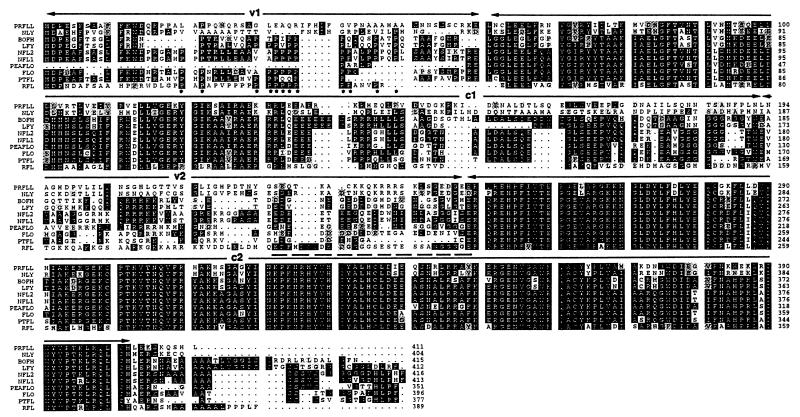
Figure 1
Figure 1
Sequence comparison of FLO/LFY-like proteins (accession numbers in parentheses): PrFLL from P. radiata (U92008); NLY from P. radiata (U76757); BOFH from Brassica oleracea (718362); LFY from Arabidopsis thaliana (M91208); NFL1 and NFL2 from Nicotiana tabacum (U16172 and U16174, respectively); PEAFLO from Pisum sativum (AF010190); FLO from Antirrhinum majus (M55525); PtFL from Populus balsamifera (U931 96); and RFL from Oryza sativa (AB005620). Black boxes indicate identical amino acids, shaded boxes indicate amino acids with similar properties, and dots indicate gaps introduced to optimize alignment. c1 and c2, conserved regions; v1 and v2, variable regions. Positions of the proline residues within the proline-rich region are indicated by asterisks. Acidic domain indicated by dashed line.
Figure 2
Figure 2
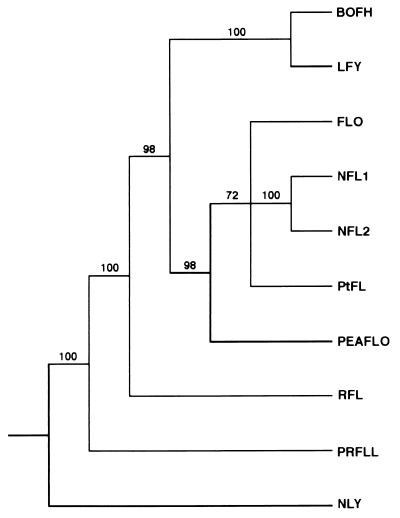
Phylogenetic tree of the FLO/LFY gene family. A single most parsimonious tree was obtained (consistency index = 0.917; retention index = 0.760). Bootstrap values for 100 replicates are shown above each branch.
Figure 3
Figure 3
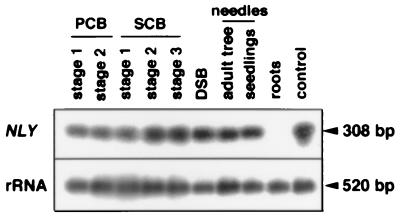
RT-PCR analyses of NLY transcripts levels in PCB (stages 1–2), SCB (stages 1–3), DSB from an adult tree and 1-month-old seedlings and roots. PCR products were blotted onto nylon membranes and hybridized to 32P-labeled NLY cDNA clone. The rRNA fragment was amplified from the same RNA samples as a positive control.
Figure 4
Figure 4
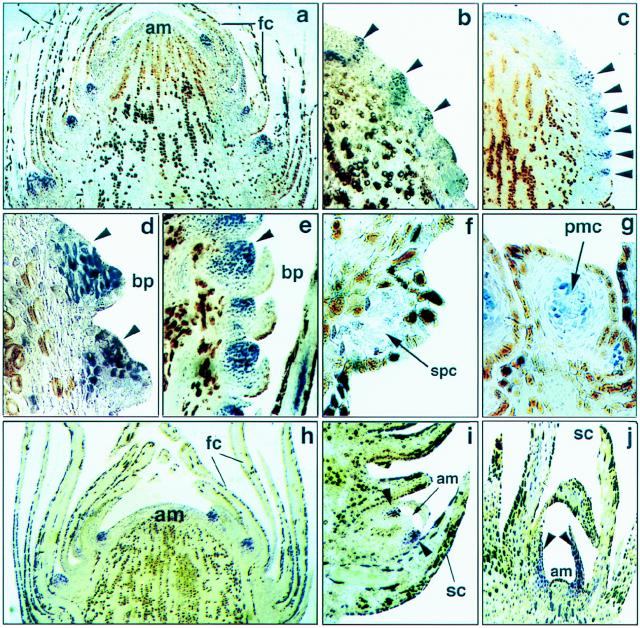
In situ localization of NLY transcripts in: (a) female LSTB during initiation of axillary apices on the side of apical meristem. (×40.); (b) differentiating SCB with initiating bract primordia (arrowheads). (×80.); (c) SCB with developed bract primordia (arrowheads) (stage 1). (×50.); (d) SCB with initiating ovuliferous scale primordia (arrowheads) (stage 2). (×200.); (e) SCB with developed fused bract-ovuliferous scale primordia complex (ovuliferous scale primordia indicated with arrowheads) (stage 3). (×100.); (f) PCB with initiating microsporophylls (stage 1). (×200.); (g) PCB after completion of microsporophyll initiation (stage 2). (×60.); (h) vegetative LSTB during initiation of undifferentiated axillary apices. (×40.); (i) DSB with initiating needle primordia (arrowheads). (×90.); (j) DSB with developing needle primordia (arrowheads). (×45.) am, apical meristem; bp, bract primordia; fc, fertile cataphylls; pmc, pollen mother cells; sc, sterile cataphylls; spc, sporogenous cells
Figure 5
Figure 5
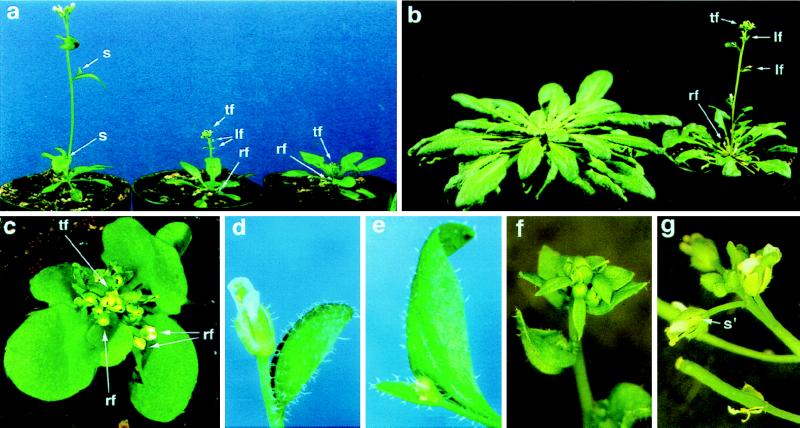
Phenotypic effects of NLY expression in Arabidopsis. (a) Plants (4 weeks old) grown under LD conditions. (Left) Wild-type plant (Columbia ecotype) with developing lateral shoots (s); (Center) 35S∷NLY-1 plant; and (Right) 35S∷NLY-7 plants with shorter primary shoots terminating with terminal flowers (tf) and solitary flowers arising in the axils of rosette leaves (rf) and bracts (if). (b) Plants (9 weeks old) grown under SD conditions. (Left) Wild-type plant (Columbia ecotype). (Right) 35S∷NLY-1 plant, which has already produced a flowering shoot. (c) Top view of extreme phenotype observed in 35S∷NLY-7 line, with terminal flower (tf) immediately above the rosette. Secondary shoots in the axils of rosette leaves have been transformed into solitary flowers (rf). (d) Solitary flower in the axil of a bract, replacing a lateral shoot in a 35S∷NLY plant. (e) Lateral shoot of wild-type Arabidopsis showing clusters of developing flowers. (f) Main shoot of a lfy-26 mutant; (g) Main shoot of a lfy-26 LFY∷NLY-6 plant. s’, petaloid stamen with shortened filament.

References

    1. Ma H. Genes Dev. 1994;8:745–756. - PubMed
    1. Weigel D, Alvarez J, Smyth D R, Yanofsky M F, Meyerowitz E M. Cell. 1992;69:843–859. - PubMed
    1. Mandel M A, Gustafson-Brown C, Savidge B, Yanofsky M E. Nature (London) 1992;360:273–277. - PubMed
    1. Kempin S A, Savidge B, Yanofsky M F. Science. 1995;267:522–525. - PubMed
    1. Jofuku K D, der Boer B G W, Van Montagu M, Okamuro J K. Plant Cell. 1994;6:1211–1225. - PMC - PubMed

Associated data

LinkOut - more resources