Relation between left ventricular function and oxidative stress in patients undergoing bypass surgery
- PMID: 9602656
- PMCID: PMC1728633
- DOI: 10.1136/hrt.79.3.242
Relation between left ventricular function and oxidative stress in patients undergoing bypass surgery
Abstract
Objective: To determine whether preoperative left ventricular ejection fraction (LVEF) is related to the degree of myocardial oxidative stress during bypass surgery in man.
Design: Observational study.
Setting: Tertiary care centre.
Patients and interventions: 31 patients (LVEF range was 20% to 68%) undergoing elective coronary bypass surgery with blood cardioplegic reperfusion were studied. Arterial and coronary sinus blood was collected before aortic cross clamping (T0) and at 0 (T1), 15 (T2), and 30 (T3) minutes after unclamping. Transmural left ventricular biopsies were also obtained from 15 patients at T0 and at T1.
Main outcome measures: Glutathione and adenine nucleotides were measured in myocardial biopsies, while coronary sinus-artery differences for glutathione, nucleotides, and products of lipid peroxidation were calculated from blood specimens. Creatine kinase (myocardial band; CK-MB) was measured in plasma at four and 12 hours after operation.
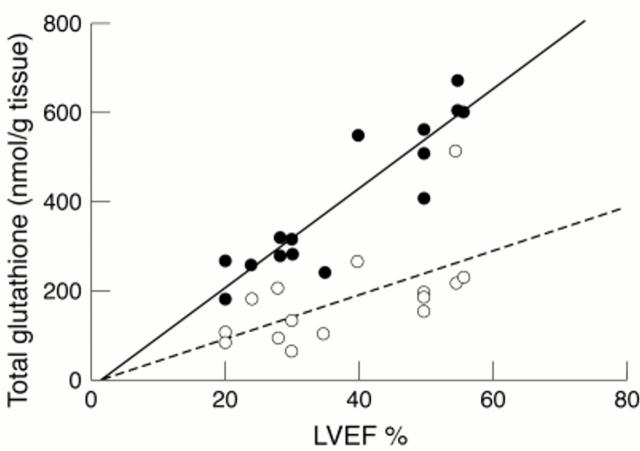
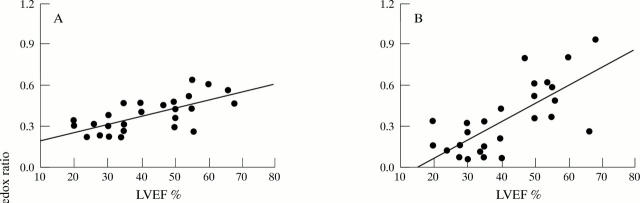
Results: Myocardial glutathione and adenine nucleotides were correlated (p < 0.02) with preoperative LVEF both at T0 (r = 0.909 and 0.672) and T1 (r = 0.603 and 0.605). Oxidised glutathione released from the heart during reperfusion was inversely correlated with LVEF (r = -0.448, -0.466, and -0461 at T1, T2, and T3, p < 0.01), while reduced glutathione (r = 0.519 and 0.640 at T1 and T2) and glutathione redox ratio (r = 0.647, 0.714, 0.645, and 0.702 at T0, T1, T2, and T3) showed a direct correlation (p < 0.01). Lipid peroxidation at T1 was negatively related to LVEF (r = -0.492). CK-MB was also negatively related to LVEF (r = -0.440 at 4 h and -0.462 at 12 h).
Conclusions: The capacity to counterbalance oxidative burst following ischaemia and reperfusion appears to be related to the functional ability of the heart.
Figures
Comment in
-
Are patients with poor left ventricular function more prone to oxidative stress during cardiac surgery?Heart. 1998 Mar;79(3):219. doi: 10.1136/hrt.79.3.219. Heart. 1998. PMID: 9602650 Free PMC article. No abstract available.
References
Publication types
MeSH terms
Substances
LinkOut - more resources
Full Text Sources
Other Literature Sources
Medical
Research Materials
Miscellaneous