


Growth of geobacter sulfurreducens with acetate in syntrophic cooperation with hydrogen-oxidizing anaerobic partners
- PMID: 9603840
- PMCID: PMC106304
- DOI: 10.1128/AEM.64.6.2232-2236.1998
Growth of geobacter sulfurreducens with acetate in syntrophic cooperation with hydrogen-oxidizing anaerobic partners
Abstract
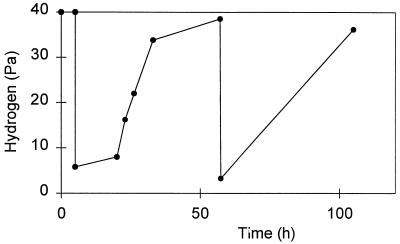
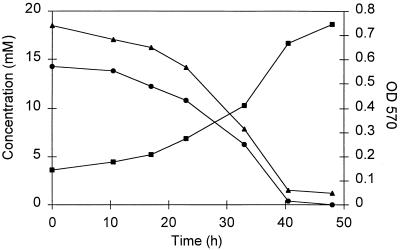
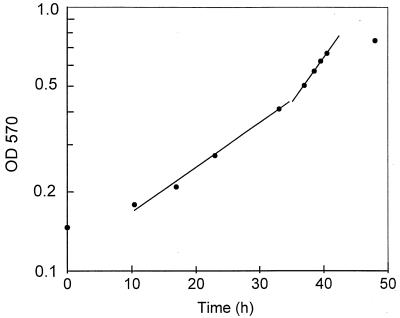
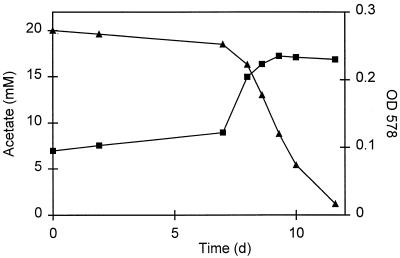
Pure cultures of Geobacter sulfurreducens and other Fe(III)-reducing bacteria accumulated hydrogen to partial pressures of 5 to 70 Pa with acetate, butyrate, benzoate, ethanol, lactate, or glucose as the electron donor if electron release to an acceptor was limiting. G. sulfurreducens coupled acetate oxidation with electron transfer to an anaerobic partner bacterium in the absence of ferric iron or other electron acceptors. Cocultures of G. sulfurreducens and Wolinella succinogenes with nitrate as the electron acceptor degraded acetate efficiently and grew with doubling times of 6 to 8 h. The hydrogen partial pressures in these acetate-degrading cocultures were considerably lower, in the range of 0.02 to 0.04 Pa. From these values and the concentrations of the other reactants, it was calculated that in this cooperation the free energy change available to G. sulfurreducens should be about -53 kJ per mol of acetate oxidized, assuming complete conversion of acetate to CO2 and H2. However, growth yields (18.5 g of dry mass per mol of acetate for the coculture, about 14 g for G. sulfurreducens) indicated considerably higher energy gains. These yield data, measurement of hydrogen production rates, and calculation of the diffusive hydrogen flux indicated that electron transfer in these cocultures may not proceed exclusively via interspecies hydrogen transfer but may also proceed through an alternative carrier system with higher redox potential, e.g., a c-type cytochrome that was found to be excreted by G. sulfurreducens into the culture fluid. Syntrophic acetate degradation was also possible with G. sulfurreducens and Desulfovibrio desulfuricans CSN but only with nitrate as electron acceptor. These cultures produced cell yields of 4.5 g of dry mass per mol of acetate, to which both partners contributed at about equal rates. These results demonstrate that some Fe(III)-reducing bacteria can oxidize organic compounds under Fe(III) limitation with the production of hydrogen, and they provide the first example of rapid acetate oxidation via interspecies electron transfer at moderate temperature.
Figures
References
-
- Bokranz M, Katz J, Schröder I, Roberton A M, Kröger A. Energy metabolism and biosynthesis of Vibrio succinogenes. Arch Microbiol. 1983;135:36–41.
-
- Bronder M, Mell H, Stupperich E, Kröger A. Biosynthetic pathways of Vibrio succinogenes growing with fumarate as terminal electron acceptor and sole carbon source. Arch Microbiol. 1982;131:216–223. - PubMed
-
- Bryant M P. Microbial methane production—theoretical aspects. J Anim Sci. 1979;48:193–201.
-
- Dawson R M C, Elliott D C, Elliott W H, Jones K M. Data for biochemical research. 2nd ed. Oxford, United Kingdom: Clarendon Press; 1969.
LinkOut - more resources
Full Text Sources
Other Literature Sources
Molecular Biology Databases
