


doi: 10.1128/AEM.64.6.2240-2246.1998.
New unstable variants of green fluorescent protein for studies of transient gene expression in bacteria
Affiliations
- PMID: 9603842
- PMCID: PMC106306
- DOI: 10.1128/AEM.64.6.2240-2246.1998
Item in Clipboard
New unstable variants of green fluorescent protein for studies of transient gene expression in bacteria
Appl Environ Microbiol.
1998 Jun.
Abstract
Use of the green fluorescent protein (Gfp) from the jellyfish Aequorea victoria is a powerful method for nondestructive in situ monitoring, since expression of green fluorescence does not require any substrate addition. To expand the use of Gfp as a reporter protein, new variants have been constructed by the addition of short peptide sequences to the C-terminal end of intact Gfp. This rendered the Gfp susceptible to the action of indigenous housekeeping proteases, resulting in protein variants with half-lives ranging from 40 min to a few hours when synthesized in Escherichia coli and Pseudomonas putida. The new Gfp variants should be useful for in situ studies of temporal gene expression.
Figures
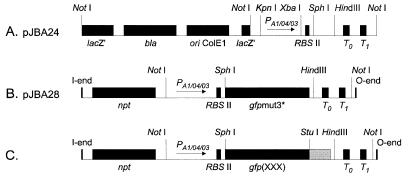
Schematic drawings of cloning and transposon vectors (not to scale). (A) Cloning vector pJBA24. (B) Transposon vector pJBA28. (C) Transposon vectors pJBA114, pJBA116, pJBA118, and pJBA120. In all transposon plasmid vectors only the transposon parts flanked by the O and I ends of mini-Tn5 are shown, and the drawings indicate only the relevant restriction sites. Abbreviations: ori, origin of replication; lacZ′, truncated lacZ gene; bla, ampicillin resistance gene; npt, kanamycin resistance gene; PA1/04/03, LacI-repressible promoter; RBSII, synthetic ribosome binding site; gfpmut3*, gene encoding Gfp(S2R, S65G, S72A) (referred to as Gfpmut3*); T0, transcriptional terminator from phage lambda; T1, transcriptional terminator from the rrnB operon of E. coli; gfp(XXX), gene encoding either Gfp(LAA), Gfp(LVA), Gfp(AAV), or Gfp(ASV) (see text for details).
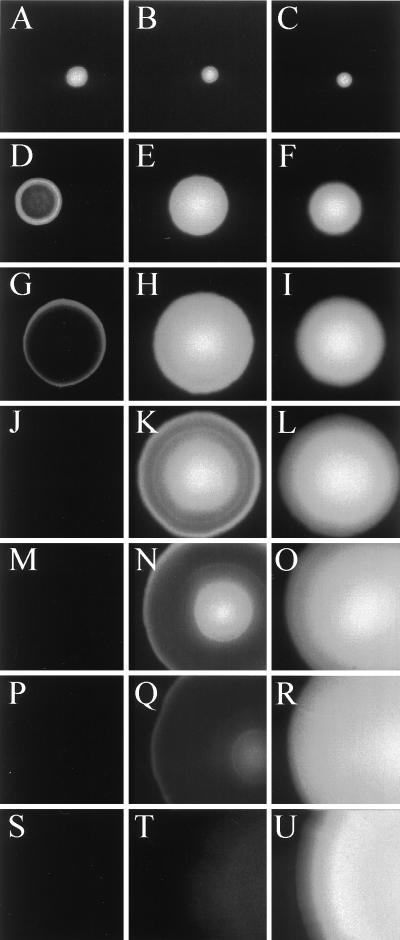
Time-resolved epifluorescence images of single colonies of P. putida strains expressing either Gfpmut3* or peptide-tagged variants of Gfpmut3*. (A, D, G, J, M, P, and S) Strain KT2442 (lacIq) expressing Gfp(LAA); (B, E, H, K, N, Q, and T) KT2442 (lacIq) expressing Gfp(AAV); (C, F, I, L, O, R, and U) KT2442 (lacIq) expressing Gfpmut3*. Incubation times at 30°C were 18 h (A, B and C), 30 h (D, E, and F), 42 h (G, H, and I), 54 h (J, K, and L), 73 h (M, N, and O), 102 h (P, Q, and R), and 192 h (S, T, and U).
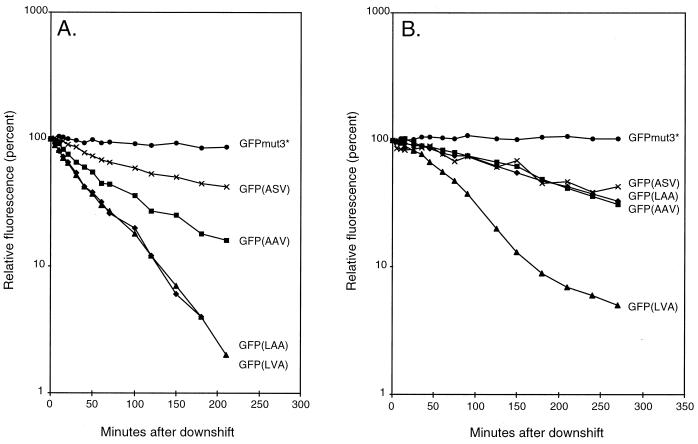
(A) Stability of Gfp variants in E. coli following a downshift. •, MV1190(λ-pir)(pJBA28) expressing Gfpmut3*; ×, MV1190(λ-pir)(pJBA120) expressing Gfp(ASV); ▪, MV1190(λ-pir)(pJBA118) expressing Gfp(AAV); ▴, MV1190(λ-pir)(pJBA116) expressing Gfp(LVA); and ⧫, MV1190(λ-pir)(pJBA114) expressing Gfp(LAA). (B) Stability of Gfp variants in P. putida following a downshift. •, KT2442 (lacIq) expressing Gfpmut3*; ×, KT2442 (lacIq) expressing Gfp(ASV); ▪, KT2442 (lacIq) expressing Gfp(AAV); ▴, KT2442 (lacIq) expressing Gfp(LVA); and ⧫, KT2442 (lacIq) expressing Gfp(LAA).
References
-
- Casper S J, Holt C A. Expression of the green fluorescent protein-encoding gene from tobacco mosaic virus-based vector. Gene. 1996;173:69–73. - PubMed
-
- Chalfie M, Tu Y, Euskirchen G, Ward W W, Prasher D C. Green fluorescent protein as a marker for gene expression. Science. 1994;263:802–805. - PubMed
-
- Chauhan A K, Apirion D. The gene for a small stable RNA (10Sa RNA) of Escherichia coli. Mol Microbiol. 1989;3:1481–1485. - PubMed
Publication types
MeSH terms
Substances
LinkOut - more resources
Full Text Sources
Other Literature Sources
