


doi: 10.1128/AEM.64.6.2266-2268.1998.
Estimation of nitrifying bacterial activities by measuring oxygen uptake in the presence of the metabolic inhibitors allylthiourea and azide
Affiliations
- PMID: 9603846
- PMCID: PMC106310
- DOI: 10.1128/AEM.64.6.2266-2268.1998
Item in Clipboard
Estimation of nitrifying bacterial activities by measuring oxygen uptake in the presence of the metabolic inhibitors allylthiourea and azide
Appl Environ Microbiol.
1998 Jun.
Abstract
The effects of two metabolic inhibitors on an enriched nitrifying biomass during incubation for short periods of time were investigated by determining respirometric measurements. Allylthiourea (86 &mgr;M) and azide (24 &mgr;M) were shown to be strong, selective inhibitors of ammonia and nitrite oxidation, respectively. Consequently, a differential respirometry method for estimating nitrifying and heterotrophic bacterial activities within a mixed biomass is proposed.
Figures
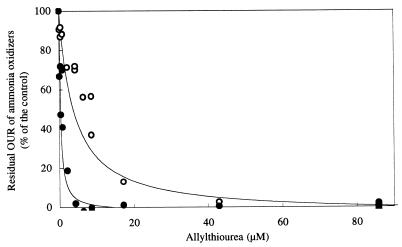
Residual oxygen uptake rate (OUR) of ammonia oxidizers after 0.5 (○) or 10 (•) min of exposure to allylthiourea (0 to 86 μM). A washed biomass suspension incubated with no substrate but with azide 24 μM (nitrite oxidizers were therefore inactive [Table 1]) was supplemented with ammonia (10 mg of NH4+ N · liter−1) and, after 5 min, with allylthiourea (0 to 86 μM). Values were obtained by comparing the oxygen uptake rates of ammonia oxidizers (from which endogenous oxygen was removed) before and after a 0.5- or 10-min exposure to allylthiourea. The endogenous oxygen uptake rate was not affected by 86 μM allylthiourea (Table 1).
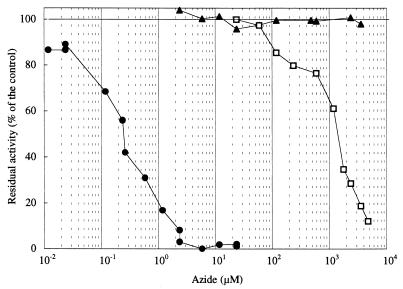
Effect of azide on endogenous (▴), nitrite-dependent (•), and ammonia-dependent (□) oxygen uptake rates. For endogenous respiration, the oxygen uptake rates of a washed biomass incubated with no substrate (endogenous oxygen uptake rate) before and after addition of azide (0 to 4,800 μM) were compared, which yielded the percentage of residual activity for endogenous respiration. For nitrite oxidizers, in the presence of 10 mg of NO2− N · liter−1 the oxygen uptake rates (from which endogenous rates were removed) before and after addition of azide (0 to 24 μM) were compared, which yielded the percentage of residual activity for nitrite-dependent respiration. For ammonia oxidizers, a washed biomass supplemented with 10 mg of NH4+ N · liter−1 and 10 mg of NO2− N · liter−1 was subsequentially inhibited by azide (24 to 4,800 μM) and, after 5 min, by allylthiourea (86 μM). The difference between the oxygen uptake rates before and after allylthiourea was added yielded the oxygen uptake rate for ammonia oxidizers in the presence of azide. This value was compared to the value obtained in a control experiment, which was similar except that the inhibitors were introduced in an inverse order (i.e., ammonia oxidizer activity in the absence of azide), which yielded the percentage of residual activity for ammonia oxidizers in the presence of azide. The endogenous oxygen uptake rate was not affected by 4,800 μM azide.
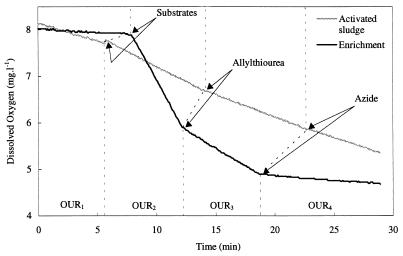
Typical profiles for oxygen uptake by an enriched nitrifying biomass (106 mg of protein · liter−1) and an activated sludge sample (Morainvilliers, France; 225 mg of protein · liter−1). Samples (pH 7.6, 20°C) were supplemented with a mixture of substrates (10 mg of NH4+ N · liter−1, 10 mg of NO2− N · liter−1, and 10 mg of acetate C · liter−1) and subsequently inhibited by allylthiourea (86 μM) and azide (24 μM). From this respirogram, endogenous respiration and ammonia, nitrite, and acetate oxidation activities may be calculated by determining the following oxygen uptake rates (OUR): OUR1, OUR2 − OUR3, OUR3 − OUR4, and OUR4 − OUR1, respectively.
References
-
- Aleem H M I, Sewell D L. Mechanism of nitrite oxidation and oxidoreductase systems in Nitrobacter agilis. Curr Microbiol. 1981;5:267–272.
-
- Ellis T G, Barbeau D S, Smets B F, Grady C P L., Jr Respirometric technique for determination of extant kinetic parameters describing biodegradation. Water Environ Res. 1996;68:917–926.
-
- Hochstein L I, Tomlinson G A. The enzymes associated with denitrification. Annu Rev Microbiol. 1988;42:231–261. - PubMed
LinkOut - more resources
Full Text Sources
