


Evidence for a conjugation-like mechanism of DNA transfer in Helicobacter pylori
- PMID: 9603879
- PMCID: PMC107256
- DOI: 10.1128/JB.180.11.2901-2905.1998
Evidence for a conjugation-like mechanism of DNA transfer in Helicobacter pylori
Abstract
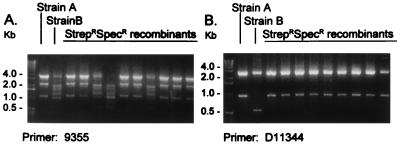
Many strains of Helicobacter pylori are naturally competent for transformation in vitro. Since there is a high degree of genetic variation among H. pylori strains, we sought to determine whether mechanisms of DNA exchange other than transformation exist in these organisms. Studies were done with H. pylori cells that each were resistant to two different antibiotics; the procedure used involved mating of cells on plates or in broth, in the absence or presence of DNase. In each experiment, such matings produced progeny with the markers of both parents. Examination of the full resistance profile and random arbitrarily primed DNA PCR (RAPD-PCR) profiles of the progeny indicated that DNA transfer was bidirectional. DNase treatment reduced but did not eliminate transfer; only the presence of both DNase and a membrane separating the cells did so. For progeny derived from matings in the presence of DNase, antibiotic resistance and RAPD profiles indicated that transfer was unidirectional. DNase-treated cell-free supernatants also did not transform, ruling out transduction. These experiments indicate that both a DNase-sensitive mechanism (transformation) and a DNase-resistant conjugation-like mechanism involving cell-to-cell contact may contribute to DNA transfer between H. pylori cells.
Figures
References
-
- Akopyanz N S, Kersulyte D, Berg D E. CagII, a new multigene locus associated with virulence in Helicobacter pylori. Gut. 1995;37:A1.
-
- Atherton J C, Cao P, Peek R M, Tummuru M K R, Blaser M J, Cover T L. Mosaicism in vacuolating cytotoxin alleles of Helicobacter pylori. J Biol Chem. 1995;270:17771–17777. - PubMed
-
- Blaser M J. Genetic basis for heterogeneity of Helicobacter pylori. In: Hunt R H, Tytgat G N J, editors. Helicobacter pylori. Basic mechanisms to clinical cure. Dordrecht, The Netherlands: Kluwer Academic Publishers; 1996. pp. 33–39.
Publication types
MeSH terms
Substances
Grants and funding
LinkOut - more resources
Full Text Sources
